On September 24, the U.S. Securities and Exchange Commission (SEC) and the Financial Industry Regulatory Authority (Finra) jointly announced that they would investigate more than 200 publicly traded companies that had previously announced encryption treasury plans, citing that these companies generally experienced “abnormal stock price fluctuations” shortly before releasing related news.
Since MicroStrategy took the lead in incorporating Bitcoin into its balance sheet, the “Crypto Treasury” has become a sensational “financial alchemy” in the US stock market—new stocks like Bitmine and SharpLink have seen their prices soar dozens of times due to similar operations. According to data released by Architect Partners, 212 new companies have announced since 2025 that they will raise approximately $102 billion to purchase mainstream encryption assets such as BTC and ETH.
However, this capital frenzy has triggered widespread questioning while driving up prices. The mNAV of MSTR (the ratio of market value to net asset value) fell from 1.6 to 1.2 within a month, while two-thirds of the mNAV of the top twenty cryptocurrency treasury companies are below 1. Questions regarding asset bubbles, insider trading, and other related issues are emerging endlessly, and this new asset allocation trend is facing unprecedented regulatory challenges.

How the encryption vault company's flywheel operates.
The financing flywheel of the treasury company is built on the mNAV mechanism, which is essentially a reflexive flywheel logic that allows the treasury company to have what seems like “infinite bullets” during a bull market. mNAV refers to the market net asset value ratio, calculated as the enterprise market value (P) relative to its net asset value per share (NAV). In the context of treasury strategy companies, NAV refers to the value of the digital assets they hold.
When the stock price P is higher than the net asset value NAV (i.e., mNAV > 1), the company can continuously raise funds and reinvest the raised capital into digital assets. Each issuance and purchase will increase the per-share holdings and book value, thereby further strengthening the market's confidence in the company's narrative and driving the stock price higher. Thus, a closed-loop positive feedback flywheel starts to spin: mNAV rising → financing through issuance → purchasing digital assets → per-share holdings increase → market confidence enhances → stock price rises again. It is through this mechanism that MicroStrategy has been able to continuously finance and purchase Bitcoin over the past few years without severely diluting its shares.
Once the stock price and liquidity are pushed high enough, the company can unlock a whole set of institutional capital entry mechanisms: it can issue debt, convertible bonds, preferred shares and other financing tools, turning the narratives in the market into book assets, which in turn pushes up the stock price, forming a flywheel. The essence of this game is the complex resonance between stock price, narrative, and capital structure.
However, mNAV is a double-edged sword. The premium can represent a high level of market trust, or it may merely be speculative hype. Once mNAV converges to 1 or falls below 1, the market shifts from “enhancement logic” to “dilution logic”. If the price of the token itself drops at this time, the flywheel will shift from positive rotation to a negative feedback loop, causing a double whammy on market value and confidence. In addition, the financing of treasury strategy companies is also built on the premium flywheel of mNAV. When mNAV remains in a discount status for a long time, the space for new issuance will be blocked, and the businesses of small and mid-cap shell companies that are already stagnant or on the verge of delisting will be completely overturned, causing the established flywheel effect to collapse instantly. Theoretically, when mNAV < 1, a more reasonable choice for the company is to sell holdings to repurchase stocks in order to restore balance, but one should not generalize; discounted companies may also represent undervalued assets.
In the bear market of 2022, even when MicroStrategy's mNAV briefly fell below 1, the company chose not to sell its cryptocurrency for repurchase, but instead insisted on retaining all Bitcoin through debt restructuring. This “die-hard” logic stems from Saylor's faith-based vision of BTC, viewing it as a core collateral asset that is “never to be sold.” However, this path is not one that all treasury companies can replicate. Most altcoin treasury stocks lack stable core businesses, and transforming into “buying coin companies” is merely a means of survival without the support of belief. Once the market environment deteriorates, they are more likely to sell off to stop losses or realize profits, triggering a stampede.
Does insider trading exist ###
SharpLink Gaming is one of the earliest cases to shake the market in this round of “crypto treasury frenzy.” On May 27, the company announced it would increase its holdings of Ethereum to up to $425 million as reserve assets. On the day the news was released, the stock price soared to $52. However, strangely, as early as May 22, the trading volume of the stock had significantly increased, with the stock price jumping from $2.7 to $7, while the company had not yet made any announcements or disclosed any information to the SEC.

This phenomenon of “news not released, stock price leading” is not an isolated case. MEI Pharma announced the launch of a $100 million Litecoin treasury strategy on July 18, but the stock price rose for four consecutive days before the announcement, increasing from $2.7 to $4.4, nearly doubling. The company did not submit any major updates or release a press statement, and its spokesperson declined to comment on the matter.
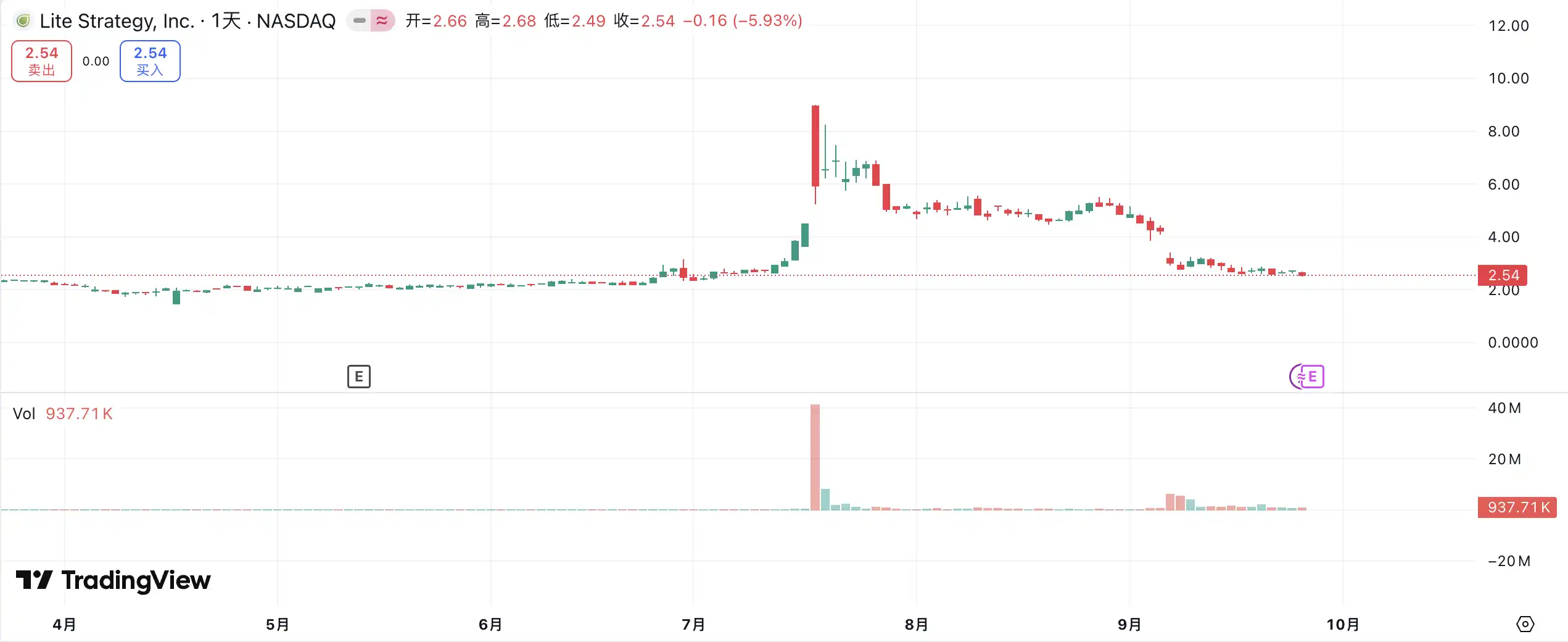
Similar situations have also occurred in companies such as Mill City Ventures, Kindly MD, Empery Digital, Fundamental Global, and 180 Life Sciences Corp, all of which experienced varying degrees of abnormal trading fluctuations before announcing their encryption treasury plans. The possibility of information leakage and insider trading has raised the alert of regulators.
DAT Will the narrative meeting collapse?
Arthur Hayes, an advisor to Upexi, pointed out that the crypto treasury has become a new narrative in the traditional corporate finance space. He believes that this trend will continue to evolve across multiple mainstream asset tracks. However, we must be clear: on each chain, there can ultimately be at most one or two winners.
Meanwhile, the head effect is accelerating. Although over 200 companies have announced encryption treasury strategies by 2025, covering multiple chains such as BTC, ETH, SOL, BNB, TRX, funding and valuation are rapidly concentrating towards a few companies and assets—BTC treasury and ETH treasury occupy a large part of DAT company's territory. In each asset class, there are only one or two companies that can truly succeed; the BTC track is MicroStrategy, the ETH track is Bitmine, and the SOL track may be Upexi, while other projects struggle to form competitive scale.
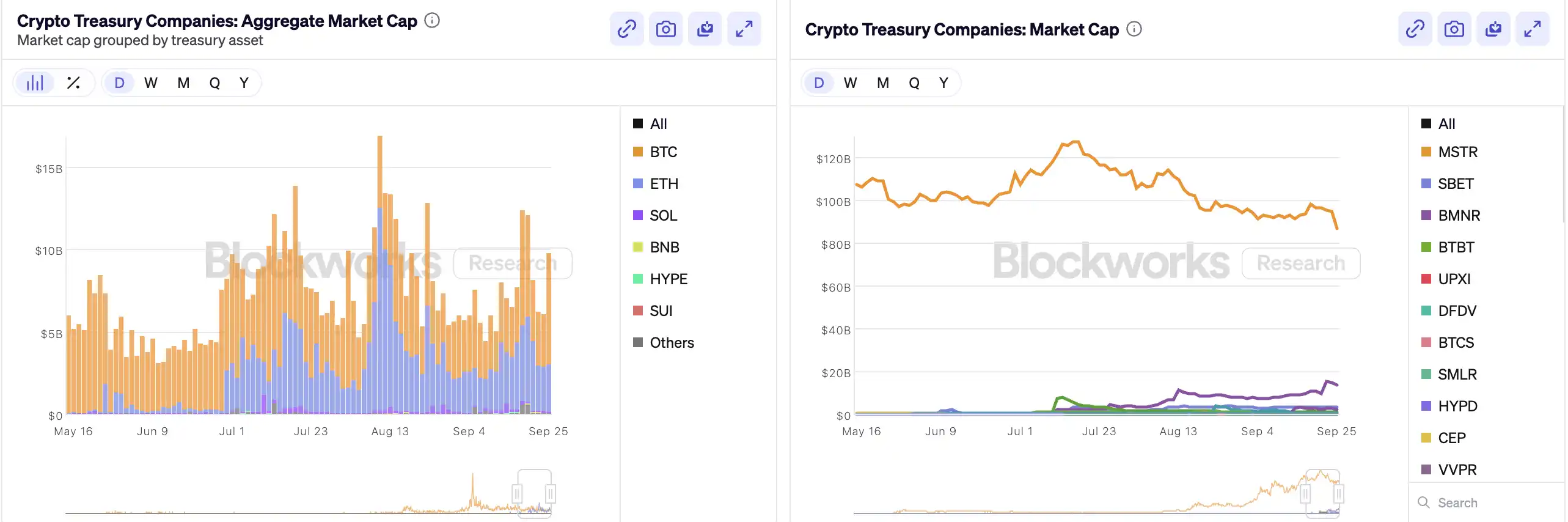
As verified by Michael Saylor, there is a significant amount of institutional fund managers in the market who want exposure to Bitcoin but cannot directly buy BTC or hold ETFs—however, they can buy shares of MSTR. If you can package a company holding crypto assets into their “compliance basket”, these funds are willing to buy assets that are only worth $10 on the books at prices of $2, $3, or even $1 . This is not irrational; this is institutional arbitrage.
In the second half of the cycle, new issuers will still emerge in the market, resorting to more aggressive corporate financial instruments to pursue higher price elasticity. When prices decline, these practices will backfire. Arthur Hayes predicts that this cycle will see a major DAT incident similar to the FTX collapse. At that time, these companies may falter, and their stocks or bonds could experience significant discounts, causing substantial market turmoil.
Regulators have also noticed this structural risk. At the beginning of September, NASDAQ proposed to enhance the review of DAT companies; today, the SEC and FINRA have jointly launched an investigation into insider trading. These actions by regulators aim to compress the insider space, raise the issuance threshold and financing difficulty, thereby reducing the manipulation space for newly established DAT companies. For the market, this means that “pseudo leaders” will be accelerated to be cleared out, while the real leading companies will still survive and even grow through narrative.
Summary
The narrative of the encryption treasury continues, but the thresholds are rising, regulations are tightening, and the bubble clearing will proceed simultaneously. For investors, it is essential to see through the logic and arbitrage paths behind the financial structure, while also being constantly vigilant about the accumulation of risks behind the narrative—this “on-chain alchemy” cannot be performed indefinitely; the winner takes all, and the loser exits.


