# CLARITYActStalled

3.28M

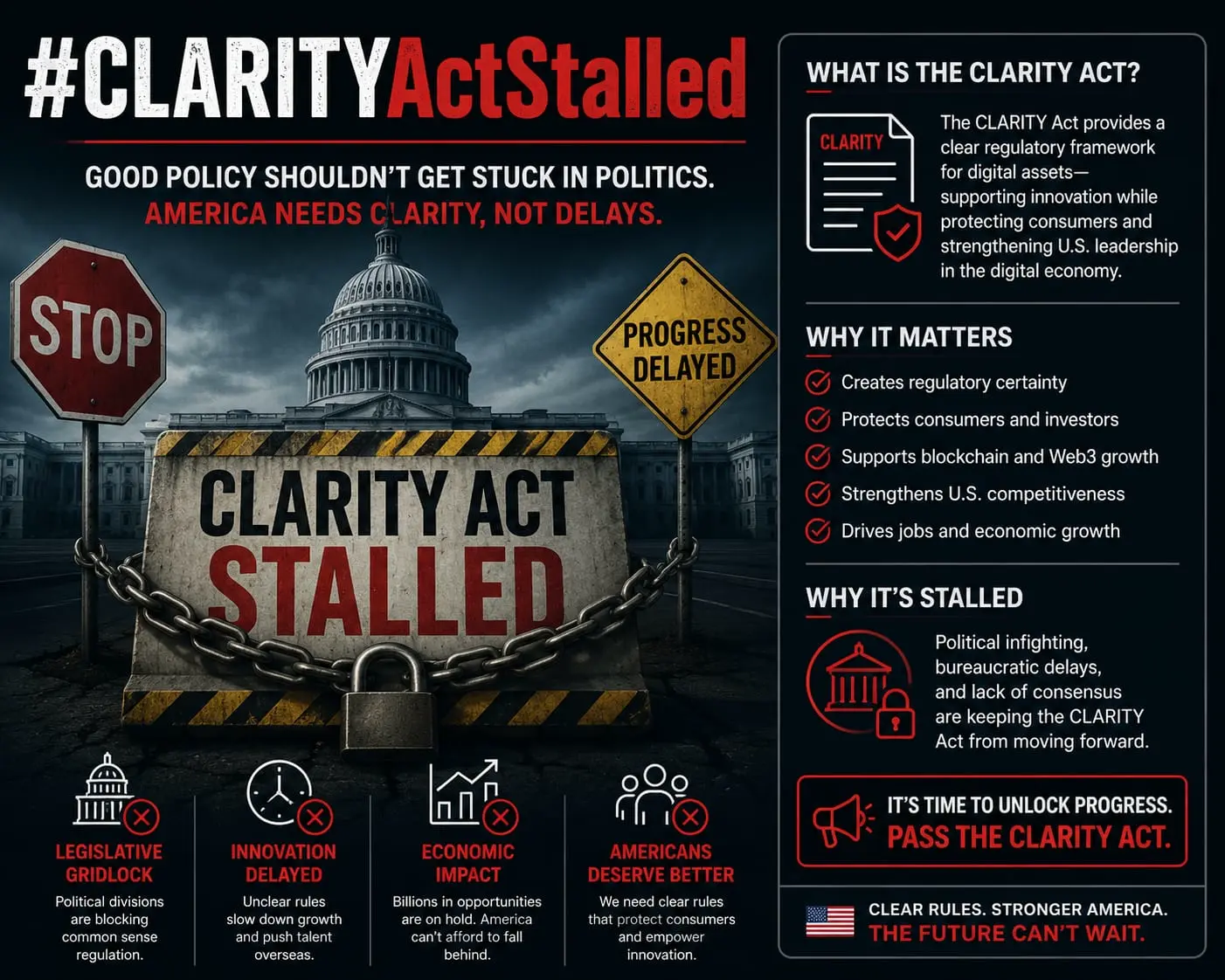
The CLARITY Act is seen as a regulatory cornerstone for the U.S. crypto industry. Recent reports suggest progress has stalled, with bipartisan disagreements over stablecoin yield provisions. If delayed until Q3 or later, the compliance path for institutional entry could become uncertain. Legislative progress remains the top macro variable to watch.

📢 Gate Square | 5/7 Hot Topics: #CLARITY法案推进受阻
The U.S. Senate is actively pushing the CLARITY Act for critical review on May 11th. However, the banking alliance is mounting a fierce opposition, worried that the "member rewards" clause in the bill will trigger a massive bank run. Supporters warn that if it is not passed before August, the U.S. may permanently lose its dominance in digital assets. Current market forecasts show a probability of over 60% for passage within the year.
🎁 Predict the legislative outcome and draw 5 lucky winners to share a $1,000 trading position experience voucher
View Original
post-image
Clarity Act signed into law in 2026?
Yes 67%
No 35%
$12.89K Vol
  • Reward
  • 13
  • Repost
  • Share
Crypto_Buzz_with_Alex:
✅ The CLARITY Act passes within 2026 — with moderate amendments to the member rewards clause to satisfy banking concerns. ✅ Passage triggers a 15–25% crypto market rally within 30 days as institutional confidence surges. ✅ Stablecoin market cap doubles within 12 months of implementation. The U.S. cannot afford to sit this one out. Digital asset dominance, once lost, does not come back
View More
#CLARITY法案推进受阻
⚡ CLARITY Act — Will the U.S. Secure Its Digital Asset Dominance or Lose It Forever?
The U.S. Senate is at a critical crossroads. The CLARITY Act is being pushed for review on May 11th — and the battle happening behind the scenes is one of the most important moments for crypto regulation in American history. Banking alliances are mounting fierce opposition, supporters are warning of permanent consequences, and the entire crypto market is watching closely.
Let me share my honest analysis on both discussion points.
1️⃣ Can Bipartisan Cooperation Break Through Banking Opposition?
Gate广场_Official
📢 Gate Square | 5/7 Hot Topics: #CLARITY法案推进受阻
The U.S. Senate is actively pushing the CLARITY Act for critical review on May 11th. However, the banking alliance is mounting a fierce opposition, worried that the "member rewards" clause in the bill will trigger a massive bank run. Supporters warn that if it is not passed before August, the U.S. may permanently lose its dominance in digital assets. Current market forecasts show a probability of over 60% for passage within the year.
🎁 Predict the legislative outcome and draw 5 lucky winners to share a $1,000 trading position experience voucher!
💬 This discussion:
1️⃣ Can bipartisan cooperation help the bill break through amid banking opposition?
2️⃣ Once stablecoin policies are implemented, what impacts will they have on traditional finance and the crypto market?
Participate in Polymarke prediction: https://gate.onelink.me/Hls0/prediction?page=detail&event_ticker=158505&source=cex
🔗 Share now: https://www.gate.com/post
📅 Deadline: 5/9 18:00 (UTC+8)
repost-content-media
  • Reward
  • 1
  • Repost
  • Share
ybaser:
2026 GOGOGO 👊
#CLARITYActStalled
Crypto was supposed to enter 2026 with clarity.
Instead, the industry entered another cycle of delay, uncertainty, and political hesitation.
The slowdown surrounding the CLARITY Act is no longer being viewed as a temporary legislative issue. It is becoming a direct signal of how disconnected traditional political systems are from the speed of technological evolution.
For years, the digital asset sector has operated inside a regulatory gray zone where exchanges, builders, institutional investors, and startups are forced to navigate overlapping agencies, inconsistent enforcem
BTC-1.11%
post-image
post-image
  • Reward
  • 2
  • Repost
  • Share
ybaser:
Ape In 🚀
View More
#CLARITYActStalled
The crypto industry entered 2026 expecting clearer regulations. Instead, the latest developments surrounding the CLARITY Act once again exposed how slowly political systems move compared to technological innovation.
Across the digital asset market, frustration is growing. Exchanges, developers, institutional firms, and investors have spent months waiting for a legal framework that clearly defines how cryptocurrencies should operate within the United States. What they continue receiving instead is regulatory overlap, uncertain enforcement, and delayed political decisions.
Th
BTC-1.11%
discovery
#CLARITYActStalled
The crypto industry entered 2026 expecting clearer regulations. Instead, the latest developments surrounding the CLARITY Act once again exposed how slowly political systems move compared to technological innovation.
Across the digital asset market, frustration is growing. Exchanges, developers, institutional firms, and investors have spent months waiting for a legal framework that clearly defines how cryptocurrencies should operate within the United States. What they continue receiving instead is regulatory overlap, uncertain enforcement, and delayed political decisions.
This is no longer just a legal debate. It is becoming a global competitiveness issue.
While Washington continues arguing over classifications and jurisdiction, other regions are advancing rapidly. The UAE keeps attracting major crypto firms and Web3 projects. Europe is moving forward through MiCA implementation. Hong Kong is reopening its doors to regulated digital asset participation. Capital and innovation rarely remain trapped in environments where rules are unclear for too long.
That is why the slowdown surrounding the CLARITY Act carries significance far beyond US politics.
The market is increasingly exhausted by uncertainty being treated as a long-term strategy.
Every major crypto cycle eventually reaches the same challenge. Institutions want exposure to digital assets. Builders want room to scale. Users demand innovation. Yet regulators still struggle to determine whether crypto belongs under securities law, commodity regulation, payment infrastructure, or an entirely new category.
One reality is becoming harder to ignore: if regulatory confusion continues, liquidity, talent, and innovation may continue shifting outside the United States at a faster pace.
That does not mean crypto adoption slows globally. It simply means leadership changes location.
Ironically, the industry itself has evolved far ahead of the political process. Spot Bitcoin ETFs are already operating. Major financial institutions are actively exploring tokenization. Traditional finance companies that once dismissed crypto are now quietly developing digital asset infrastructure behind the scenes. Meanwhile, lawmakers are still debating frameworks that properly reflect the current state of the industry.
At the same time, traders should recognize something important. Regulatory uncertainty often increases volatility, but volatility also creates opportunity.
Periods of confusion tend to shake out emotional participants while experienced investors position themselves strategically for longer-term growth. Crypto markets have repeatedly shown that adoption momentum can survive political delays, regulatory pressure, and market-wide fear.
Today’s market response also highlighted the difference between retail expectations and institutional behavior. Retail investors often seek immediate approvals and fast bullish momentum. Institutions are taking a longer-term approach by preparing infrastructure early because they understand regulation usually follows capital demand eventually.
Another issue drawing growing criticism is selective enforcement. Many crypto companies argue regulators continue relying on lawsuits and reactive actions instead of delivering transparent operating rules. That environment creates hesitation among startups and weakens innovation inside the US ecosystem.
Despite the regulatory frustration, broader market conditions remained relatively stable. Bitcoin dominance holding near elevated levels suggests institutional confidence in BTC itself remains strong. Investors increasingly separate Bitcoin’s long-term role from temporary political uncertainty.
For traders, investors, and builders, one lesson remains critical: market direction should not depend entirely on political headlines.
Regulation matters. Legislation matters. But long-term adoption trends matter even more.
Crypto has already survived exchange failures, deep bear markets, banking pressure, and years of skepticism. A delayed bill may temporarily slow momentum, but it does not change the broader transformation happening across global finance.
The bigger question now is no longer whether digital assets will continue expanding worldwide.
The real question is which countries will position themselves to lead the next era of the crypto economy.
repost-content-media
  • Reward
  • 2
  • Repost
  • Share
SheenCrypto:
2026 GOGOGO 👊
View More
#CLARITYActStalled
Hey crypto fam 👋
You’ve heard the buzz about the CLARITY Act — the bill that was supposed to be the U.S. industry’s north star for regulatory clarity. ✨
But here’s the latest plot twist:
🚧 Progress has stalled.
Why? Bipartisan squabbles over… stablecoin yield provisions. (Because of course.)
That means a likely delay until Q3 or later. And for institutions waiting on the sidelines? Their compliance roadmap just got a little foggier. 🌫
So what’s the #1 macro variable to watch?
Legislative progress. Period.
But hey — delays don’t mean despair. They mean detours. And in cry
post-image
post-image
  • Reward
  • Comment
  • Repost
  • Share
#CLARITYActStalled
• Crypto Regulation Faces Another Delay
The crypto community is closely watching developments around the CLARITY Act as momentum behind the bill appears to be slowing. Many investors expected the legislation to become a turning point for digital asset regulation in the United States, but ongoing political disagreements and regulatory debates have delayed progress once again.
• Why the CLARITY Act Matters
The main purpose of the CLARITY Act is to establish clearer rules for cryptocurrencies and blockchain companies. One of the biggest challenges in the crypto industry has be
BTC-1.11%
ETH-2.44%
post-image
post-image
post-image
  • Reward
  • 2
  • Repost
  • Share
ybaser:
To The Moon 🌕
View More
#CLARITYActStalled #CLARITYActStalled 🚨📉
The crypto industry was expecting a major breakthrough from the proposed CLARITY Act, but political disagreements and regulatory pressure have slowed the momentum. The delay has created uncertainty across the digital asset market, especially for projects waiting for clear legal classification and compliance rules.
What Is Happening? The CLARITY Act was designed to create a more transparent framework for cryptocurrencies, exchanges, DeFi platforms, and blockchain-based assets in the United States. Its main goal was to define which assets fall under se
BTC-1.11%
post-image
  • Reward
  • 1
  • Repost
  • Share
HighAmbition:
2026 GOGOGO 👊
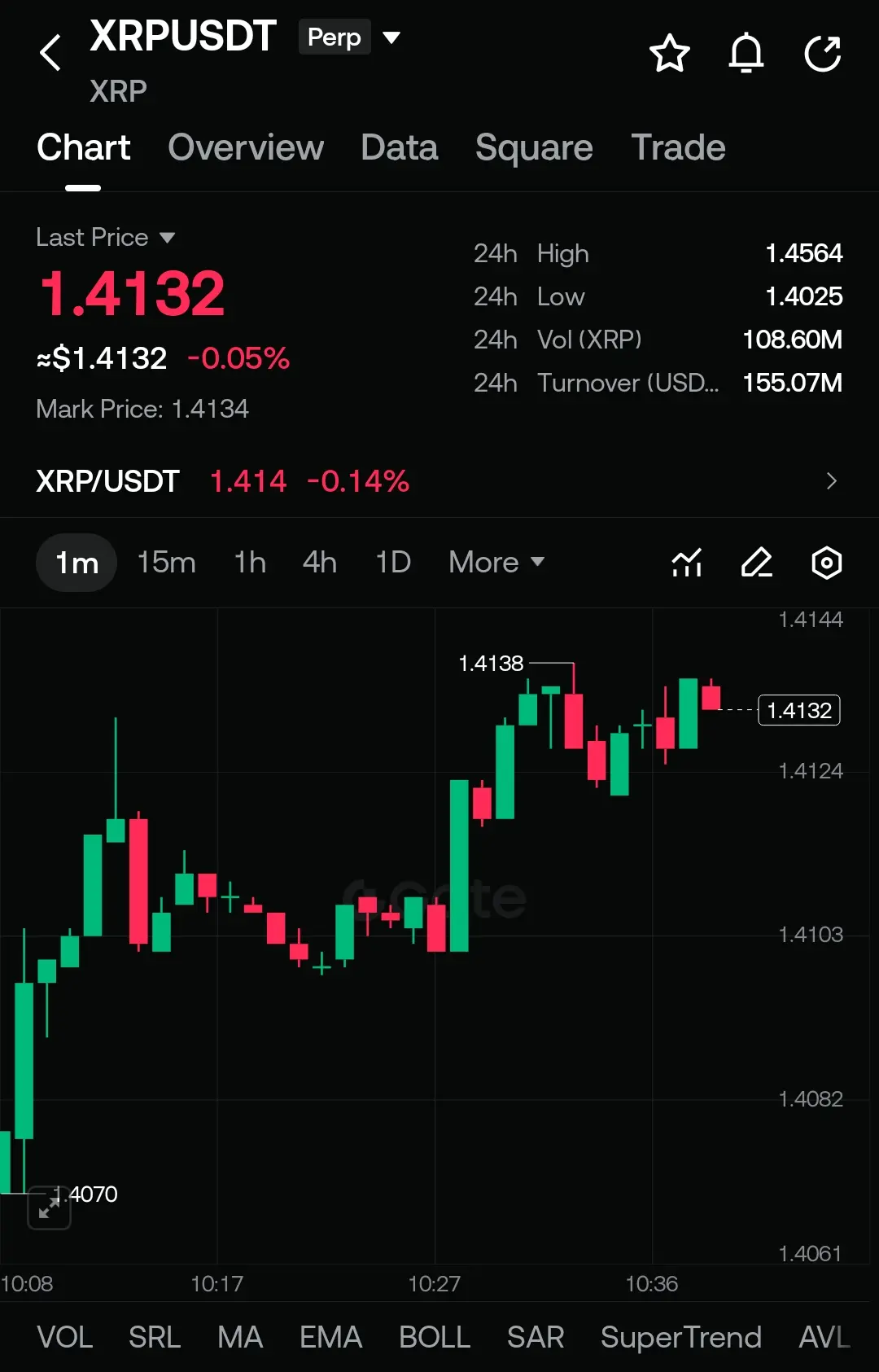
💎 $XRP /USDT Support Rebound Setup
📍 Entry Zone: $1.3900 – $1.4120
🎯 Target 1: $1.4600
🎯 Target 2: $1.5300
🎯 Target 3: $1.6200
🛑 Stop Loss: $1.3450
💡 XRP facing mild pullback while maintaining broader bullish structure — rebound possible from support.
#GateSquareMayTradingShare #BTCPullback #CLARITYActStalled #DailyPolymarketHotspot #StablecoinReserveDrops
XRP-1.32%
post-image
  • Reward
  • Comment
  • Repost
  • Share
#CLARITYActStalled
The crypto industry entered 2026 expecting clearer regulations. Instead, the latest developments surrounding the CLARITY Act once again exposed how slowly political systems move compared to technological innovation.
Across the digital asset market, frustration is growing. Exchanges, developers, institutional firms, and investors have spent months waiting for a legal framework that clearly defines how cryptocurrencies should operate within the United States. What they continue receiving instead is regulatory overlap, uncertain enforcement, and delayed political decisions.
Th
BTC-1.11%
post-image
  • Reward
  • 22
  • Repost
  • Share
ybaser:
2026 GOGOGO 👊
View More
#CLARITY法案推进受阻
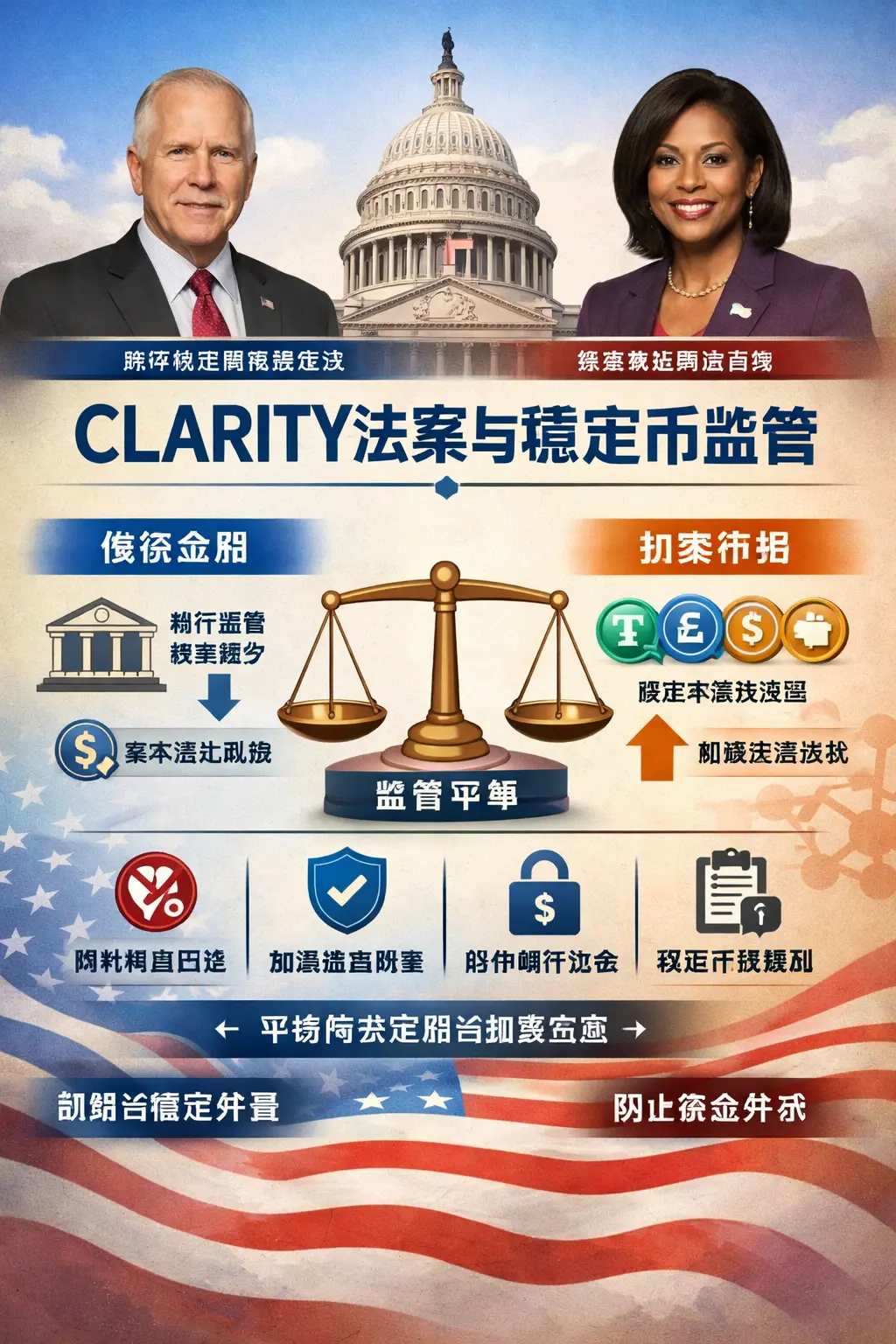
Bipartisan cooperation has already proven crucial to the progress of the CLARITY Act; Senators Tillis and Alsobrooks reached a compromise on stablecoin yields that addresses banking concerns. Once implemented, stablecoin policies will reshape both traditional finance and crypto markets by providing regulatory clarity that could consolidate U.S. leadership in digital assets while limiting deposit flight risks.
Senators Tillis and Alsobrooks agreed to allow crypto platforms to offer activity-based incentives while prohibiting rewards similar to bank deposit interest.
The Ameri
post-image
  • Reward
  • 4
  • Repost
  • Share
BlackBullion_Alpha:
Ape In 🚀
View More
Load More