


Content
1.What is Spot Martingale?
2.Pros and Cons of Spot Martingale
3.Terms Explained
4.How to use Spot Martingale
5.Case Analysis
6.Spot Martingale FAQ
1.What is Spot Martingale?
Spot Martingale is a strategy applied to average the cost in capital management. Its fundamental concept involves increasing the next investment amount after experiencing losses, with the objective of recuperating losses and attaining profits in a single transaction when the market rebounds. The core concept of Spot Martingale is to buy in batches to average down the cost, and subsequently sell out all positions at once to make a profit when there is a market upturn. When facing market fluctuations, this strategy generally offers a more stable return and a relatively manageable risk.
2.Pros and Cons of Spot Martingale
2.1 Pros
2.1.1 Average cost of "buying at the bottom"
Martingale makes purchases in batches after a fixed percentage drop, which helps prevent "buying at the bottom" or "buying halfway," ultimately lowering the average cost.
2.1.2 Dynamic Profit-Taking Strategy
Traders are required to set a profit-taking ratio and sell out at once when there is a market rebound. The profit-taking price dynamically adjusts in accordance with the profit-taking ratio.
2.1.3. Controllable Risks
Traders can dynamically adjust the buy-sell ratio according to their trading preferences to control the risk.
2.2 Cons
2.2.1 Not Suitable for One-Sided Markets
If the market remains in a one-sided trend, it may become challenging to reach the "profit-taking point," potentially turning "floating losses" into "real losses."
2.2.2 Tying up more funds
Since each buy and sell order needs to be placed when a strategy starts to run, it will tie up larger funds when a number of positions are added.
3.Terms Explained
3.1 Price Deviation
The preset price drop percentage for additional positions. When the price of the token drops by the corresponding percentage, a DCA order will be executed to increase your position and therefore lower the average cost.
3.2 Max DCA Orders
Max DCA Orders mean the maximum number of DCA orders that can be placed per cycle. For example, if the max DCA is set to 8, the system will place 8 DCA orders after the initial order is filled based on the Price Deviation.
3.3 Amount Multiplier
The bot will divide the total investment amount into several equal parts to buy at the bottom of each cycle. This value determines the multiplier for the "buying at the bottom" amount next time in relation to the previous purchase amount, with an input range of 1-2.
3.4 TP Target Per Cycle
In each cycle, Take Profit Price = Current cycle's Average position cost x PR, where PR = (1 + Profit Taking Ratio + 0.1%) / (1 - Transaction Fee ratio). When the Take Profit price is triggered, the strategy will try to sell all coins you have bought to take profit. The bot will end the current trading cycle and start the next one as specified after the order is fully executed. The trading fees have been deducted from the profit obtained after profit-taking.
3.5 Stop Loss
Stop Loss Price = Average Position Cost × (1 - Stop Loss %). When the SL price has been triggered and the order is fully filled, the current strategy will be terminated.
4.How to use Spot Martingale?
4.1 AI mode
Currently, there are 3 types of AI modes for Spot Martingale: HODL, High-Risk Arbitrage, and Low-Risk Arbitrage. Each type is backtested with 7-day and 30-day historical data to generate the parameters with the highest annualized returns. Users can choose different AI modes based on returns and their own risk appetite.
4.1.1 HODL
HODL is characterized by large price gaps, a high ratio of profit, and a moderate frequency of adding positions. Users need to wait patiently until they find the right time to enter the market, thereby achieving stable profits at low risks.
4.1.2 High-Risk Arbitrage
High-risk arbitrage involves small price gaps, a low ratio of profit, and less frequency to add positions. Typically, users who are more risk-tolerant, possess robust financial assets, and are experienced in frequent trading are better suited for this strategy.
4.1.3 Low-Risk Arbitrage
Low-risk arbitrage features large price gaps, a larger total number of positions added, and a smaller ratio of profit. This reduces the risk of missing downturn opportunities while striking a balance between profitability and risk.
4.2 Manual Mode
4.2.1 Basic Parameters
There are 3 parameters: "Price Deviation", "Profit Taking Ratio Per Cycle", and "Max DCA Orders."
1)Price Deviation
When the initial order is bought at the market price in each cycle, positions will be added if the price drops by a certain percentage. The range for this setting is between 0.1% and 15%.
2)Profit Taking Ratio Per Cycle
In each cycle, when you buy at the bottom in batches and then witness a market upturn, you can take profit by selling out when you've achieved a certain profit percentage. Setting this parameter, the input value must be ≥ 0.1%. The formula is as follows: Current cycle's Average position cost x PR, where PR = (1 + Profit Taking Ratio + 0.1%) / (1 - Transaction Fee ratio).
3)Max DCA Orders
The number of positions added in each cycle determines how the funds will be divided for buying at the bottom. For example, if the number of added positions each time increases exponentially by a power of 2, with 5 as the maximum DCA orders, the Martingale robot will execute purchases in a sequence of 1, 1, 2, 4, 8, 16, 32, and so on. The range for the Max DCA Orders is 1-30.
4.2.2 Advanced
1)Amount Multiplier
This value determines the multiplier for the "buying at the bottom" amount next time in relation to the previous purchase amount, with an input range of 1-2.
2)Stop Loss
Stop Loss Price = Average Position Cost × (1 - Stop Loss %). When the SL price has been triggered and fully executed, the current strategy will be terminated. The stop loss target range is 0.1% - 99.99%.
3) Trigger Price
The Martingale strategy is triggered and executed only when the latest market price reaches the trigger price.
4.3 Customize Parameter Settings
"Customize parameters" allow users to freely set the "Price Deviation" and "Buy-in Amount" based on their own needs, without being influenced by the system's formulaic algorithms.
1) Sequence No: The maximum number of buy-ins per cycle.
2) Price Deviation: If the price drops by a specified percentage compared to the last buy-in price, the next position will be added.
3) Buy: The number of BASE currency units to buy per order. Users can freely set this value under "Customize parameters", with a maximum of 10,000 units.
4) Add a Position: Adding a position means increasing an additional buying opportunity.
Users can input the corresponding number of additional positions as needed.
5) Delete a Position: Deleting a position means reducing an additional buying opportunity.
5.Case Analysis
5.1 Basic Settings & Advanced Settings
Assume the trading fee is 0.2%, and the price of the initial order is 30,000 USDT, the basic settings include the following parameters:
- Investment amount:30,000USDT
- Price Deviation:5%
- Max DCA Orders:8
- TP Target Per Cycle:10%
The advanced settings parameters are as follows:
- Amount Multiplier: 1.5
- Trigger Price: 30,000 USDT
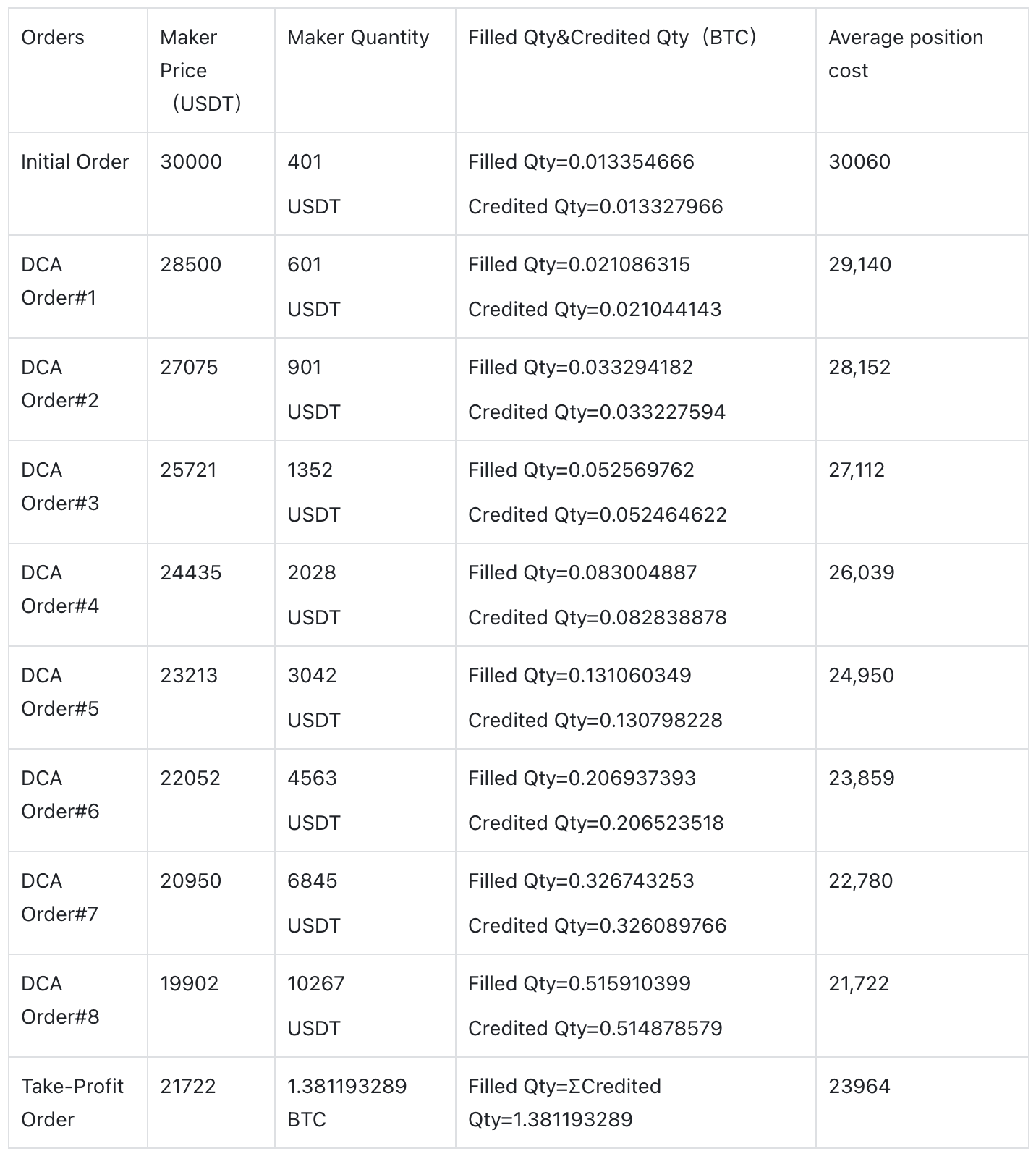
To ensure profitability, the take-profit ratio has been increased by 0.1% of the profit margin
- Sold Take profit QTY = 23964*1.3811932 = 33099 USDT
- Credited Qty = 33099 USDT*(1-0.2%) = 33033 USDT
- Total profit = 33033 USDT-30000 USDT = 3033 USDT
- Profit Margin = 10% , reached the take profit target.
5.2 Customize parameters
Assume "Customize parameters" are set as follows:
- Investment amount:30,000 USDT
- TP Target Per Cycle:10%
- Trigger Price:30,000 USDT(Assume the price of the initial order is 30,000 USDT)
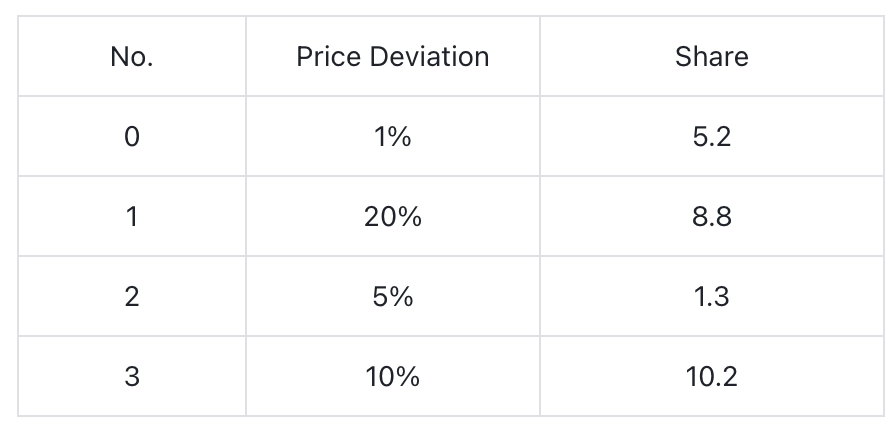
Based on the "customize parameters", the execution for each order is as follows
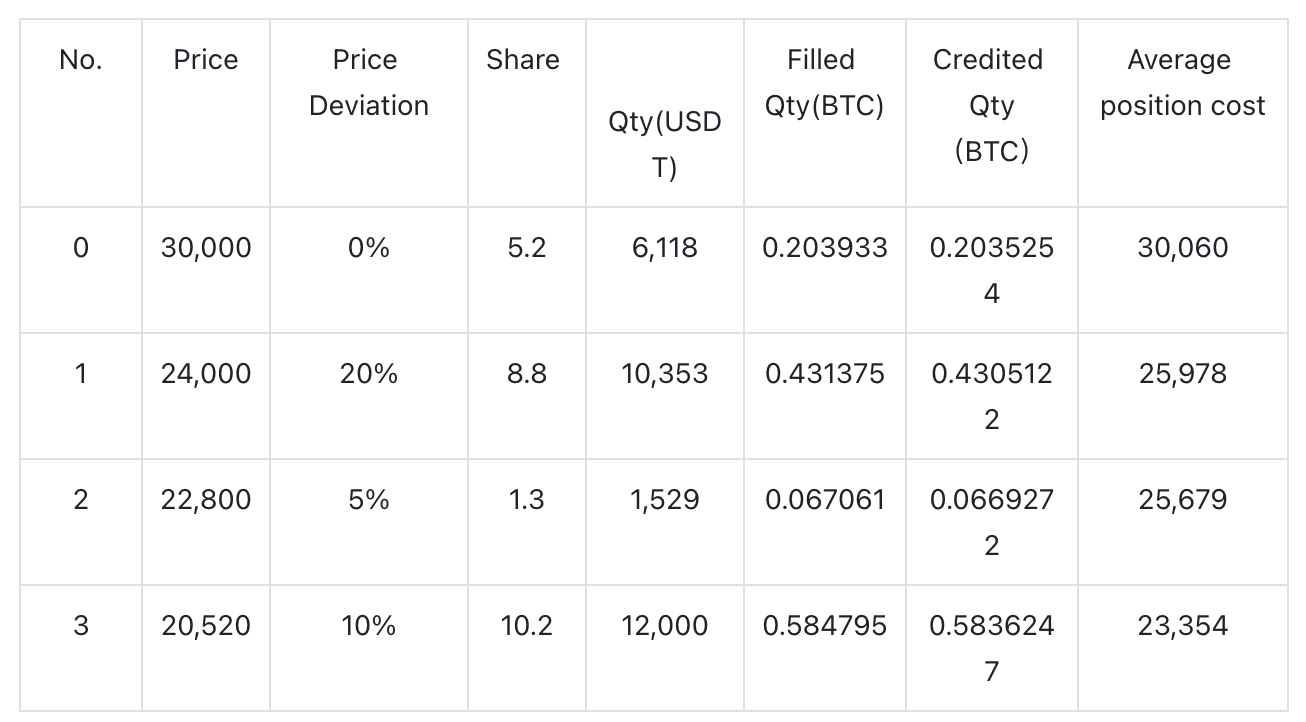
Assuming a transaction fee rate is 0.2%, to ensure profitability, the take-profit ratio has been increased by a minimum profit margin of 0.1%
- Take profit price:23,354*PR = 25,759 USDT
- PR =(1+Profit Taking Ratio + 0.1%) / (1 - Transaction Fee ratio)= 1.101 / 0.998 = 1.103
- Sold BTC Qty:Σ Credited Qtyt = 1.284594564
- Sold USDT Qty = Take profit price*Sold BTC Qty = 33,096 USDT
- Credited USDT Qty = 33,090*(1-0.2%) = 33030
- Profit margin = 3030/30,000*100% = 10% , reached the take profit target.
6.Spot Martingale FAQ
6.1 Why does my strategy suffer from losses from the beginning? Will it keep losing during a one-sided downtrend market?
Spot Martingale is a strategy that involves buying more as the price falls to reduce the average cost. Therefore, the profit margin is initially in a loss state. However, when the market rebounds, it can sell out all positions to take profit. If the market experiences a one-sided downtrend, it will buy at the bottom in batches, resulting in temporary floating losses. But as long as the market experiences even a slight rebound, it can automatically sell out all positions to take profit.
6.2 Can I set a stop loss for spot martingale?
Yes, you can. You can set a stop-loss price in the parameters to protect your assets. When the price of the trading asset falls below the stop-loss price, a limit sell order will be placed.
6.3 Can the transaction fees exceed the profit?
No. Spot Martingale takes transaction fees into account when selling and automatically includes the fee ratio, so transaction fees will not exceed profits. However, it is still recommended to set the 'Price deviation' higher than your spot trading fees.
6.4 How should I choose among 'Trading Types,' 'Manual Mode,' and 'Customize Parameters' for Spot Martingale?
If you are a beginner, we recommend using the 'Trading Types' option. AI mode conducts backtesting on 'HODL,' 'High-Risk Arbitrage,' and 'Low-Risk Arbitrage' based on historical data from the past 7 and 30 days. It automatically calculates the Martingale parameters with the highest profit: Price deviation, Max DCA Orders, TP Target Per Cycle, and Amount Multiplier. Users only need to select the investment amount (which must be greater than or equal to the minimum investment amount).
If you are an experienced trader, you can use "Manual mode" to customize parameters according to your own preferences.
If you are a professional trader with years of experience in Martingale strategies, you can choose "Customize Parameters" to configure the strategy to your specific needs."
6.5 Are there any limitations on the number of cycles for Spot Martingale?
No. It will continue to cycle as long as the account funds meet the minimum investment amount required by the parameters until the user manually terminates the strategy.
Gate reserves the final right to interpret the product.
Disclaimer
The content provided herein is for reference and educational purposes only and does not constitute any financial, investment, trading, or legal advice, nor does it constitute an offer or solicitation to buy or sell any digital assets. Gate makes no express or implied representations or warranties regarding the accuracy, completeness, or timeliness of the information contained herein. Product features, interfaces, rules, and fee structures may be updated or adjusted at any time. Please refer to the latest announcements and the actual information displayed on the Gate platform for the most accurate details.
Digital asset investments involve significant risk, and prices may fluctuate substantially. You may lose the entire amount of your investment. Please make decisions cautiously based on your own financial situation and risk tolerance after fully understanding the associated risks. If necessary, you are advised to consult an independent professional financial or legal advisor.
For more information about potential risks, please refer to Gate's Risk Disclosure and User Agreement.
