In times of high volatility, how should liquidity be managed?
Ferra provides an answer: different market-making models each solve specific problems and have their own boundaries. They can be understood from three dimensions: price formation methods, slippage characteristics, and LP risk structures:
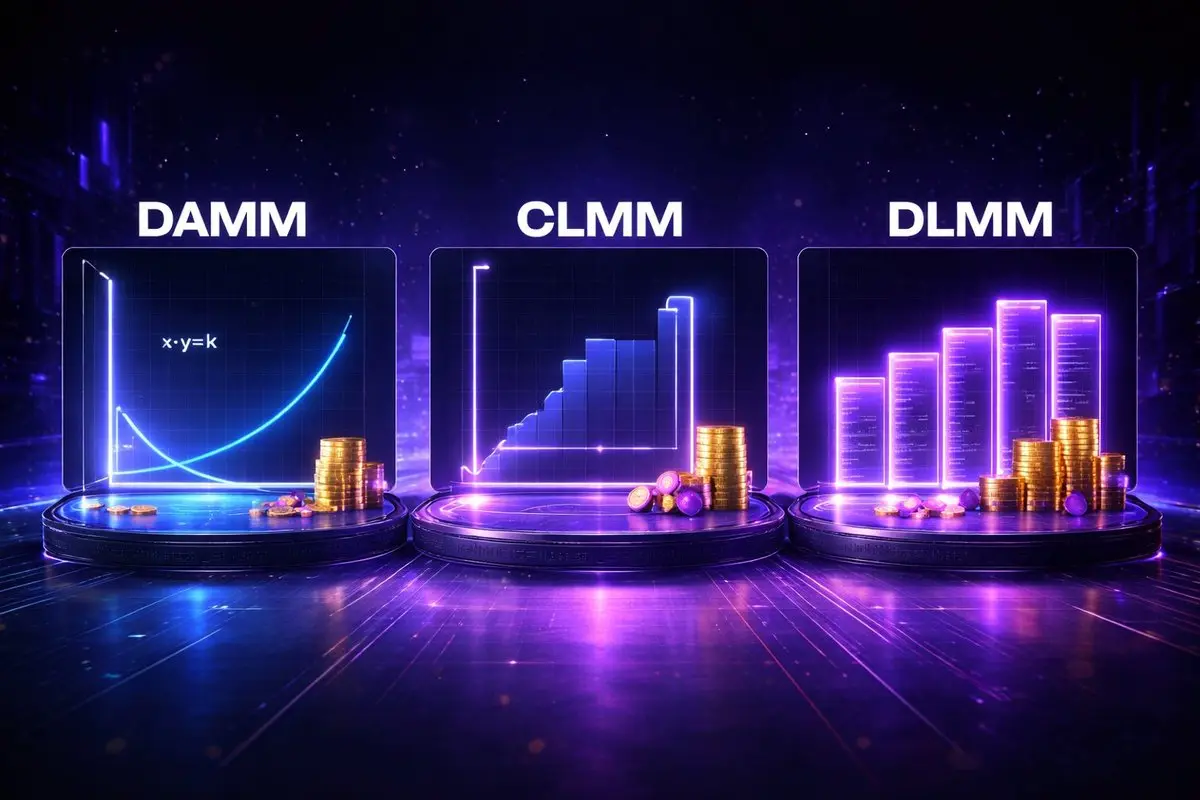
- DAMM (Traditional AMM, x·y = k)
This is the most classic market-making model, where prices change continuously, and every trade moves the price curve. Its advantages are a simple structure, no need for active management, and suitability for passive LPs. The drawbacks are also obvious: funds are spread evenly across the entire price range, large trades incur high slippage, capital efficiency is the lowest, and it is not friendly to LPs in volatile assets.
- CLMM (Concentrated Liquidity AMM)
CLMM improves capital efficiency by allowing LPs to choose specific price ranges. Liquidity is only active within designated intervals, and fee income is more concentrated. However, prices still change continuously within the range, so slippage remains; once the price moves out of the range, LPs become single-sided assets, requiring frequent management and rebalancing, which demands higher operational skills.
- DLMM (Dynamic Liquidity Market Maker)
DLMM is Ferra's core innovation. It does not use a continuous curve but divides the price into discrete bins. Within a single bin, the price is fixed; as long as liquidity is sufficient, trades can be executed with zero slippage. Only when a trade consumes an entire bin does the price jump to the next level. Coupled with dynamic fee rates that automatically increase during high volatility periods, this mechanism hedges arbitrage risks. For LPs, DLMM offers more controllable execution outcomes, clearer risk exposure, and supports both unilateral market-making and various liquidity distributions, making it especially suitable for highly volatile assets and new tokens.
//
Summary of core differences
DAMM ensures trades can always be executed but with the lowest efficiency; CLMM concentrates funds within effective ranges but has high management costs; DLMM achieves more predictable price execution and more reasonable LP returns in volatile markets.
//
From a design perspective, DLMM is not simply an upgrade of DAMM or CLMM but redefines price formation in high-frequency trading and high-volatility environments. This is also why Ferra considers DLMM as the underlying liquidity model rather than just an optional feature.
#KaitoYap @KaitoAI #Yap @ferra_protocol
Ferra provides an answer: different market-making models each solve specific problems and have their own boundaries. They can be understood from three dimensions: price formation methods, slippage characteristics, and LP risk structures:
- DAMM (Traditional AMM, x·y = k)
This is the most classic market-making model, where prices change continuously, and every trade moves the price curve. Its advantages are a simple structure, no need for active management, and suitability for passive LPs. The drawbacks are also obvious: funds are spread evenly across the entire price range, large trades incur high slippage, capital efficiency is the lowest, and it is not friendly to LPs in volatile assets.
- CLMM (Concentrated Liquidity AMM)
CLMM improves capital efficiency by allowing LPs to choose specific price ranges. Liquidity is only active within designated intervals, and fee income is more concentrated. However, prices still change continuously within the range, so slippage remains; once the price moves out of the range, LPs become single-sided assets, requiring frequent management and rebalancing, which demands higher operational skills.
- DLMM (Dynamic Liquidity Market Maker)
DLMM is Ferra's core innovation. It does not use a continuous curve but divides the price into discrete bins. Within a single bin, the price is fixed; as long as liquidity is sufficient, trades can be executed with zero slippage. Only when a trade consumes an entire bin does the price jump to the next level. Coupled with dynamic fee rates that automatically increase during high volatility periods, this mechanism hedges arbitrage risks. For LPs, DLMM offers more controllable execution outcomes, clearer risk exposure, and supports both unilateral market-making and various liquidity distributions, making it especially suitable for highly volatile assets and new tokens.
//
Summary of core differences
DAMM ensures trades can always be executed but with the lowest efficiency; CLMM concentrates funds within effective ranges but has high management costs; DLMM achieves more predictable price execution and more reasonable LP returns in volatile markets.
//
From a design perspective, DLMM is not simply an upgrade of DAMM or CLMM but redefines price formation in high-frequency trading and high-volatility environments. This is also why Ferra considers DLMM as the underlying liquidity model rather than just an optional feature.
#KaitoYap @KaitoAI #Yap @ferra_protocol