




#BuyTheDipOrWaitNow?
BuyTheDipOrWaitNow? Crypto Market Crossroads
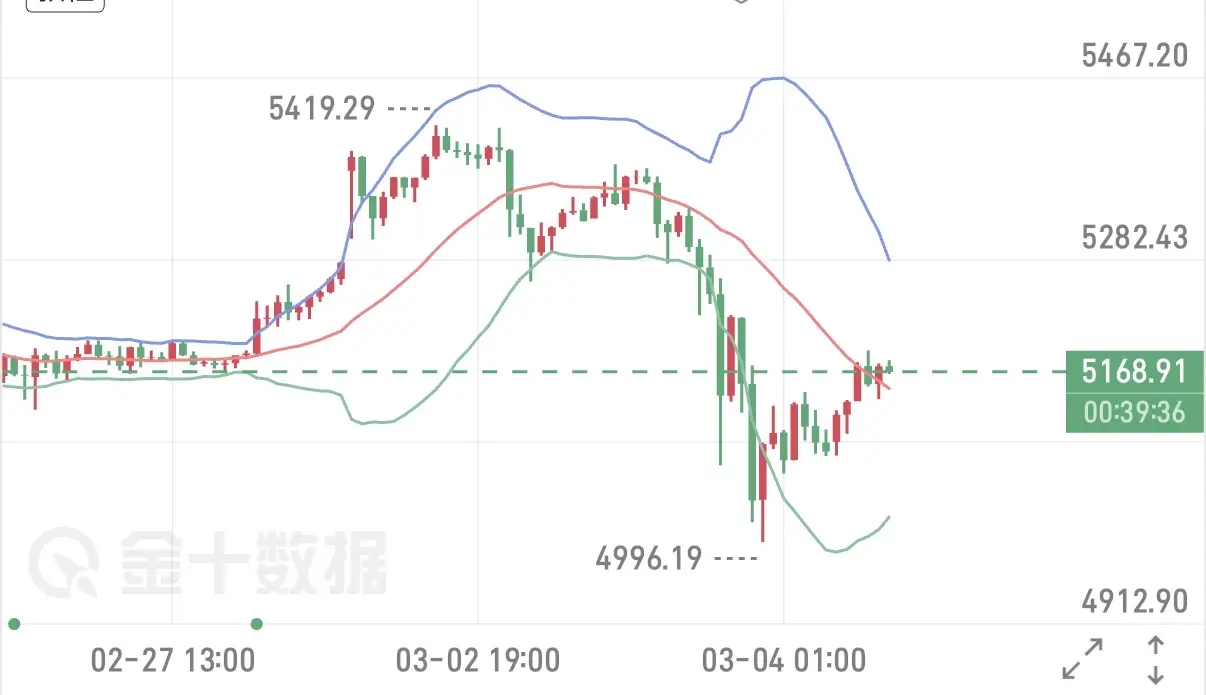
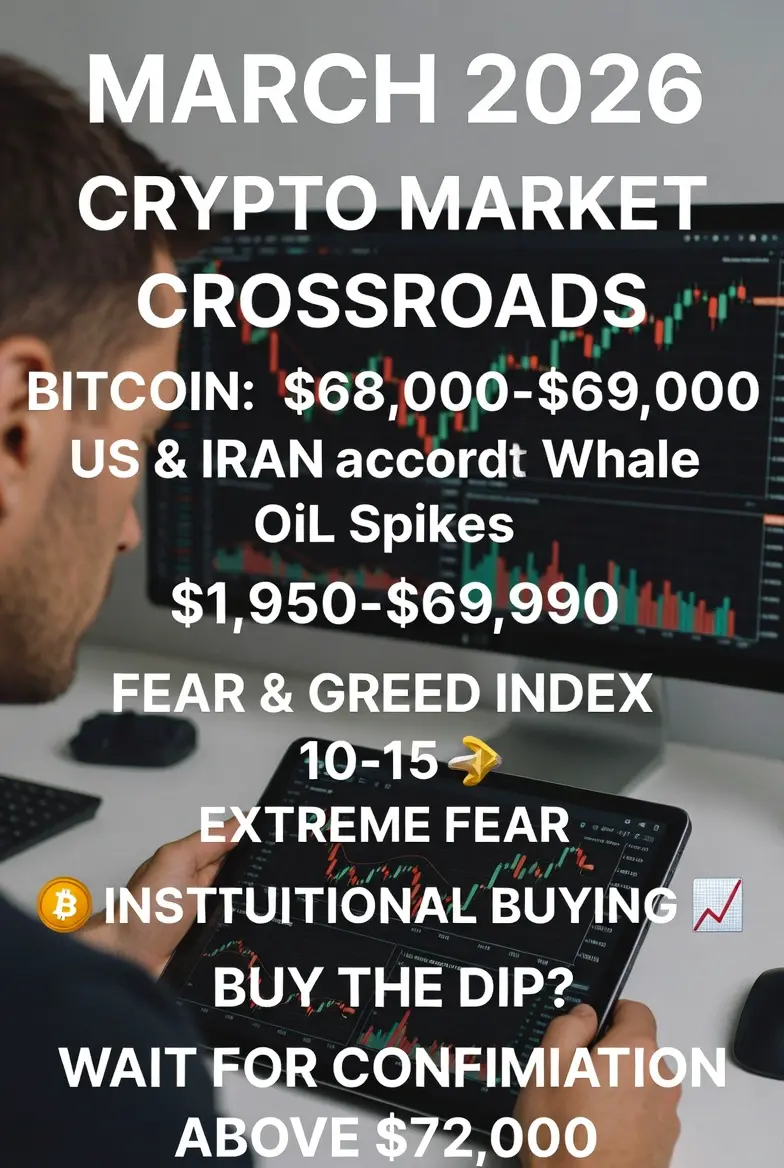
Right now the crypto market sits at a classic fork in the road: extreme fear has pushed Bitcoin back to ~$68,000–$69,000 after a violent weekend dip to $63,000, Ethereum hovers around $1,950–$1,990, and altcoins remain battered. The Fear & Greed Index lingers in single digits (10–15), marking one of the deepest capitulation readings of the cycle so far. Geopolitical escalation between the US and Iran continues to dominate headlines oil spikes, equity weakness, and uncertainty over Strait of Hormuz disruptions keep traditional risk assets under pressure. Yet Bitcoin staged a sharp V-shaped rebound, reclaiming key supports and showing short-squeeze strength that many expected would collapse further. So the burning question on every trader’s mind in Karachi and globally: Buy the dip aggressively right now, or wait for clearer confirmation?
The bear case for waiting is still very real and cannot be dismissed lightly. Five consecutive red monthly candles for BTC, year-to-date drawdown approaching 23%, massive ETF net outflows over recent months, and persistently high correlations with equities (around 0.6) all point to a market that remains fragile. If the Iran conflict broadens say, sustained closure threats materialize or direct US ground involvement escalates liquidity could dry up fast, triggering another leg lower. Technical analysts highlight vulnerable zones: failure to hold $66,000–$67,000 could cascade toward $62,300 (200-day MA cluster), then $58,000–$60,000 psychological floor. On-chain metrics show mixed signals long-term holders are mostly HODLing, but retail panic selling persists, and whale accumulation, while present, hasn’t yet reached the aggressive levels seen at previous cycle bottoms. Polymarket odds still price in a meaningful chance of Bitcoin dipping below $50,000 sometime in 2026. In this environment, waiting for a decisive reclaim of $72,000–$73,000 resistance or a Fear & Greed reading above 30 (neutral territory) would reduce emotional whipsaw and provide better risk-reward entry points.
On the flip side, the contrarian bull argument for buying the dip is equally compelling—and growing stronger by the hour. Extreme Fear readings historically mark major capitulation zones; every major crypto cycle bottom (2018, 2022) saw similar or worse sentiment before explosive reversals. The weekend recovery wasn’t just noise—Bitcoin erased nearly the entire geopolitical-driven drop in under 48 hours, flipped former resistance into support, and absorbed heavy selling pressure without new lows. Institutional footprints are visible: spot volumes surged 40%+ during the rebound, ETF flows flipped net positive in spots, and on-chain data confirms renewed whale buying (hundreds of thousands of BTC accumulated in the last 30 days). In conflict zones like Iran, Bitcoin and stablecoin outflows have spiked dramatically as citizens seek borderless capital preservation—real-world utility during chaos that reinforces the “digital gold in crises” narrative. Macro tailwinds are quietly building too: stronger-than-expected US ISM data counters some inflation fears from oil, global M2 money supply remains at record highs, and war spending almost guarantees more fiscal stimulus and debasement pressure—conditions that favor scarce assets like BTC and ETH over the long run.
Ethereum specifically strengthens the dip-buy case. At current levels (~$1,950), ETH sits well below its 200-day moving average and trades at historically depressed BTC-pair ratios. Whale wallets continue stacking, Layer-2 activity and stablecoin growth remain robust, and upcoming upgrades (even if delayed) promise efficiency gains. If Bitcoin holds and pushes toward $72,000+, ETH has historically outperformed in risk-on rotations—$2,100–$2,300 short-term targets look realistic on a clean break above $2,000. The altcoin market as a whole is compressed and oversold; many quality projects trade near or below 2022 bear-market lows. A sentiment flip could unleash violent catch-up rallies once fear peaks.
So where does the smart positioning lie in March 2026? The highest-conviction approach right now is gradual, disciplined accumulation on weakness rather than all-in FOMO or complete sidelining. Dollar-cost-average into core holdings (BTC, ETH, select blue-chip alts) during these fear spikes, but keep position sizes modest (5–15% of intended exposure per tranche) and maintain strict risk management—trailing stops below key supports or hedging with options/futures if volatility spikes further. Waiting for $72,000+ confirmation reduces downside but risks missing the early part of a potential reversal. Buying aggressively here maximizes upside if capitulation is truly in, but exposes you to more pain if macro/geopolitical headlines worsen.
Bottom line: This is not a screaming “safe” buy zone yet, but it is a textbook high-conviction contrarian opportunity for patient, risk-aware participants. Extreme fear + resilient price action + real hedging demand in active war zones = the ingredients that have preceded every major crypto bull leg historically. The market rarely gives clean, low-stress entries right now it’s handing fear on a platter. Decide your risk tolerance, size accordingly, and stay nimble. Whether you buy the dip today or wait for more proof, one thing is clear: the next few weeks will be decisive.
What’s your move,
holding powder dry for now?
BuyTheDipOrWaitNow? Crypto Market Crossroads
Right now the crypto market sits at a classic fork in the road: extreme fear has pushed Bitcoin back to ~$68,000–$69,000 after a violent weekend dip to $63,000, Ethereum hovers around $1,950–$1,990, and altcoins remain battered. The Fear & Greed Index lingers in single digits (10–15), marking one of the deepest capitulation readings of the cycle so far. Geopolitical escalation between the US and Iran continues to dominate headlines oil spikes, equity weakness, and uncertainty over Strait of Hormuz disruptions keep traditional risk assets under pressure. Yet Bitcoin staged a sharp V-shaped rebound, reclaiming key supports and showing short-squeeze strength that many expected would collapse further. So the burning question on every trader’s mind in Karachi and globally: Buy the dip aggressively right now, or wait for clearer confirmation?
The bear case for waiting is still very real and cannot be dismissed lightly. Five consecutive red monthly candles for BTC, year-to-date drawdown approaching 23%, massive ETF net outflows over recent months, and persistently high correlations with equities (around 0.6) all point to a market that remains fragile. If the Iran conflict broadens say, sustained closure threats materialize or direct US ground involvement escalates liquidity could dry up fast, triggering another leg lower. Technical analysts highlight vulnerable zones: failure to hold $66,000–$67,000 could cascade toward $62,300 (200-day MA cluster), then $58,000–$60,000 psychological floor. On-chain metrics show mixed signals long-term holders are mostly HODLing, but retail panic selling persists, and whale accumulation, while present, hasn’t yet reached the aggressive levels seen at previous cycle bottoms. Polymarket odds still price in a meaningful chance of Bitcoin dipping below $50,000 sometime in 2026. In this environment, waiting for a decisive reclaim of $72,000–$73,000 resistance or a Fear & Greed reading above 30 (neutral territory) would reduce emotional whipsaw and provide better risk-reward entry points.
On the flip side, the contrarian bull argument for buying the dip is equally compelling—and growing stronger by the hour. Extreme Fear readings historically mark major capitulation zones; every major crypto cycle bottom (2018, 2022) saw similar or worse sentiment before explosive reversals. The weekend recovery wasn’t just noise—Bitcoin erased nearly the entire geopolitical-driven drop in under 48 hours, flipped former resistance into support, and absorbed heavy selling pressure without new lows. Institutional footprints are visible: spot volumes surged 40%+ during the rebound, ETF flows flipped net positive in spots, and on-chain data confirms renewed whale buying (hundreds of thousands of BTC accumulated in the last 30 days). In conflict zones like Iran, Bitcoin and stablecoin outflows have spiked dramatically as citizens seek borderless capital preservation—real-world utility during chaos that reinforces the “digital gold in crises” narrative. Macro tailwinds are quietly building too: stronger-than-expected US ISM data counters some inflation fears from oil, global M2 money supply remains at record highs, and war spending almost guarantees more fiscal stimulus and debasement pressure—conditions that favor scarce assets like BTC and ETH over the long run.
Ethereum specifically strengthens the dip-buy case. At current levels (~$1,950), ETH sits well below its 200-day moving average and trades at historically depressed BTC-pair ratios. Whale wallets continue stacking, Layer-2 activity and stablecoin growth remain robust, and upcoming upgrades (even if delayed) promise efficiency gains. If Bitcoin holds and pushes toward $72,000+, ETH has historically outperformed in risk-on rotations—$2,100–$2,300 short-term targets look realistic on a clean break above $2,000. The altcoin market as a whole is compressed and oversold; many quality projects trade near or below 2022 bear-market lows. A sentiment flip could unleash violent catch-up rallies once fear peaks.
So where does the smart positioning lie in March 2026? The highest-conviction approach right now is gradual, disciplined accumulation on weakness rather than all-in FOMO or complete sidelining. Dollar-cost-average into core holdings (BTC, ETH, select blue-chip alts) during these fear spikes, but keep position sizes modest (5–15% of intended exposure per tranche) and maintain strict risk management—trailing stops below key supports or hedging with options/futures if volatility spikes further. Waiting for $72,000+ confirmation reduces downside but risks missing the early part of a potential reversal. Buying aggressively here maximizes upside if capitulation is truly in, but exposes you to more pain if macro/geopolitical headlines worsen.
Bottom line: This is not a screaming “safe” buy zone yet, but it is a textbook high-conviction contrarian opportunity for patient, risk-aware participants. Extreme fear + resilient price action + real hedging demand in active war zones = the ingredients that have preceded every major crypto bull leg historically. The market rarely gives clean, low-stress entries right now it’s handing fear on a platter. Decide your risk tolerance, size accordingly, and stay nimble. Whether you buy the dip today or wait for more proof, one thing is clear: the next few weeks will be decisive.
What’s your move,
holding powder dry for now?





 :
: