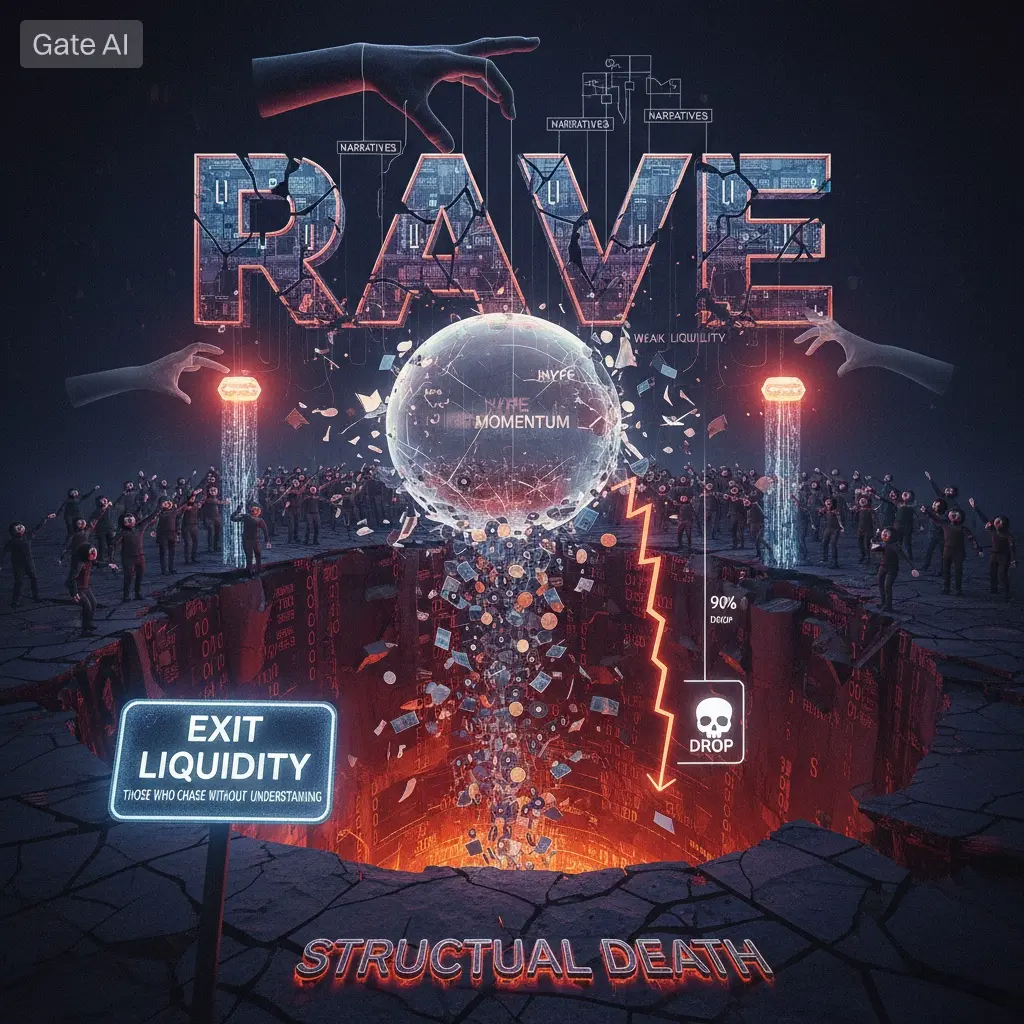
#RAVECrashes90% This was not a random crash. It was a textbook execution of how weak markets die fast and how unprepared traders get erased even faster.
A 90% collapse is not volatility — it is structural failure. When an asset loses nearly all its value within hours, it exposes one truth: there was never real strength behind the price, only momentum built on unstable ground.
RAVE did not “suddenly” crash. The conditions for this collapse were forming long before the first red candle printed. Rapid upside movement created the illusion of strength, but in reality it was a liquidity trap. Price moved up faster than real demand could sustain, meaning every new buyer was simply providing exit liquidity for earlier participants.
This is where most traders misunderstand the market. They see price rising and assume value is increasing. In reality, in low-liquidity environments, price is not discovery — it is distortion. A small amount of capital can push prices aggressively higher, creating a false sense of opportunity. But when selling begins, the same thin liquidity turns into a vacuum.
Before the crash, the structure likely showed all classic warning signals: aggressive parabolic growth, shallow order books, concentrated token distribution, and heavy speculative volume. These are not bullish indicators — they are early signs of fragility. The stronger the move without foundation, the more violent the collapse that follows.
The psychology behind this event is even more predictable than the price action itself. First comes acceleration, where early gains attract attention. Then comes FOMO, where retail participants enter late, driven by fear of missing out rather than understanding. Then comes distribution, where informed participants quietly reduce exposure. And finally comes panic, where exits become impossible because everyone is trying to sell into disappearing liquidity.
By the time most traders react, the market is no longer functioning normally. Orders slip, spreads widen, and price drops cascade. This is not just selling — it is a chain reaction where each sell triggers the next. Liquidity does not just decrease, it vanishes.
There are only a few realistic explanations for a move of this magnitude, and none of them are bullish. Either liquidity was intentionally pulled, a vulnerability was exploited, large holders exited aggressively, or the entire price structure was artificially inflated and then released. Different causes, same outcome: collapse.
Experienced participants do not wait for confirmation after a crash. They watch the signals before it happens. Sudden wallet movements, abnormal liquidity changes, unusual transaction spikes, and shifts in holder behavior are not noise — they are early warnings. Ignoring them is not bad luck, it is poor discipline.
The most important lesson here is not about RAVE specifically. It is about how risk is mispriced by retail traders. Small-cap assets offer high upside, but they also carry asymmetric downside. You can lose far more, far faster, than you expect. Without strict risk management, participation becomes speculation, and speculation without control becomes loss.
After a 90% drop, the instinct to “buy the dip” becomes strongest. This is where most traders fail again. They confuse a destroyed structure with an opportunity. But a chart that has collapsed this deeply is not discounted — it is broken. Recovery is not impossible, but statistically it is rare and often temporary without fundamental rebuilding.
The correct approach after such an event is not action, but restraint. Wait for stabilization, observe whether liquidity returns, analyze whether the project shows transparency and response, and only then reassess. Acting too early is not bravery — it is impatience disguised as confidence.
From a broader perspective, events like this reinforce a critical market reality. Crypto remains a high-opportunity environment, but it is still dominated by inefficiencies, information gaps, and emotional decision-making. Capital that survives and grows is not the most aggressive — it is the most disciplined.
RAVE is not the first asset to collapse like this, and it will not be the last. The difference between those who lose and those who learn is simple: one group reacts to price, the other studies structure.
If you are still approaching markets based on hype, momentum, and short-term excitement, this event should reset your thinking completely. Because in this space, the market does not forgive poor positioning — it exposes it.
The real takeaway is not about what happened to RAVE. It is about what this event reveals about how markets function under stress, how liquidity behaves when pressure increases, and how quickly sentiment can shift from greed to fear.
Opportunities in crypto are real, but they are never free. Every gain comes attached with risk, and every risk ignored eventually demands payment.
The traders who last are not the ones who catch every move. They are the ones who avoid the moves that can end them.
#CryptoRisk #MarketStructure #TradingPsychology #liquidity