Author: Yan Yimi
Source: Academic Headlines
The ancient scrolls that “disappeared” more than 2,000 years ago are now reproduced by AI.
**Recently, a 21-year-old computer science student used artificial intelligence (AI) technology to discover the first word in the unopened Herculaneum scroll. **
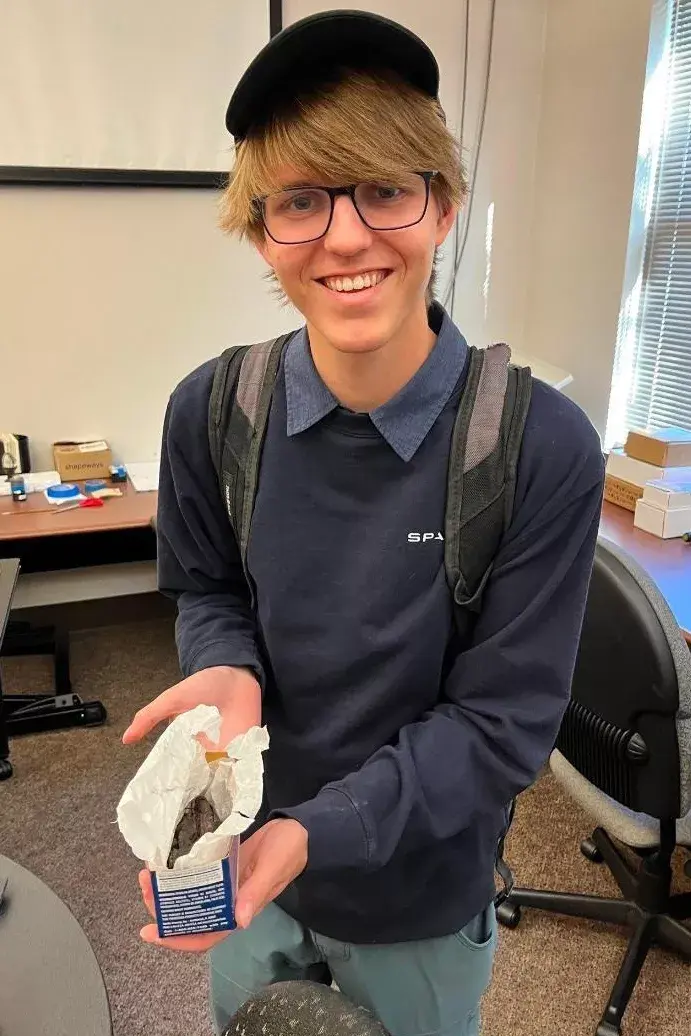 He was Luke Farritor of the University of Nebraska-Lincoln, who developed a machine learning algorithm that could detect Greek letters on rolled papyrus, including πορphiυρας (porphyras), meaning “purple.”
**Luke won the $40,000 First Letters prize for successfully deciphering and reading more than 10 characters in a 4-square-centimeter area by training a neural network and highlighting ink using subtle, small-scale differences in surface texture. **
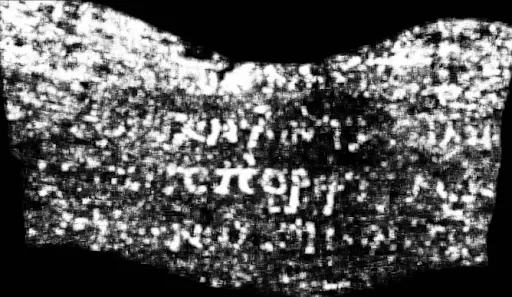 Luke Farritor’s first submission
Federica Nicolardi, a papyrus at the University of Naples in Italy and a member of the academic committee that reviewed Farritor’s research, said: ** "I was shocked when I saw the first image, I could actually see something from the inside of the scroll. ”**
The Herculaneum Scrolls, ancient scrolls held in a private library near Pompeii, were buried and carbonized by the eruption of Mount Vesuvius in 79 AD. For nearly 2,000 years, the only surviving ancient library has been buried under volcanic mud 20 meters underground. In the 18th century, they were excavated and,** while preserved to some extent, were very fragile and could turn to dust if not handled properly.
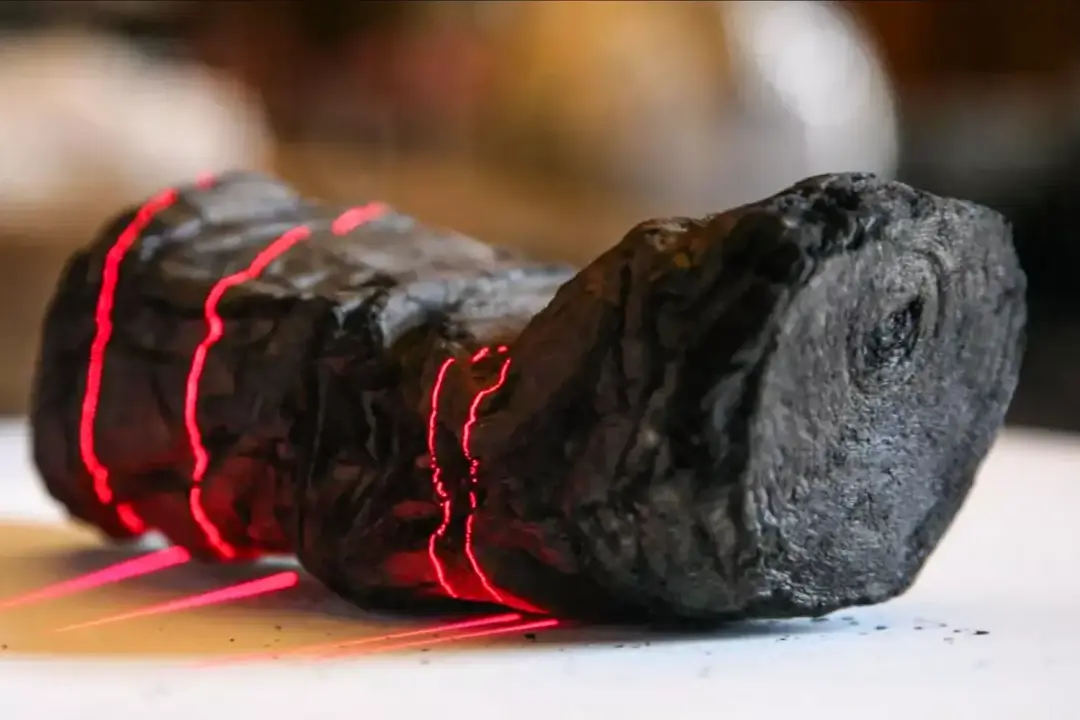 **How do I read a reel that won’t open? This question has remained unanswered for hundreds of years. **
In 2019, Professor Brent Seales of the University of Kentucky’s EduceLab imaged the Herculaneum Scrolls in a particle accelerator, generating 3D CT scans with resolutions up to 4 μm. His team also scanned and photographed fragments of the separated scroll with visible ink, providing a ground-real dataset. Professor Seales’ graduate student, Stephen Parsons, worked to use machine learning models to detect ink from CT scans, and was successful on separated fragments.
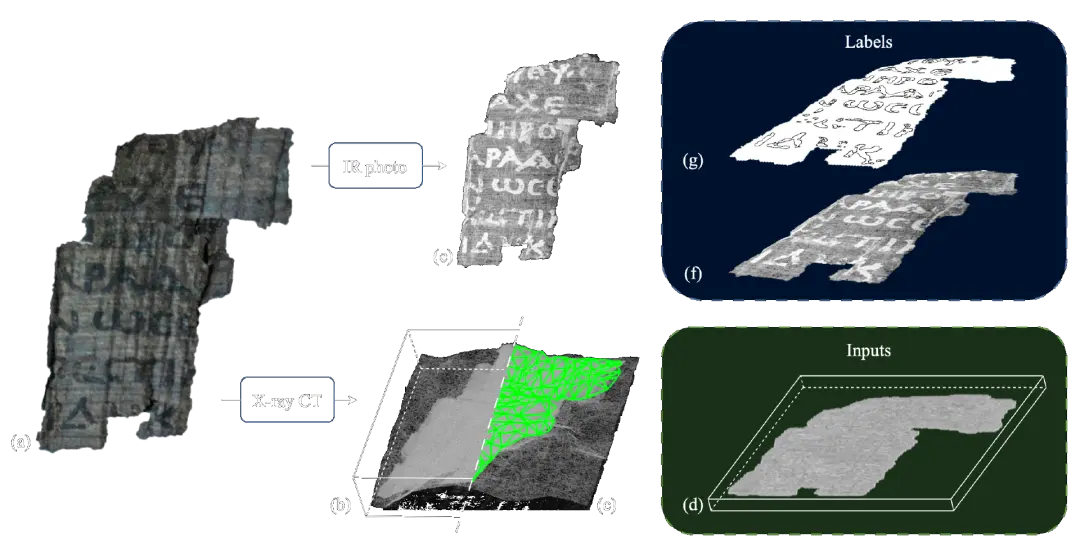 Train a machine learning model on real-world data from isolated fragments (Source: Stephen Parsons’ PhD thesis)
This success caught the attention of tech entrepreneurs Nat Friedman and Daniel Gros, who launched the Vesuvius Challenge to accelerate this progress. **They launched an open competition in March 2023 with several smaller awards for the development of open source tools and technologies in addition to the $700,000 grand prize.
Later, a small group of researchers began using tools originally built by EduceLab and improved by the community to draw the 3D structure of the scroll. By July of this year, hundreds of square centimeters of scrolls had been divided and “almost flattened.”
In early August, former JPL startup founder Casey Handmer wrote a blog post about discovering a “crack pattern” that looked like ink. **Casey was the first person in 2000 years to find ink and a letter in an unopened scroll.
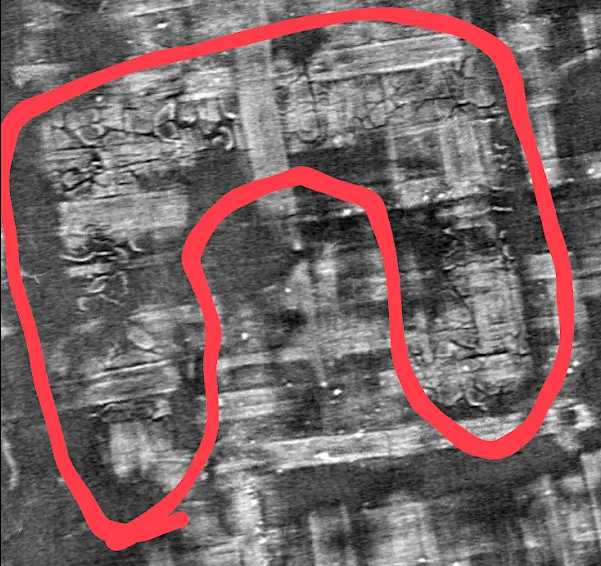 Figure | Annotation showing ink position (Source: Casey’s blog post)
Luke Farritor, a college student and SpaceX summer intern, heard about the Vesuvius Challenge from Dwarkesh Patel’s podcast interview with Nat.
The crack patterns he saw in Casey were discussed in Discord and began training machine learning models on crack patterns late at night. With each new crack discovered, the model is improved and more cracks can be revealed on the scroll.
Luke found dozens of ink strokes as well as some complete letters that he could label and use as training data. Soon after, the scroll revealed crack marks invisible to the naked eye. Soon, these traces began to form hints of letters and actual words.
Meanwhile, another contestant, Youssef Nader, an Egyptian biorobotics graduate student in Berlin, took a different approach. Motivated by Casey and Luke’s discovery, he screened the winners of the Ink Inspection Award on Kaggle, which focuses on improving Stephen Parsons’ machine learning approach to isolated fragments. He uses domain transfer techniques to adapt these models to the scrolls: unsupervised pre-training on the reel data, followed by fine-tuning the fragment labels.
He submitted the idea for the Ink Detection Followup Prize and won a small prize. A few weeks later, Youssef submitted his work to the First Letter Award. He saw the early results Luke shared on Twitter and Discord and decided to focus on the same area in the reels.
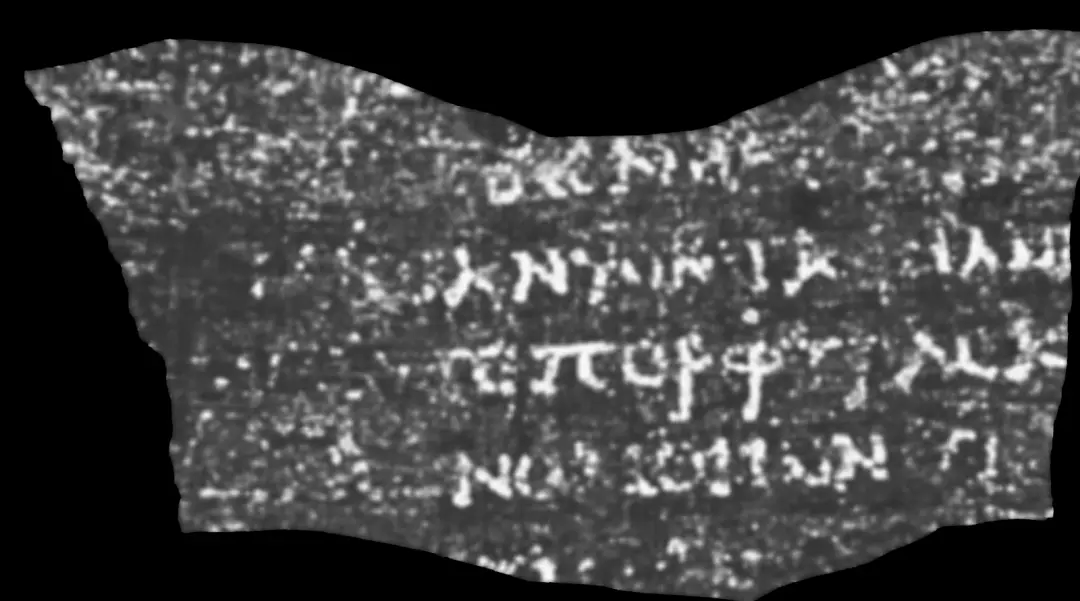 Youssef Nader’s final submission
Although he didn’t rely on Casey to manually find cracks, he managed to find some letters through a modified model of the Kaggle competition. He then annotates what looks like a letter in the label data.
Segmenting teams and contestants continued to make progress, and a few days ago Youssef’s model produced a new image with astonishing clarity and size (pictured below).
 Thea Sommerschield, an ancient Greek and Roman historian at Caphoscascari University in Venice, explained to Nature that the discovery could “revolutionize our understanding of ancient history and literature.”
Reference Links:
Disclaimer: The information on this page may come from third parties and does not represent the views or opinions of Gate. The content displayed on this page is for reference only and does not constitute any financial, investment, or legal advice. Gate does not guarantee the accuracy or completeness of the information and shall not be liable for any losses arising from the use of this information. Virtual asset investments carry high risks and are subject to significant price volatility. You may lose all of your invested principal. Please fully understand the relevant risks and make prudent decisions based on your own financial situation and risk tolerance. For details, please refer to
Disclaimer.


