Chainaanalysis found that no country’s crypto economy has grown more than Saudi Arabia over the past year.
The MENA (Middle East and North Africa) region is seeing increasing adoption of cryptocurrencies for various reasons. In countries with unstable currencies or high inflation rates, cryptocurrencies can serve as a means of protecting wealth.
In contrast, individuals in economically stable countries such as the United Arab Emirates are more inclined to explore innovative and investment-oriented applications of cryptocurrencies.
A recent Chainaanalysis report delves into why the Middle East and North Africa ranks sixth among the regions analyzed by the blockchain company this year. The study covers the period from July 2022 to June 2023, estimating that the MENA region captured approximately $389.8 billion in on-chain value during this period. This figure represents nearly 7.2% of the global transaction volume recorded throughout the study period.
The Middle East and North Africa region has three countries in the top 30 in this year’s index: Turkey (12th), Morocco (20th) and Iran (28th).
Adoption of DeFi in the UAE
In a press release shared with CryptoPotato, Chainaanalysis revealed that the UAE is the most prominent country in the MENA region with a higher proportion of cryptocurrency activity taking place on decentralized finance (DeFi) protocols compared to its neighbors except Israel. Much higher.
The UAE has transformed itself into the world’s cryptocurrency hub by adopting an innovation-friendly regulatory framework that promotes innovation while safeguarding consumer protection. These regulatory measures have attracted numerous cryptocurrency entrepreneurs and enthusiasts to the region, which may explain the increase in DeFi usage.
The release of Comprehensive Regulatory Framework A in February 2023 provided a major boost to the country’s crypto ecosystem. Akos Erzse, senior manager of public policy at Dubai-based cryptocurrency platform BitOasis, emphasized that one of the main factors that sets A apart is that it is designed to “ensure that the rules meet the needs of the industry.”
The executive said in an interview with Chainaanalysis,
“A new impetus for forward-looking regulatory transparency in the region has attracted a large number of cryptocurrency players to the UAE. There are different rulebooks for staking, broker-dealers, advisory services, custodians – which makes businesses more It is easy to understand the specific regulatory requirements for providing certain services.”
Türkiye and Saudi Arabia are not far behind
Turkey also ranks fourth globally in terms of raw cryptocurrency trading volume, with inflows of approximately $170 billion last year.
This places Türkiye’s trading volume behind only the United States, India and the United Kingdom.
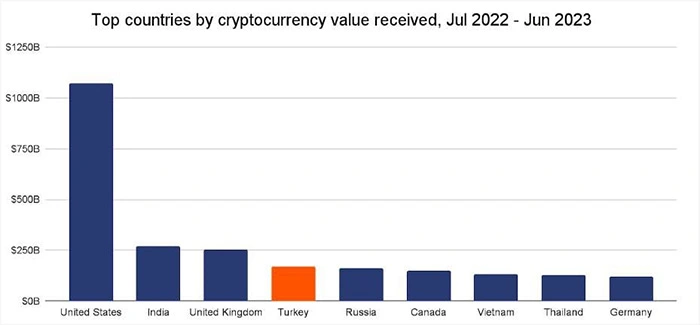
Top countries ranked by cryptocurrency value received. Source: Chainalysis
While the UAE’s cryptocurrency economy appears to be primarily driven by innovation and a desire to diversify investments, Turkish users appear to be turning to cryptocurrencies as a means of hedging against currency devaluation and protecting their savings.
The report also shows that USDT is the most commonly purchased asset using Turkish Lira on global exchanges. Additionally, despite an overall decline in NFT activity since mid-2022, Turkey still leads the region in NFT platform web traffic.
Abdulmajed Alhamzah, country general manager for Saudi Arabia at cryptocurrency exchange Rain, attributes this growth to retail investors, who constitute a large demographic group that accepts cryptocurrencies as a means of diversifying their investment portfolios.
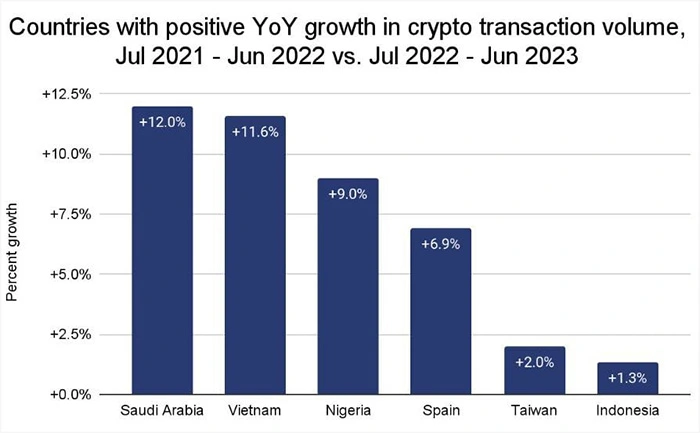
Countries with positive year-on-year growth in cryptocurrency trading volume. Source: Chainalysis
Disclaimer: The information on this page may come from third parties and does not represent the views or opinions of Gate. The content displayed on this page is for reference only and does not constitute any financial, investment, or legal advice. Gate does not guarantee the accuracy or completeness of the information and shall not be liable for any losses arising from the use of this information. Virtual asset investments carry high risks and are subject to significant price volatility. You may lose all of your invested principal. Please fully understand the relevant risks and make prudent decisions based on your own financial situation and risk tolerance. For details, please refer to
Disclaimer.


