Original source: Zero One Finance
Author: Shen Zhuoyan
 Image source: Generated by Unbounded AI
In many discussions about the financial model, “landing application” has become the final key word.
For financial services, precision and security compliance are the biggest prerequisites for the application of any technology. Therefore, the application of the financial large model is by no means a simple “bringing doctrine”. It needs to be fine-tuned repeatedly in combination with business needs on a general basis, which is also the main focus of the current financial large model.
At the end of July, according to research and analysis by Yang Wang, deputy secretary-general of Tencent Research Institute, the number of domestic large-scale models with parameters above 1 billion has increased from 79 at the end of May to 116, including about 18 large-scale financial models.
Some people believe that the emergence of the largest model may bring the digital transformation process of financial institutions to the same starting line and fill the “transformation gap” among financial institutions. This is an opportunity not to be missed for small and medium-sized financial institutions. **
On the premise of ensuring information accuracy and safety compliance, the first to obtain commercial breakthroughs in financial business scenarios has become the decisive point in the competition among 18 financial large-scale model research and development institutions.
Everyone shows their talents and grabs the track
At the end of March, Bloomberg, the world’s largest financial information company, released a large-scale language model with 50 billion parameters—BloombergGPT, which marked the birth of the world’s first large-scale financial model and also set off a wave of large-scale financial models in China.
According to Bloomberg, the large model is trained on a 3630 tokens financial data set and a 345 billion tokens public data set, which can fully support NLP (natural language processing) tasks in the financial field, and its performance is significantly better than other open models of similar scale. Performance on NLP benchmarks is also at or above average.
The sound of BloombergGPT has brought practical direction to the country.
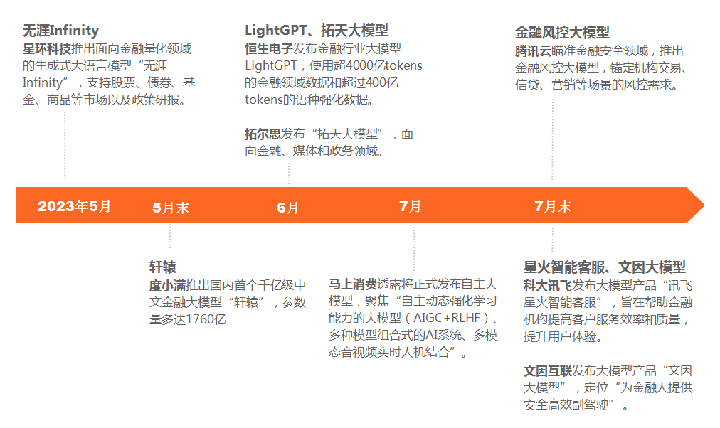 Figure 1: Timeline of major domestic financial models (incomplete statistics)
Source: Zero One Think Tank
In May, Transwarp Technology, a leading provider of big data basic software, launched the first generative big language model “Wuya Infinity” for the field of financial quantification. **According to his introduction, Transwarp Infinity supports comprehensive review, summary and deductive reasoning of market events such as stocks, bonds, funds, and commodities, as well as in-depth analysis of policy research reports, providing decision-making assistance for fund managers.
In late May, Du Xiaoman launched China’s first 100 billion-level Chinese financial model “Xuanyuan”. tasks such as commentary, financial data analysis, and financial news understanding. Xu Dongliang, CTO of Du Xiaoman, said that the Xuanyuan model is trained based on the massive financial data accumulated by Du Xiaoman’s actual business scenarios, ensuring that while improving financial capabilities, general capabilities will not be lost.
In June, Hang Seng Electronics released LightGPT, a large model for the financial industry. According to him, LightGPT uses more than 400 billion tokens of financial data (including information, announcements, research reports, structured data, etc.) and more than 40 billion tokens of language-enhanced data (including financial textbooks, financial encyclopedias, government reports, regulations Regulations, etc.), and use it as the secondary pre-training corpus of the large model to support the fine-tuning of more than 80+ financial-specific task instructions.
On June 29, **Torsi released the Tuotian large-scale model, and launched three large-scale industry models for the fields of media, finance, and government affairs. **On the financial model, the company is based on its own 11 billion+ financial subject data, 10 billion-level industrial index data, 3 billion+ detailed data of industrial elements, 200 million+ industrial dynamic ontology, more than 500+ indexing dimensions, 10,000 + Knowledge indexing rules, 100,000+ industry labels as professional training data. Just a few days ago, TRS announced that it plans to raise 1.8 billion yuan for the research and development of large-scale models in the Tuotian industry and the AIGC application industrialization project.
In July, Malaysia Consumption revealed that it will officially release its own large-scale model, focusing on "large-scale models with independent dynamic reinforcement learning capabilities (AIGC+RLHF), multiple model-combined AI systems, and multi-modal audio and video real-time human-machine Combined with the “three core key capabilities”, it is committed to solving key issues in the security and controllability, privacy protection, and infrastructure capacity building of large-scale models in the financial industry.
**In the wave of large financial models, wealth management institutions and operators are not far behind. Haitong Securities, Shenwan Hongyuan, GF Securities, Xingye Securities, Changjiang Securities, Southwest Securities, Guohai Securities, Guosheng Securities, Huafu Securities, and Caida Securities announced that they will become the first batch of ecological cooperation for Baidu’s “Wen Xin Yi Yan” Partners, wealth management operators represented by Flush Flush and Oriental Fortune also announced that they will focus on building an AI investment advisory platform, in-depth research in AIGC, interactive AI and other fields, improve content ecological construction, and enhance intelligent operation capabilities.
Tencent Cloud aims at the field of financial security and launches a large-scale financial risk control model to anchor the risk control needs of institutional transactions, credit, marketing and other scenarios. Li Chao, chief scientist of Tencent Yuntianyu, believes that risk control, especially the pre-loan risk control link, has the most urgent needs. In the credit field, fraud caused by illegal production has accounted for 40%-70% of the entire overdue scale.
The large-scale model product “Xunfei Xinghuo Smart Customer Service” released by HKUST Xunfei aims to help financial institutions improve the efficiency and quality of customer service and improve user experience. Xunfei Xinghuo intelligent customer service products have been comprehensively improved in terms of intent understanding ability, professional knowledge application ability, dialogue design and interaction ability, and personalized expression ability. Valuable technical services.
Wenyin Internet announced a solution based on the “Wenyin Large Model” to connect multiple financial scenarios. According to the introduction, the solution covers multiple scenarios such as debt issuance, IPO, ESG rating evaluation, robo-investment research, robo-advisor, credit evaluation, bond rating, compliance audit, news writing, industrial maintenance, etc. Provide a safe and efficient co-pilot.”
Corresponding to the products, some industry standards are also emerging. At the end of July, Tencent Cloud and China Academy of Information and Communications Technology jointly launched a joint promotion plan for large-scale industry model standards. The two parties announced that they would jointly lead the preparation of China’s first large-scale model standards for the financial industry.
According to reports, the standard’s evaluation method for large models in the financial industry covers application scenarios such as investment research, investment advisory, risk control, marketing, customer service, banking, insurance, and securities, and it also evaluates large models in terms of data compliance and traceability. , privatization deployment, risk control and other aspects put forward requirements.
Application Layer Strategy Debate
The application of the financial big model has the same root as commercialization, commercialization is the ultimate goal, and application is the necessary path to realize commercialization.
Due to the different directions of application, the capabilities displayed by the financial model are also different. According to the way of model capability output, it can be divided into two ways: centralized and decentralized.
The centralized mode means that the enterprise calls the API of the general large model or the third-party vertical model to build business functions; the decentralized mode means that the enterprise fine-tunes the general model with proprietary data according to the usage scenarios and functions, forming one or more A small model of an actual business.
**The application strategy of the Tencent cloud financial model is from zero to whole at the risk control level. **Specifically speaking, in response to the needs of financial institutions for dynamic risk control modeling, expert experience is abstracted into a series of risk control strategy sets, and then a large risk control model is formed, and then the large risk control model is used to deal with fake people, fake machines, and fake people. The fraudulent behavior of real machine and fake machine.
According to reports, the channels and customer groups of a financial institution are changing rapidly, and the traditional joint modeling method based on experts is inefficient and costly, and cannot meet the rapid iteration requirements of the risk control system. After accessing the large industry model of Tencent Cloud, the model The iteration cycle was shortened from 17 days to 3 days, and the modeling efficiency increased by 60%.
This approach coincides with the views of Lin Changle, executive vice president of the Cross Information Core Technology Research Institute. Lin Changle proposed the technical route of combining the relevant professional field parameters in the large model with the professional model, and realized the connection between the professional field model and the large model by writing the precision parameters of the professional model into the large model.
**WarrenQ-Chat, an intelligent investment research platform jointly launched by Hang Seng Electronics and Hang Seng Juyuan, pursues the accuracy of financial information. Users can easily obtain financial market prices, information and data through dialogue instructions, and the dialogue generated by each sentence Both support the source of the original text to ensure that the source of the news can be traced.
**HKUST Xunfei “Spark Smart Customer Service” pays more attention to improving customer interaction experience with AI capabilities. **According to Zhao Gan, vice president of iFLYTEK Research Institute and CTO of Financial Technology Division, Xinghuo intelligent customer service is based on pan-domain open knowledge problem capabilities, large models, industry knowledge bases and external APP docking, which can solve new knowledge that is difficult to update , Fact-based questions and answers are easy to “open crowns and Li Dai” and other questions; through logical reasoning of situational thinking chains, personalized products can be recommended for users, enabling marketing to acquire customers.
**Wang Xiaochuan, the founder of Baichuan Intelligent, believes that 80% of the value of large models may be contained in decentralized models and services. **
**Where will the commercialization go? **
According to reports from Geek Park, it is reported that with the clarification of supervision, the release of the first batch of compliant models is worth looking forward to. At the same time, there are actually no official compliance requirements for the current application in the To B field, which will boost the implementation of large-scale models in enterprises, and will also promote the development of the tool layer and application layer.
**But for the C-end, compliance first is an inevitable trend. **As Yang Tao, deputy director of the National Finance and Development Laboratory, said, when large artificial intelligence models are applied in the financial field, more attention should be paid to the auditability and interpretability of large models and the changes in risk characteristics caused by participation in financial activities , data protection, responsibility sharing, compliance boundaries and other issues, and strengthen the governance of data ethics, algorithm ethics, subject ethics, and behavior ethics.
Chai Hongfeng, academician of the Chinese Academy of Engineering and dean of the Financial Technology Research Institute of Fudan University, believes that the current large-scale model has not yet tapped the emergence effect in the vertical field of finance**.
On the one hand, due to the privacy of financial data and knowledge, it is difficult to share, and it is impossible to build a huge data set. This can enhance the linkage between industry, academia and research, and jointly build a stronger financial vertical field base model; on the other hand, due to financial There are more data modes, and it is difficult to carry out unified processing modeling, and today’s large models still need to be strengthened in expressing this multi-modality.
Bao Jie, the founder of Wenyin Internet, raised the issue of constraints on commercialization**. Financial customers do not have unlimited budgets, usually only hundreds of thousands of up-front investment of several million. Practical constraints often come from distributed training, data cleaning process, prompt word optimization, various data formats, and how to balance the proportion of full-parameter training and prompt engineering and reduce costs in order to achieve better training results. Problems solved in the project.
Some practitioners believe that the final customers of the current exploration of the commercialization of large financial models will still fall on small and medium-sized financial institutions. From multiple perspectives such as the regulatory environment, market competition, and data security, top financial institutions have no reason or willingness to use external large-scale models. **
This means that in the process of self-research by leading financial institutions, small and medium-sized financial institutions cooperate with existing mature large-scale models to win a certain amount of catching up space, which is an excellent window period to make up for the gap in digitalization.
At the same time, cooperation with small and medium-sized financial institutions is also an excellent battlefield to test the customization capabilities of large model providers in the application layer.
As Lv Zhongtao, Chief Technology Officer of ICBC said, considering the cost-effectiveness of input and output, small and medium-sized financial institutions can introduce various large-scale public cloud APIs or privatized deployment services on demand to directly meet their empowerment demands.
Redefining Fintech
** From the perspective of positioning, the improvement of the quality and efficiency of the financial industry by the large model is a continuation of the past financial technology, but the effect is infinitely high, which is tantamount to opening a new era. **
Du Xiaoman CEO Zhu Guang once said that the emergence of large-scale model technologies like GPT means that all the competition and advantages surrounding the mobile Internet and AI 1.0 are coming to an end. Large-scale model technology will reshape the way of working and the pattern of multiple industries, the most obvious of which may be the financial industry. In other words, big model technology redefines fintech.
It is also based on the accumulation of financial technology applications in the past that Lu Zhongtao believes that large models and traditional models will coexist in the short term. At the same time, large models can be used as central control, and traditional models can be used as skills. In the long run, if the calculation complexity of the large model is reduced and the interpretability is enhanced, its comprehensive cost-effective advantages will be highlighted, and the large model will gradually replace the traditional model.
Chai Hongfeng believes that the combination of financial vertical field model building and financial data will become an important driving force to promote the innovation and development of financial technology, and human-computer hybrid intelligent technology will become an innovation-driven technology that promotes the progress of the financial field. In order to overcome many existing problems in the application of large financial models, it is imperative to strengthen the cooperation between industry, university and research institutes.
Reference materials:
-
The “Hundred Models War” returns to rationality! Tencent Cloud took the lead in compiling China’s first financial industry large-scale model standard to promote this business
-
Large-scale models are in full bloom. The application of large-scale models in the financial field is highly anticipated.
-
Wenyin Internet Baojie: Hundreds of thousands of investment and millions of investment, financial institutions can have their own industry model
-
Boiling 251 days, interviewing nearly a hundred practitioners, about 5 current situations of the large model world
-
How to release the value of the big model to the financial industry?
-
Academician Chai Hongfeng: Thinking and Prospect of Big Model Empowering Financial Technology


