Article source: Xinzhiyuan
Edit: Run Lumina
Many people think that artificial intelligence has no innovative ability, but the following research will change this “stereotype”.
From Go to games to completing various repetitive tasks, AI has far surpassed humans in many aspects.
Many people are already imagining that in the future AI will liberate humans from boring work and allow humans to focus on the work that only humans can do.
Such as emotional communication with humans, or work that requires creativity.
However, many recent studies have confirmed that AI can feel and express human emotions better than many people.
Similarly, in terms of creativity, AI seems to be no worse than humans.
Recently, human-computer interaction expert Jakob Nielsen (Jakob Nielsen) wrote a column article, using 3 recent scientific studies and a short article created by ChatGPT, to prove to us:
For jobs that require creativity, there are almost no human beings!
Study 1: AI generates 7 times more top product ideas than humans
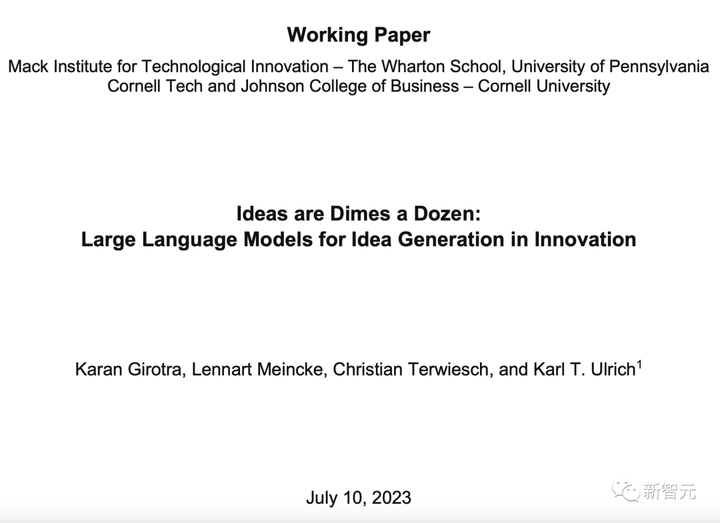
A study by researchers at Cornell Tech and the Wharton School of the University of Pennsylvania compared ChatGPT 4 to humans, a control group of “students attending elite universities.”
 Although students are not admitted to “elite universities” on the basis of creativity, they are undoubtedly admitted, at least in part, on the basis of IQ and academic performance. They are likely to far exceed the population average on nearly every measure of intellectual ability.
The student data was collected in 2021, before generative AI became widely available, so it can be argued that the data is partly an expression of pure human creativity.
Because, without restricting the use of AI tools by restricting the human control group, the study of humans and AI will quickly become difficult, because any bright student may use AI tools on similar tasks.
The researchers assigned students and AI a task at the same time:
“You are an entrepreneur looking for an innovative start-up to generate a new product idea. The product is aimed at college students in the US. It should be a physical commodity, not a service or software.
The retail price of this product can be less than about $50. A product doesn’t necessarily need to already exist, nor does it necessarily have to be explicitly available. "
This process is similar to the ideation process for generating new products in real companies, since the researchers do not want to limit the original idea of the product.
In fact, ideas that seem impossible at first may often be produced after engineers think about them, and may eventually achieve great commercial success.
After simple fine-tuning of the brainstorming results, the researchers first let the AI independently generate 100 ideas, then showed it a sample of good ideas, after which it generated 100 more ideas.
The first finding of the study is that AI is much more efficient than humans at generating ideas. ChatGPT generated 200 product ideas in 15 minutes, while the average human performance was to generate 5 ideas of the same level in the same time.
In other words, ChatGPT is 40 times more efficient than humans in generating ideas, with a performance improvement of 3900%.
But when it comes to product ideas, the quantity of ideas is far less important than the quality. After all, bad ideas are useless.
The researchers measured the quality of the ideas by having 20 human judges rate each idea, who rated how interested they were in buying the product described by the idea.
The judges were scored on a scale of 0-1 based on their purchase intent, with human-generated product ideas scoring 0.40. While ChatGPT’s idea scores are 0.47 (ideas generated independently) and 0.49 (ideas generated after showing good examples).
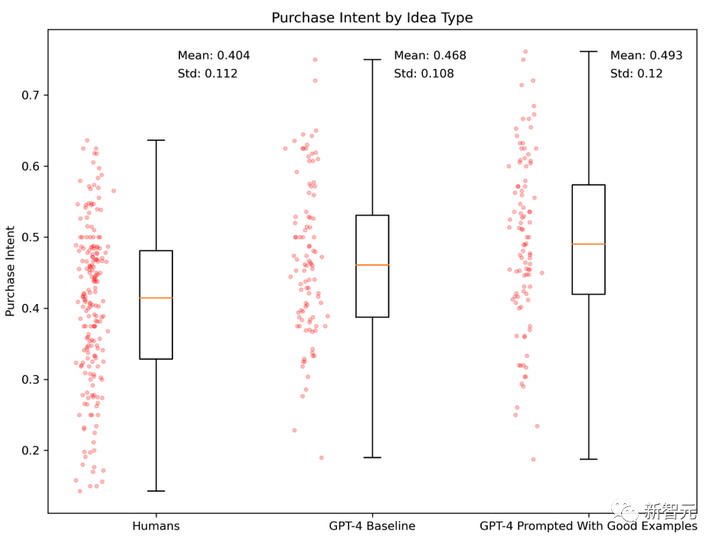 The difference between AI and humans is significant (p<0.001), while the difference in the scores of the two AIs is not.
But as discussed above, the average idea quality score is not important, most bad or mediocre ideas are actually worthless.
Therefore, it is more important to consider good ideas (defined here as the top 10%) and the best idea quality (ideas that may become actual products in a real business environment).
Here are the scores for the best ideas:
Humans: Top decile average score 0.62, best idea 0.64
ChatGPT not seeing examples of good ideas: top decile average score 0.64, best idea 0.70
ChatGPT seen examples of good ideas: top decile average score 0.66, best idea 0.75
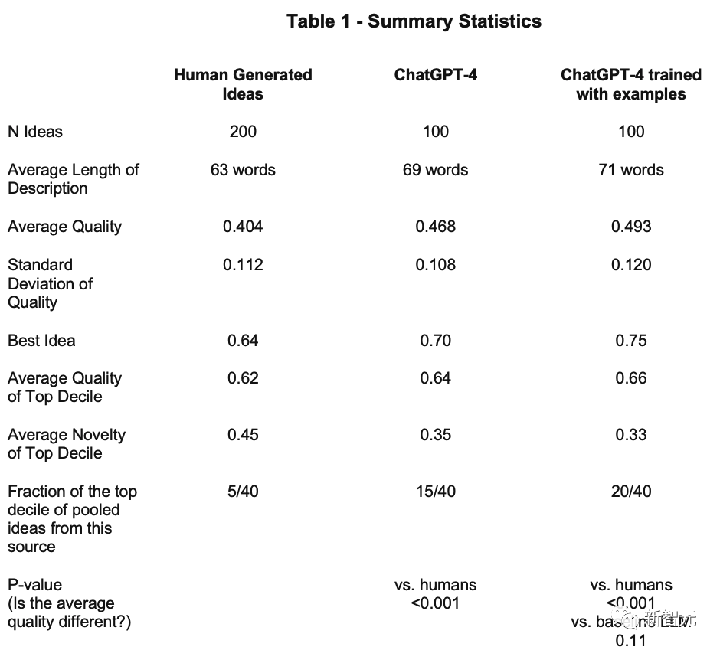 Under this evaluation standard, the difference between AI and humans is also significant (p<0.001), while the difference between the two AI scores remains insignificant.
Looking at the data from another angle, if we only look at the top 10% of the entire idea pool, whether it is human or AI-generated ideas, 87.5% of the best ideas come from ChatGPT, and only 12.5% come from college students.
Both groups contributed the same amount of original ideas, so this percentage difference is quite significant.
** In this data analysis, AI is 7 times more creative than humans! **
Humans are slightly better at novelty
Another measure of product creativity is novelty. A sufficiently novel product may not seem attractive at first, and it is only after a period of time in the market that consumers realize the benefits of these revolutionary ideas.
Creative novelty is the only thing humans do better than AI in this study of creativity.
On a scale of 0-1, humans had an average creative novelty score of 0.41, while the average AI scores were 0.37 and 0.36, respectively.
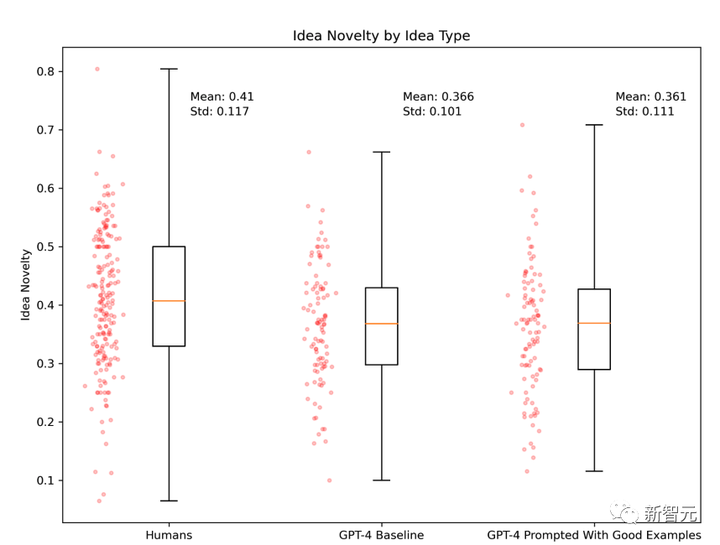 Again, the difference between the human and the AI is clear, but the difference between the two AI scores is not.
Study 2: ChatGPT 4 scores in the top 1% on the Torrens Creative Thinking Test, beating 99% of humans
Another study was done by researchers at the University of Montana, Vilnius University and the University of Montana Western Campus.
They took the Torrens Test of Creative Thinking (TTCT), the most widely used and most cited test of creativity. Our previous article gave a more detailed introduction to this research.
Research Three: Brainstorming Business Strategy Research
Similarly, ChatGPT’s performance in business strategy is also amazing.
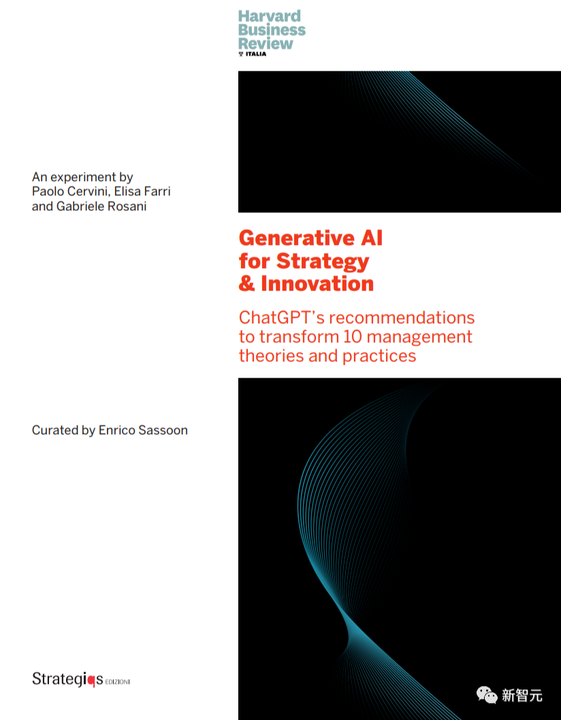
Capgemini Invent from Italy published a case study of using ChatGPT as a business partner in Harvard Business Review, and compiled the advice and planning given by it as an expert in related fields into a book.
 link address:
The researchers divided business strategy into five dimensions:
Value innovation, growth planning and practice, ecosystem platform and business, joint multi-stakeholder, open innovation.
Then let GPT-4 answer each field individually, that is, as an expert in the “vertical field”.
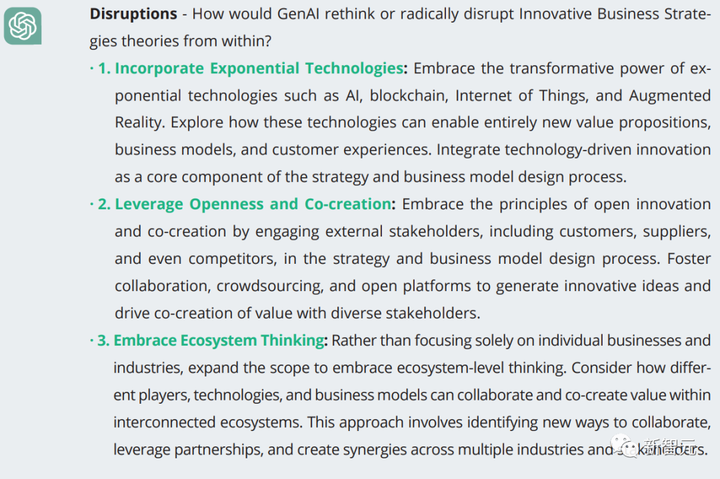
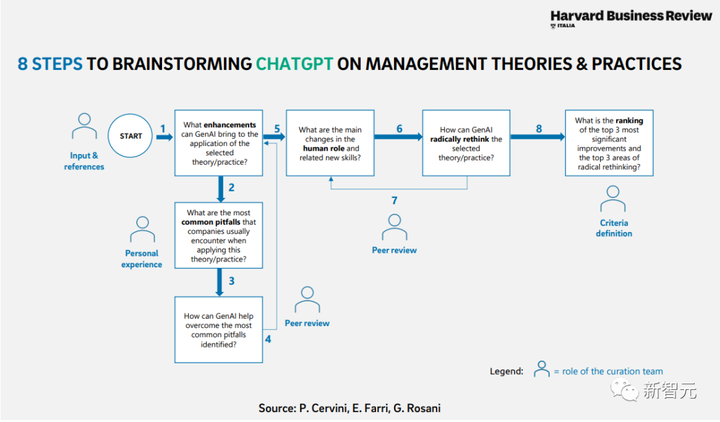 First of all, in terms of value innovation, ChatGPT answered from two perspectives: generative AI enhances existing business and subverts current business strategy theory.
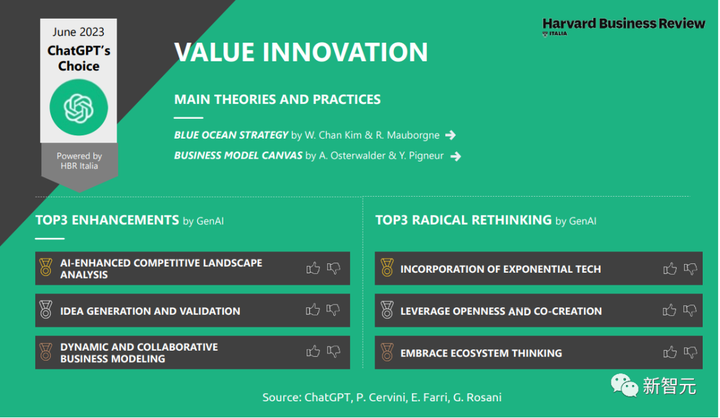 ChatGPT’s answer on how to enhance existing business includes AI-enhanced competition pattern analysis, idea generation and verification, dynamic and collaborative business modeling and other key points.
 This means generative AI can use historical data, market trends, and customer information to facilitate idea generation sessions. It can also help quickly conduct surveys and gather feedback to validate and refine new strategic ideas.
In addition, ChatGPT also proposed from the perspective of subverting the current business strategy theory: integration of exponential technology, openness and co-creation, and embracing ecosystem thinking, etc.
In this process, the role of people has changed from content producer to decision maker for evaluation and selection.
 As for the self-growth planning and practice that companies are most concerned about, ChatGPT’s performance is also quite good.
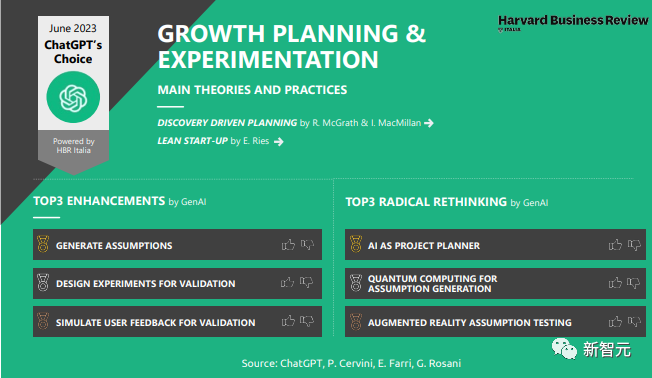 In the suggestion of generative AI to strengthen existing businesses, ChatGPT proposed that AI algorithms can autonomously generate diverse hypotheses based on large amounts of data and insights. At the same time, effective experimental design suggestions are provided and verified by simulating user feedback. These measures can accelerate the development of enterprises and reduce costs to the greatest extent.
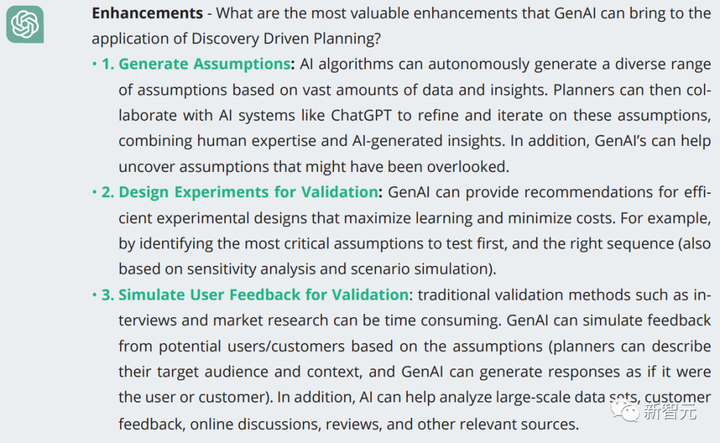 From the perspective of disruptive innovation, ChatGPT directly uses AI as the planner of the project, replacing human leaders.
It also uses the power of quantum computing to simultaneously explore all possibilities, generate corresponding foreground hypotheses, and test them immersively in simulations in augmented reality environments.
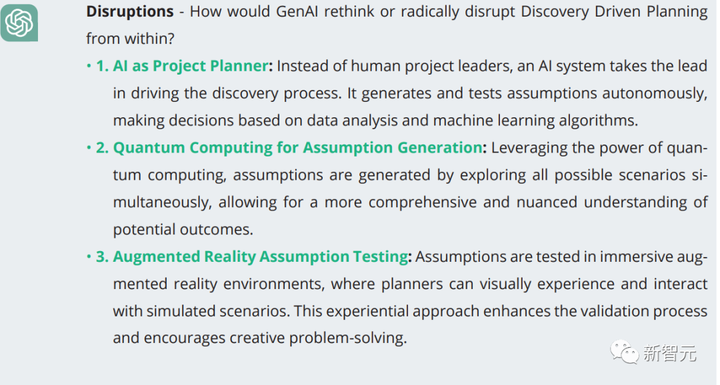 Open innovation plays an important role in business, enabling enterprises to cooperate more openly and flexibly with external parties, thereby achieving a higher level of innovation and competitiveness.
ChatGPT also makes interesting insights into the impact of generative AI on the theory and practice of open innovation.
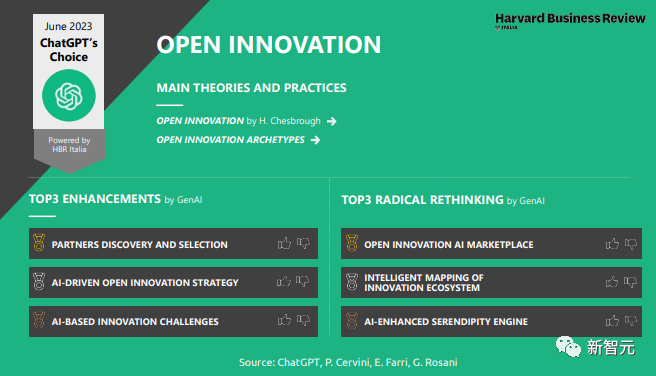 When considering what help generative AI can bring to the theoretical practice of open innovation, ChatGPT answered: Generative AI can analyze potential partners according to different criteria, thereby facilitating the process of discovery and selection.
In addition, generative AI can also identify and recommend the most open business segments, and use AI algorithms to promote idea generation, evaluation, and collaboration.
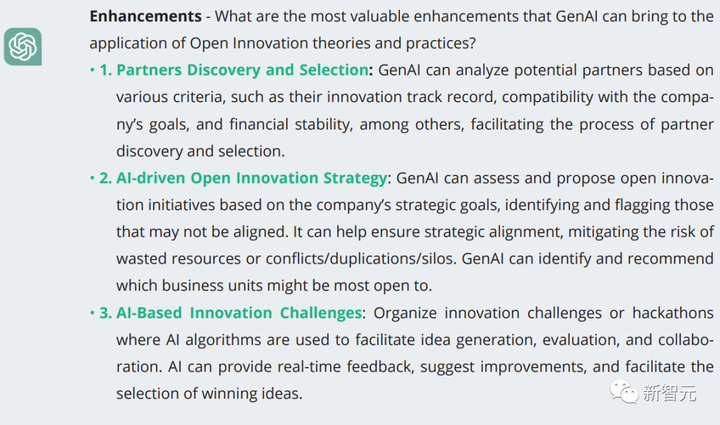 But from the perspective of breaking through the existing theory and practice, ChatGPT believes that it is possible to establish an AI-driven market, an intelligent mapping innovation ecosystem, and create an engine based on artificial intelligence algorithms to generate cross-field connections by analyzing a large number of different data. thereby promoting innovation and development.
 In other dimensions, such as ecosystem platform and business, and uniting multiple stakeholders, ChatGPT’s performance is also impressive.
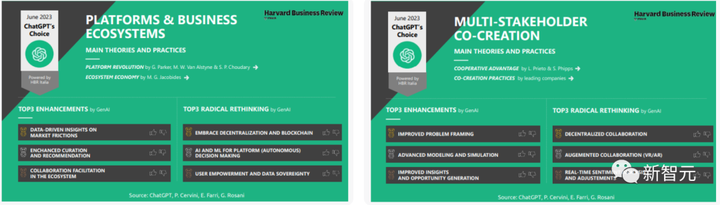 As a world-renowned corporate strategy consultant, Enrico Sassoon has a very high evaluation of the strategy and planning given by ChatGPT:
“ChatGPT has demonstrated impressive creativity, in some cases even better than many domain experts.”
However, he also warns:
“Having strong domain expertise and being critical is critical when evaluating responses and selecting generated items. This is necessary because ChatGPT tends to mix valuable insights with less valuable information. "
ChatGPT wrote an interesting fairy tale
After Nelson introduced the three cases, he also conducted an interesting experiment.
 Inspired by this picture, he asked ChatGPT to write a children’s story about “a wildebeest who thought he was an impala”.
In the opinion of the author Nelson, this is a fascinating story that shows perfect writing skills.
ChatGPT has crafted lovely plots and twists that turn a simple cue word into a short essay that many kids are sure to love.
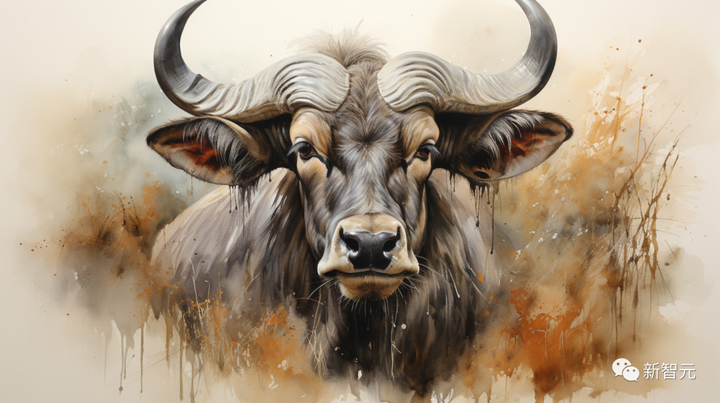 Wildebeest generated by Midjourney
Once upon a time, on the vast grasslands of Africa, there lived a young wildebeest named Wally. Wally is no ordinary wildebeest; he’s different because he thinks he’s a gazelle.
Every morning, Wally tries to jump as high as his neighbor. He envied their smooth fur and quick speed. He even tried chewing on the leaves, like they do, though he prefers the taste of grass.
One sunny day, Wally decided to join the impala herd for a drink of water. They are jumping and playing. Wally eagerly attempted a jump, but instead of doing it gracefully, he stumbled and fell, with a loud “bang.”
The impalas stopped to look at it, confused. “Wally, why are you jumping like us?” asked Ina, the leader impala.
Wally said shyly, “I want to be an impala like you because you’re elegant and fast. I’m just a clumsy wildebeest.”
Ina smiled softly. “Wally, you have a strength that we impalas don’t have. You are strong and resilient. You are part of a huge herd, marching together as one, bravely crossing a river full of crocodiles. This is us impalas. Antelope can’t do it.”
Wally paused, thinking about Ina’s words. It realizes that it is special. Embracing his own identity, Wally returns to his herd with renewed confidence.
From that day on, Wally was proud to be a wildebeest. It learns to like how unique it is and understands that everyone has their own strengths. And this, my dear friends, is the story of a wildebeest who once wanted to be an impala.
Summarize
It must be amazing when different researchers at different institutions use different methods and measure different details and come up with the same results.
The comprehensive study presented in this article is more credible than some individual studies that may be flawed.
Nelson believes AI can be creative and should be used to accelerate idea generation, whether in his field of user experience design or in other industries.
The contribution of AI in creativity also includes improving the creativity of the elderly, because the number of ideas is not important, but how you choose the final idea and how you specifically execute it in the process of improving it.
We put more original ideas into this creative “sausage machine”, and the final sausage will be more delicious.
Nelson argues that whether the reader thinks the metaphor is creative or not, it was his own and my aging brain’s. But in the past few months, he’s picked up a host of other good ideas from AI.
It is important to acknowledge the role AI can play in the work of humans.
By taking on the heavy lifting of idea generation, it enables humans to focus on critical thinking and judgment tasks, prolonging productive human careers. After age 50, cognitive decline significantly reduces unaided creativity. Improve overall efficiency.
He believes in a symbiotic relationship between humans and artificial intelligence. Both sides have roles to play, and that’s true in terms of creativity as well.
Let us move forward in this age of artificial intelligence, not in fear that we are outdated.
Please look forward to the infinite possibilities presented by the symbiotic relationship between powerful AI and human creativity.
References:


