
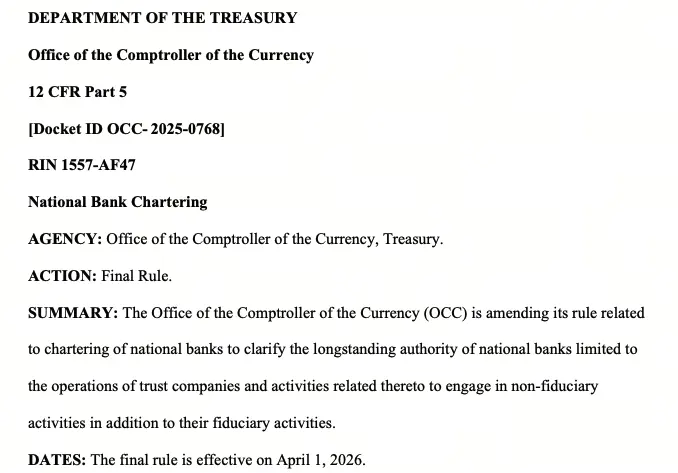
The Office of the Comptroller of the Currency (OCC) announced revisions to regulations related to national bank charters, officially permitting national trust banks to engage in non-trust activities while performing trust duties, thereby eliminating previous industry concerns about the compliance of such activities. For Ripple, Circle, and other companies that have conditionally received national trust bank licenses, this regulation opens a crucial pathway into the U.S. banking system.
OCC Revises Trust Bank Regulations: Key Policy Insights
 (Source: OCC)
The final OCC regulation confirms that national trust banks can conduct ancillary banking activities beyond solely trust services. Previously, there was industry concern: whether companies holding trust charters had the authority to engage in broader banking operations. The OCC’s final ruling explicitly answers this question — yes, they can.
Major crypto companies with conditional OCC trust bank licenses
Ripple: Expanding crypto asset custody services; recently partnered with Figment to extend custody to staking services on Ethereum and Solana.
Circle: USDC stablecoin issuer; leveraging this to strengthen its business presence within the U.S. banking compliance framework.
Paxos: Deepening its involvement in blockchain settlement; expanding institutional services through bank system integration.
This is a significant policy victory for the cryptocurrency industry, which has actively advocated for the finalization of these rules. Such integration further accelerates the convergence of cryptocurrencies and traditional finance (TradFi).
Federal Reserve’s Simplified Master Account Program: The Next Step for Crypto Access to Payment Systems
In addition to OCC policies, the Federal Reserve is advancing a “Simplified Master Account” plan, which, if implemented, would allow companies like Ripple and Circle limited access to the Fed’s payment system. Fed Governor Chris Waller proposed this plan, with plans to announce related regulations in Q4 of this year.
However, this plan faces clear resistance. The crypto industry and banking sector are at odds; banks believe crypto companies should not have direct access to the Fed’s payment system, and the Colorado Bankers Association has warned that such accounts could facilitate rapid fraud.
Fed Governor Michelle Bowman stated during a Senate Banking Committee hearing that the Fed is working with other banking regulators to develop regulations covering capital and liquidity requirements for stablecoin issuers (including those mandated by the GENIUS Act), clarifying which digital asset activities are permitted, and is open to providing regulatory feedback on new use cases. The regulatory framework for crypto companies entering the U.S. banking system is gradually taking shape, though final rules will take time to implement.
Frequently Asked Questions
Q: What does the OCC new regulation mean for Ripple?
A: The OCC allows national trust banks to engage in non-trust activities (including non-trust custody services), enabling Ripple, which has received conditional approval, to hold and manage customer crypto assets within a compliant framework without traditional fiduciary responsibilities. This provides a clear legal basis for Ripple’s entry into the U.S. banking system and expansion of institutional custody services.
Q: Besides Ripple, which other crypto companies benefit from the OCC new regulation?
A: Circle, Paxos, and Crypto.com have also received conditional approval for OCC national trust bank licenses, benefiting from this regulatory revision alongside Ripple, marking the first tier of crypto firms integrating into the regulated U.S. banking system.
Q: How are the Fed’s Simplified Master Account plan and the OCC regulation related?
A: Both are complementary pathways for crypto companies to access the U.S. financial system. The OCC regulation addresses the scope of trust bank activities; the Fed’s plan further allows these companies to directly connect to the payment system, though it faces greater resistance from the banking industry and is still under development.
Disclaimer: The information on this page may come from third parties and does not represent the views or opinions of Gate. The content displayed on this page is for reference only and does not constitute any financial, investment, or legal advice. Gate does not guarantee the accuracy or completeness of the information and shall not be liable for any losses arising from the use of this information. Virtual asset investments carry high risks and are subject to significant price volatility. You may lose all of your invested principal. Please fully understand the relevant risks and make prudent decisions based on your own financial situation and risk tolerance. For details, please refer to
Disclaimer.
Related Articles
WLFI releases AI-powered open-source payment toolkit AgentPay SDK
Gate News reports that on March 20, WLFI announced the launch of an open-source payment toolkit for AI agents, AgentPay SDK. The SDK is built on USD1, integrating self-hosted key management functionality and policy-based transaction authorization mechanisms, and can be integrated with commonly used AI development tools such as Claude Code, Codex, Cursor, and OpenClaw.
GateNews13m ago
World Gold Council Partners with BCG to Release Tokenized Gold Shared Framework, Directly Takes On Tether and Paxos
The World Gold Council and Boston Consulting Group released a white paper proposing a "Gold as a Service" framework aimed at standardizing the issuance and management of tokenized gold, challenging the existing market dominated by Paxos and Tether. The framework will lower barriers to entry and encourage greater institutional participation. However, implementation timelines and specific plans remain unclear, and whether the WGC's brand influence can shake up the existing market remains to be seen.
動區BlockTempo19m ago
Figure Launches Figure Forge Service to Mint Crypto Loans and RWAs into Standardized Participation Tokens
Figure co-founder Mike Cagney announced the launch of the Figure Forge service, which aims to turn blockchain-native loans and other RWAs into participation tokens. The service will be used in the Democratized Prime DeFi market and will offer additional yields through the Hastra protocol, with the liquidity limit order book funded by Figure.
GateNews28m ago
Monero Core Developer Releases Q1 Development Plan Proposal Covering 7 Tasks Including Wallet API and FCMP++
Monero core developer jeffro256 released the first quarter development plan on March 20, which includes proposals for wallet API changes, support for Carrot-derived accounts, the launch of the FCMP++ stress test network, collaboration with hardware wallets, and multisignature implementation.
GateNews47m ago
World Chain Adopts Smart Agent Commerce Application Standard ERC-8183
World Chain announces adoption of ERC-8183 standard, which supports smart agent commercial applications and was jointly released with the Ethereum Foundation team. ERC-8183 emphasizes custodial mechanisms for on-chain smart contracts, with task flows passing through four major states to ensure trustless transactions.
GateNews1h ago
Aave Mantle Market Total Size Breaks Through $1.34 Billion, Becoming the Third Largest Lending Market on the Aave Platform
Gate News: As of March 20, Aave V3 has experienced continuous rapid growth since its launch on the Mantle mainnet on February 11. Data shows that the market size broke through $400 million in the first week, exceeded $550 million in the second week, and surpassed $1 billion in the third week. As of now, the total market size of Aave Mantle has exceeded $1.34 billion, making it the third-largest lending market on the Aave platform, and it continues to grow.
GateNews1h ago


