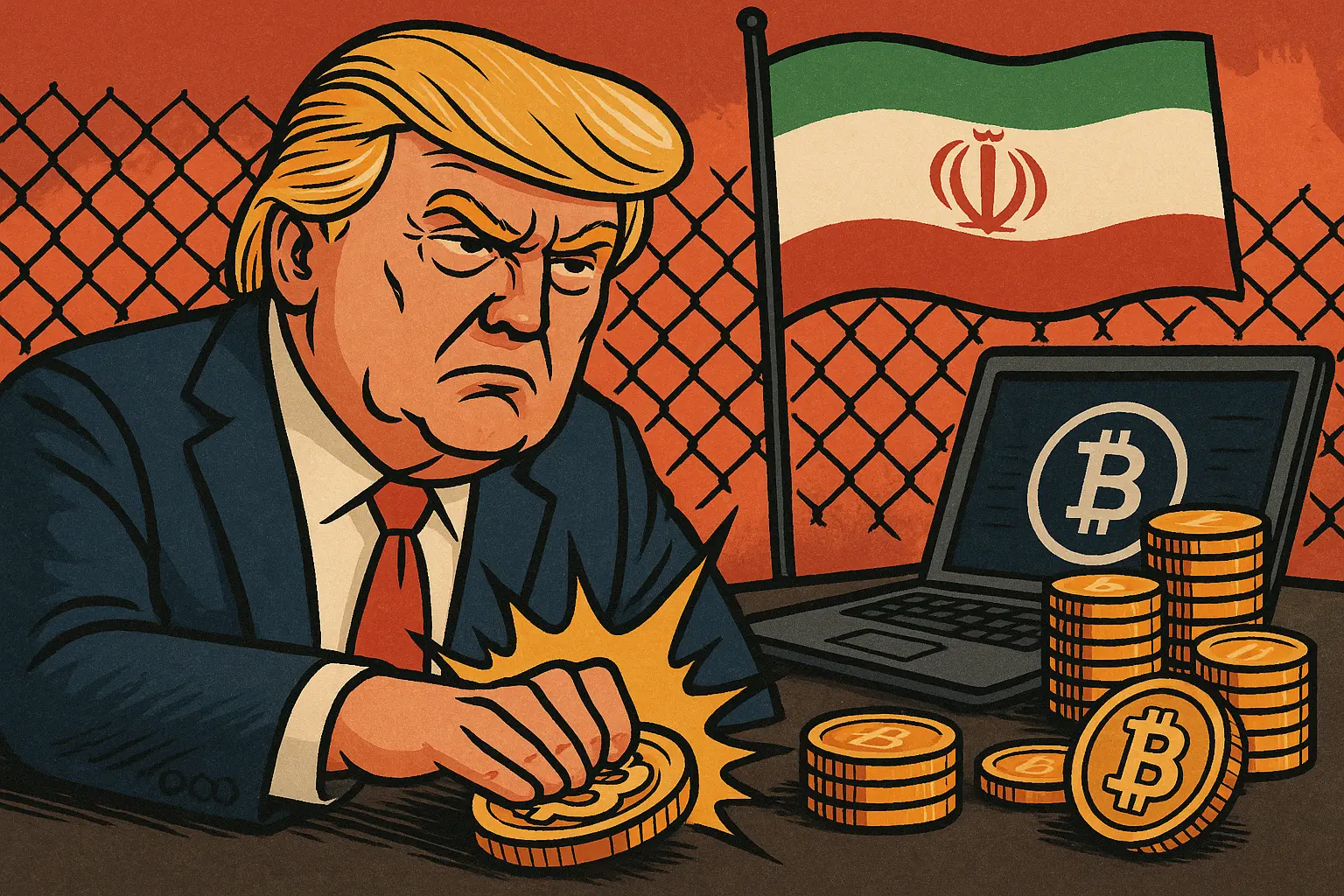
The Trump administration on Friday imposed sanctions through OFAC against the UK-registered cryptocurrency exchanges Zedcex and Zedxion, citing their facilitation of transactions for Iran’s Islamic Revolutionary Guard Corps (IRGC). This marks the first time the United States has blacklisted digital asset exchanges. Since 2022, Zedcex has processed over $94 billion in transactions, primarily through Tether’s USDT on the Tron platform.
The Trump Administration’s First Sanctions on Cryptocurrency Exchange Entities
Friday’s sanctions represent a major shift in Trump’s approach to regulating cryptocurrency exchanges. The U.S. Department of the Treasury’s Office of Foreign Assets Control (OFAC) announced that Zedcex and Zedxion processed funds for the IRGC, which is designated as a terrorist organization by both the U.S. and the European Union. The agency also sanctioned Iranian financier Babak Morteza Zanjani, accusing him of funding IRGC-related activities after his release from prison.
While OFAC has previously sanctioned individual crypto wallet addresses and technology providers related to sanctions evasion, this is the first time it has blacklisted entire exchange entities under Iran-related financial sanctions regulations. This “first” is highly significant because it indicates that the Trump administration is elevating its crypto enforcement from targeting specific addresses and tech providers to imposing systemic bans on entire platforms.
The Treasury stated that since registering in August 2022, Zedcex has processed over $94 billion in transactions, with both exchanges handling large volumes for counterparties linked to the IRGC. This staggering figure is comparable to the annual GDP of many mid-sized countries, highlighting the central role these platforms play in Iran’s sanctions evasion networks.
U.S. Treasury Secretary Scott Bessent said: “The Department will continue to target Iran’s networks and corrupt elites who enrich themselves at the expense of the Iranian people. This includes the regime’s attempts to use digital assets to evade sanctions and fund cybercriminal activities.” This statement clearly shows that the focus of Trump’s crypto regulation is not only on compliance but also on national security and counter-terrorism efforts.
Zanjani’s Money Laundering Network in the Crypto Realm
These transactions are linked to Zanjani, whom the U.S. Treasury describes as “an Iranian criminal investor who embezzled billions of dollars in Iranian oil revenues.” Zanjani is notorious in Iran’s financial circles; he was previously convicted and sentenced to death for embezzling billions from the National Iranian Oil Company. According to the Treasury, Zanjani was released after his death sentence was commuted in 2024, “aiming to launder money for the Iranian regime.”
Zanjani’s case reveals how Iran’s elite use cryptocurrencies to rebuild financial channels cut off by traditional banking systems. In conventional finance, individuals with criminal records like Zanjani are almost impossible to move large sums of money, but the anonymity and cross-border nature of crypto exchanges provide new operational avenues. This is the core challenge that Trump’s crypto regulation policy aims to address.
Earlier this month, blockchain analytics firm TRM Labs reported that since 2023, these two exchanges have handled approximately $1 billion related to IRGC funds, accounting for 56% of their total trading volume. This proportion is astonishing, indicating that over half of their business involves transactions linked to entities designated as terrorists by the U.S. and EU. Most of these funds are transacted via Tether’s USDT on the Tron platform.
Operational Characteristics of the Zanjani Network
USDT as the Main Tool: Facilitating large-scale fund transfers using Tether’s stablecoin due to its liquidity and widespread acceptance.
Tron as the Main Channel: Chosen because of its low transaction fees and fast speeds, suitable for high-frequency, large transfers.
UK Registration as a Cover: Registering in the UK provides a veneer of legitimacy, but actual operations are concentrated within Iran’s financial network.
The widespread use of USDT and Tron in Iran’s sanctions evasion network raises questions about the compliance responsibilities of Tether and Tron blockchain projects. Although these platforms themselves have not been sanctioned, the fact that their infrastructure is used to fund terrorist organizations may compel regulators to impose greater monitoring and reporting obligations.
Increasing Scrutiny of Iran’s Cryptocurrency Activities
Amid tightening controls over Iran’s crypto activities, these sanctions were enacted. Blockchain analysis firm Elliptic reported earlier this month that the Central Bank of Iran purchased at least $507 million worth of USDT, apparently to support the collapsing rial. This discovery reveals how the Iranian government is leveraging cryptocurrencies at the national level to counteract economic pressures from U.S. sanctions.
The Iranian rial has depreciated sharply over recent years due to sanctions and domestic economic issues, causing severe inflation and loss of purchasing power for ordinary Iranians. The Central Bank’s USDT purchases aim to provide a relatively stable store of value and bypass traditional banking sanctions. However, this state-led use of cryptocurrencies also makes Iran more vulnerable to sanctions targeting crypto infrastructure.
This move by Trump’s crypto policy is not isolated but part of broader sanctions strategies against Iran. The Friday announcement also targeted senior Iranian officials, including Interior Minister Eskandar Momeni Kalaghariha, responsible for commanding security forces and suppressing protests. This indicates that the Trump administration is linking crypto sanctions with human rights issues, attempting to exert multidimensional pressure to influence Iran’s behavior.
The U.S. Treasury said it has sanctioned over 875 individuals, vessels, and aircraft related to Iran’s sanctions evasion networks, with sanctions effective until 2025. U.S. citizens are prohibited from conducting business with any sanctioned persons or entities. This extensive sanctions network reflects the “maximum pressure” strategy, aiming to cut off Iran’s funding sources entirely.
Due to difficulties in reporting news from Iran, the death toll from protests is hard to quantify, but some media estimate that tens of thousands of protesters have been killed by the Iranian government in recent weeks. The Trump administration links sanctions to Iran’s violent suppression of protests, seeking to bolster its moral authority internationally while applying economic and political pressure on the regime.
Implications for Global Cryptocurrency Exchanges
This sanctions action sends a strong warning to crypto exchanges worldwide. The unprecedented move of blacklisting entire exchange entities signals that the U.S. government is raising its compliance demands. For international exchanges, claims of “lack of knowledge” or “technological neutrality” may no longer be sufficient defenses. TRM Labs’ report shows that 56% of the trading volume involves IRGC-related entities, a proportion unlikely to occur without the exchanges’ awareness or acquiescence.
Trump’s crypto policy may push global exchanges to strengthen KYC (Know Your Customer) and AML (Anti-Money Laundering) procedures. For exchanges seeking access to the U.S. market or partnerships with U.S. entities, establishing more rigorous transaction monitoring systems to identify and block sanctioned entities will be necessary. While this may increase operational costs, it is essential for mainstream integration.
Additionally, stablecoin issuers and blockchain projects may face increased regulatory scrutiny. Although Tether and Tron are not sanctioned themselves, their widespread use in sanctions evasion could prompt regulators to require these platforms to take more proactive measures to prevent abuse. This might include implementing blacklists at the protocol level or sharing more transaction data with law enforcement agencies.
Disclaimer: The information on this page may come from third parties and does not represent the views or opinions of Gate. The content displayed on this page is for reference only and does not constitute any financial, investment, or legal advice. Gate does not guarantee the accuracy or completeness of the information and shall not be liable for any losses arising from the use of this information. Virtual asset investments carry high risks and are subject to significant price volatility. You may lose all of your invested principal. Please fully understand the relevant risks and make prudent decisions based on your own financial situation and risk tolerance. For details, please refer to
Disclaimer.


