As an Arctic storm front batters multiple U.S. states, bitcoin mining activity across the country has pulled back sharply, with American-based operators scaling down operations to ease pressure on the power grid during a difficult stretch. As a result, Bitcoin’s network hashrate has declined notably, with current data placing total hashpower between 800 and 875 exahash per second (EH/s) over the past day.
Six-Day Slide: Bitcoin Hashrate Loses Nearly 250 EH/s During Arctic Blast
The Arctic storm front in late January 2026 is bearing down hardest on the South and the lower Ohio Valley, with the most severe conditions centered on Tennessee, Texas, Louisiana, Mississippi, Kentucky, Georgia, Alabama, and West Virginia. Several of these states host sizable clusters of bitcoin mining facilities, with Texas standing out in particular.
Three days ago, Bitcoin.com News reported that the world’s largest mining pool, Foundry USA, curtailed a significant portion of its hashrate in preparation for the storm after theminermag.com shared an update last week. Since then, the downward trend in hashrate has persisted. When measured using a three-day simple moving average (SMA) across a one-year window, Bitcoin has shed 385 EH/s since Oct. 15, 2025.
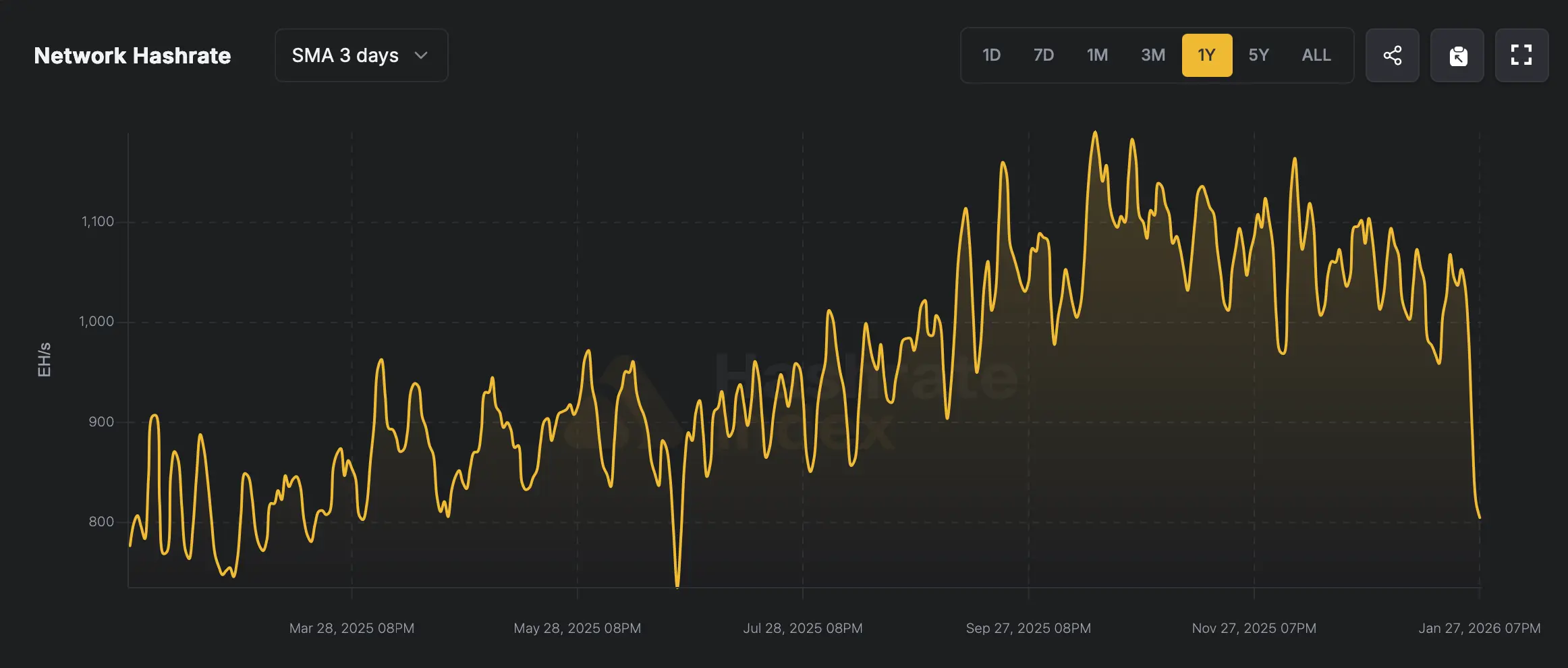 Bitcoin’s overall hashrate using the three-day SMA over a one-year timeframe via hashrateindex.com.
However, network data compiled by hashrateindex.com shows that the sharpest decline really unfolded after Jan. 22, 2026. On that date, total hashrate measured 1,053 EH/s, and today it sits at 805 EH/s using the three-day SMA. In practical terms, of the full 385 EH/s decline from the Oct. 15, 2025 all-time high of 1,190 EH/s, roughly 248 EH/s disappeared between Jan. 22 and Jan. 28.
Bitcoin’s overall hashrate using the three-day SMA over a one-year timeframe via hashrateindex.com.
However, network data compiled by hashrateindex.com shows that the sharpest decline really unfolded after Jan. 22, 2026. On that date, total hashrate measured 1,053 EH/s, and today it sits at 805 EH/s using the three-day SMA. In practical terms, of the full 385 EH/s decline from the Oct. 15, 2025 all-time high of 1,190 EH/s, roughly 248 EH/s disappeared between Jan. 22 and Jan. 28.
As noted in our report, the slowdown in hashrate has pushed block intervals well beyond the usual 10-minute target. Average block times exceeded 12 minutes when that report was published and continue to hover at 12 minutes and 12 seconds. If this pace holds, the difficulty epoch arriving around Feb. 8, 2026, would rank among the largest adjustments seen in years.
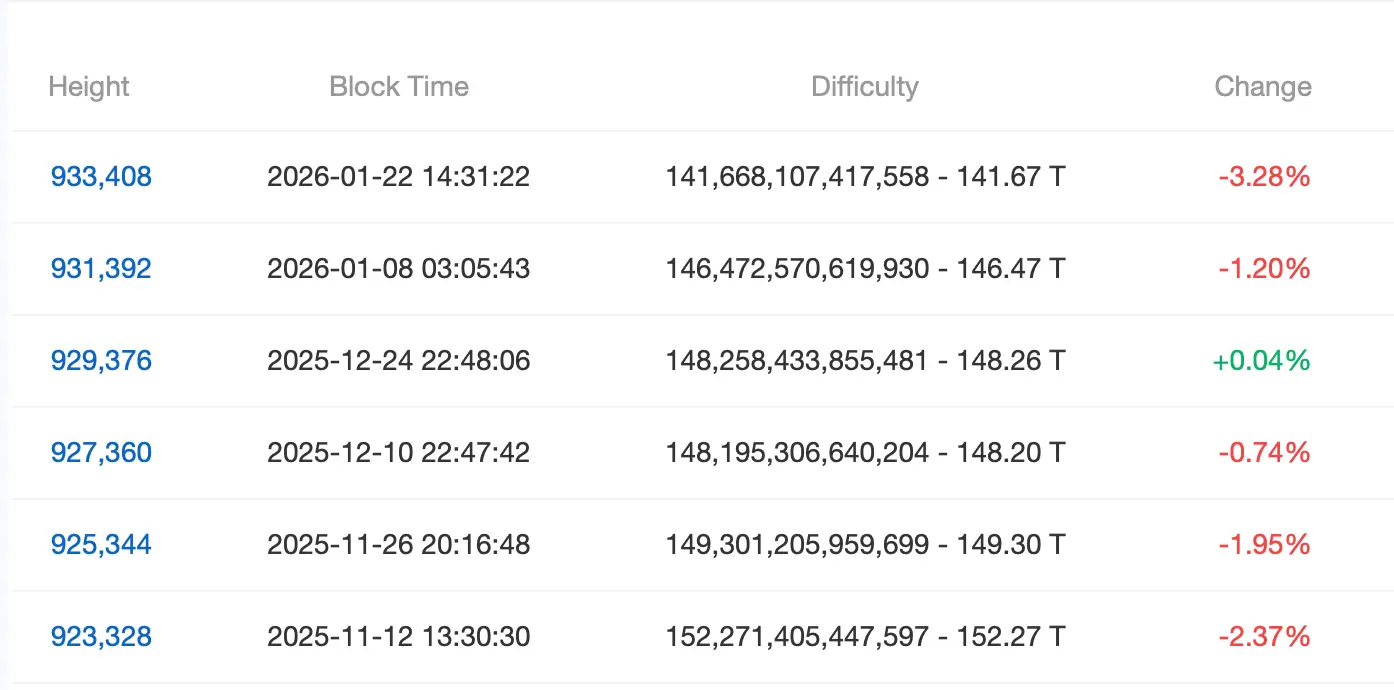 Out of the last six epochs, the difficulty has dropped five times and the increase on Dec. 24, 2025, was modest 0.04%.
At present, hashrateindex.com and other tracking platforms are projecting a difficulty reduction of more than 18%. That outcome remains highly plausible, as the Arctic storm front moving across the U.S. is expected to persist into early next week, uncomfortably close to the upcoming difficulty epoch. Should the hashrate recover and block times normalize before the adjustment, the projected drop would shrink in size, but for now, the data points toward a record-setting difficulty drop.
Out of the last six epochs, the difficulty has dropped five times and the increase on Dec. 24, 2025, was modest 0.04%.
At present, hashrateindex.com and other tracking platforms are projecting a difficulty reduction of more than 18%. That outcome remains highly plausible, as the Arctic storm front moving across the U.S. is expected to persist into early next week, uncomfortably close to the upcoming difficulty epoch. Should the hashrate recover and block times normalize before the adjustment, the projected drop would shrink in size, but for now, the data points toward a record-setting difficulty drop.
Also read: Crypto ETFs Falter as Bitcoin, Ether See Combined Exit of $211 Million
For bitcoin miners grappling with softer BTC exchange rates and thin hashprice-based revenue, the timing could hardly be better. Such a sizable difficulty adjustment would offer immediate relief by easing competitive pressure and improving the odds of earning block rewards with the same infrastructure. In an environment where margins have been tight, even a temporary improvement in network conditions could translate into a meaningful boost to operating efficiency and near-term profitability.
FAQ ⛏️
- Why is Bitcoin’s mining difficulty expected to drop in early Feb. 2026?
A sharp slowdown in hashrate and longer block times following U.S. storm-related mining curtailments has pushed the network toward a sizable downward adjustment.
- How large could the upcoming Bitcoin difficulty change be?
Current estimates from hashrateindex.com suggest the difficulty could fall by more than 18% if network conditions remain unchanged.
- What caused Bitcoin’s hashrate to decline so quickly in late January?
An Arctic storm front across major U.S. mining states forced operators, especially in Texas, to scale back activity to relieve stress on power grids.
- Why does a difficulty drop matter for Bitcoin miners?
Lower difficulty reduces competition per block, improving mining efficiency and revenue potential during periods of weaker hashprice.
Disclaimer: The information on this page may come from third parties and does not represent the views or opinions of Gate. The content displayed on this page is for reference only and does not constitute any financial, investment, or legal advice. Gate does not guarantee the accuracy or completeness of the information and shall not be liable for any losses arising from the use of this information. Virtual asset investments carry high risks and are subject to significant price volatility. You may lose all of your invested principal. Please fully understand the relevant risks and make prudent decisions based on your own financial situation and risk tolerance. For details, please refer to
Disclaimer.
Related Articles
BTC rises 0.58% in 15 minutes: whale large-capital transfers and derivatives defensive positioning drive spot buying
2026-04-20 06:30 to 2026-04-20 06:45 (UTC), the BTC price recorded a +0.58% return rate. The candlestick range was 74347.7 to 74898.0 USDT, with an amplitude of 0.74%. During this period, market attention increased because large orders and on-chain capital flow showed abnormal fluctuations, resulting in a higher overall volatility.
The main driver behind this anomalous move is whale entities concentrating large withdrawals and transfers targeting exchanges. Over the past 24 hours, the total reached 3,824 BTC, directly reducing the exchange’s BTC liquidity and bringing increased buy pressure to the spot market. On-chain data shows that the value of large transfers per transaction exceeding 1 million US dollars rose significantly during this window. As exchange immediate liquidity contracted, it pushed the BTC price upward in the short term. In addition, the derivatives market’s positioning structure changed: total futures open interest (OI) fell, and some defensive options positions shifted toward spot buying, further strengthening upside momentum.
Second, overall market liquidity remains in a fragile range. Order book data shows that large market buy orders were heavily concentrated, and buy-side depth increased noticeably. Meanwhile, in the same period, market Mempool activity and on-chain transaction fees were at low levels, and trading activity declined—making the impact of large single transfers and buy orders on price more pronounced. At the same time, leveraged funds leaving the derivatives market and options’ “maximum pain” strike price being below the spot price increased the spot market’s sensitivity to volatility. With multiple factors converging, the short-term upward price impulse was amplified.
Currently, market liquidity risk is rising, and in the short term the price is dominated by large buy orders in the order book and on-chain whale liquidity. Traders should continue to monitor the direction of whale capital flows and changes in exchange reserves, and be alert to possible price pullbacks caused by capital returning. At the same time, the key support range (72,000–74,000 USDT), order book depth, and derivatives positioning structure remain the core monitoring indicators for near-term volatility. Investors should be mindful of the risks stemming from fragile short-term liquidity and keep an eye on more real-time market developments.
GateNews3m ago
Musk’s X introduces smart tags, driving $1 billion in global trading volume in 3 days
Musk’s social platform X rolled out a brand-new “Smart Cashtags” feature on the evening of April 15 (last Tuesday). On April 17, Nikita Bier, X’s product lead, announced that in just 3 days the feature drove about $1 billion in trading volume across global markets, based on aggregated data from X’s trading pilot program.
MarketWhisper18m ago
BTC 15-minute rise of 0.53%: Institutional derivatives adding positions drives a short-term rebound
Between 2026-04-20 01:30 and 2026-04-20 01:45 (UTC), the BTC spot price fluctuated within a narrow range of 74290.9 to 74709.7 USDT. Over the 15-minute period, the return was +0.53%, with a range of 0.56%. Overall market volatility increased, drawing attention, but the number of active on-chain addresses remained steady, with no sign of extreme capital movements.
The main driver behind this move is institutional capital inflows into mainstream futures platforms and adjustments to derivatives position structures, especially CME futures open interest (OI), which rose against the trend by 2.61%. Meanwhile, some institutions added to defensive hedges and positioned for short-term rebounds within the price consolidation range. In addition, short-term Put options trading on platforms such as Deribit was active: the main contracts were concentrated on near-term downside protection, indicating that derivatives capital has increased its allocation to defensive strategies and that the spot market has passively followed the upward move.
In addition, ETF funds recorded $1.87 billion in net inflows in Q1, easing the consecutive net outflow trend seen earlier before March and providing medium-term background support for spot prices. Although on-chain active addresses over 1 hour stayed in the 19500–19600 range without abnormal increases or decreases, structural behavior by institutions across the derivatives and ETF markets converged to push short-term price volatility higher. There were no signals of sell pressure from retail traders or major whales, and no large transfers or extreme liquidation events; overall momentum came from institutional-level maneuvering.
It is worth noting that the derivatives market Put/Call ratio remains on the high side. If the price cannot continue moving upward, short-term exit pressure could intensify at any time. With overall OI shrinking, the activity of leveraged funds in the market weakens. Going forward, it is important to focus on changes in derivatives positions, ETF fund flows, and the in-and-out movements of active capital on-chain in order to respond to the risk of sharp short-term volatility. For more market information, it is recommended to continuously track relevant data indicators and capital-level anomalies.
GateNews5h ago
BTC falls 0.44% in 15 minutes: ETF fund outflows and derivatives shorts add to the slide
From 21:45 to 22:00 (UTC) on April 19, 2026, the BTC price dropped by 0.44% within 15 minutes. The candlestick range was 74,366.1 to 74,789.3 USDT, with an amplitude of 0.57%. Short-term volatility was concentrated. During this period, the trading volume for large orders rose significantly, market attention increased, and volatility intensified.
The main driving force behind this deviation was that U.S. spot Bitcoin ETFs saw a large net outflow of $291 million over two days from April 18 to April 19. This reflected institutional funds pulling away in the short term, which led to a marked increase in sell pressure in the spot market. At the same time, BTC perpetual contract
GateNews8h ago
BTC falls below 74000 USDT
Gate News bot message, Gate market data shows that BTC has fallen below 74000 USDT, with a current price of 73979.6 USDT.
CryptoRadar8h ago
BTC dips slightly by 0.53% in 15 minutes: whale transfers increase sell pressure and amplified liquidity widen the short-term drop
From 17:45 to 18:00 (UTC) on 2026-04-19, within 15 minutes BTC’s spot price fell -0.53%, with a price range of 74648.4 to 75212.8 USDT and a swing of 0.75%. During this period, market attention increased, volatility clearly accelerated, and the magnitude of the abnormal move exceeded typical levels for the same timeframe.
The main driver behind this abnormal move was that large-whale accounts concentrated transfers of BTC to a certain major exchange; the All Exchanges Whale Ratio (EMA14) rose to a near-ten-month high, and sell pressure increased significantly in a short time, becoming a direct cause of the spot price decline.
GateNews12h ago


