
- The Ethereum Foundation has launched a new post-quantum (PQ) team, declaring PQ security a top strategic target for the network this year.
- Vitalik has warned that current cryptography will be breakable by quantum computers by 2030, although some like a16z have dismissed the threat.
The technology world is divided on how immediate a threat quantum computing is; some say it could be before the end of the decade, while others give it over 50 years. However, blockchain networks like IOTA and Aptos are working on post-quantum (PQ) security in advance, and the Ethereum Foundation has become the latest to launch a PQ initiative.
Justin Drake, a researcher with the Foundation, announced recently that it has launched a new PQ team led by Thomas Coratger, another researcher who has been at the Foundation for years. Coratger’s team will include the mind behind LeanVM, a proposed zero-knowledge virtual machine that accelerates scaling in post-quantum world.
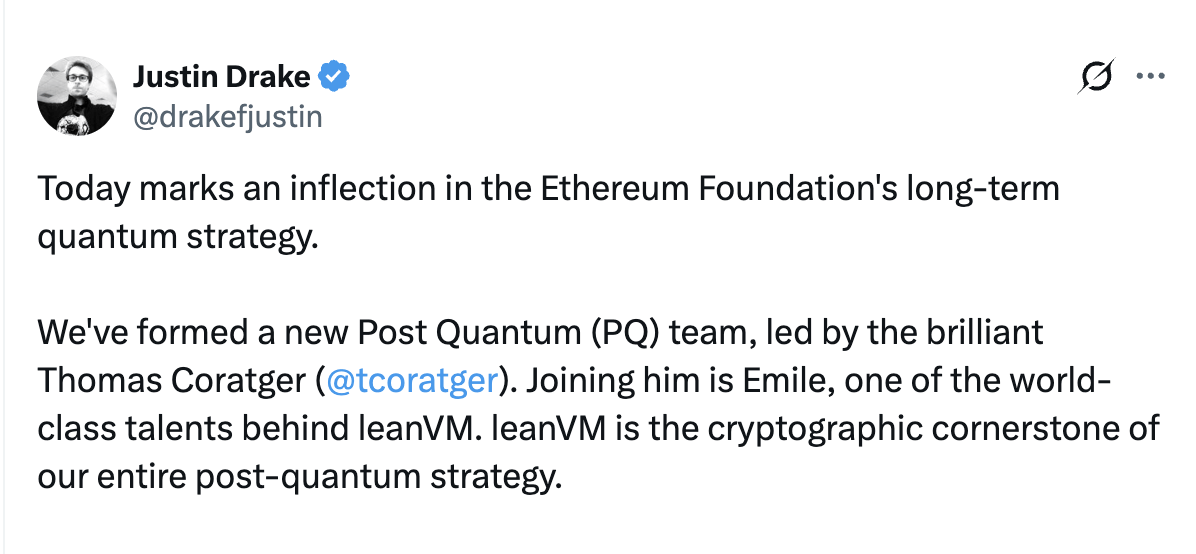
Image courtesy of Justin Drake on X.
While the Foundation is only now launching a dedicated team, Drake revealed that it has been at work since 2019, preparing for the rise of quantum computing. Founder Vitalik Buterin has been consistently calling on blockchain projects to speed up their pace as quantum computers are an existential threat. As we reported, he believes that they could break Ethereum and Bitcoin’s cryptographic techniques in four years.
To prepare for this future, researcher Antonio Sanso will begin a bi-weekly breakout call for all core developers starting next month. These calls will focus on “user-facing security, covering dedicated precompiles, account abstraction, and longer-term transaction signature aggregation with leanVM.”
Later this year, the Foundation will also host a PQ workshop, similar to the inaugural one, held last year in Cambridge. At the Ethereum conference in Cannes in March, there will also be a dedicated PQ day to discuss the latest developments.
Making Ethereum Post-Quantum Ready
The Foundation is also running multi-client PQ consensus development networks, which have brought together teams like Ream Labs and Zeam ETH, with the Foundation’s protocol coordinator Will Corcoran running the initiative.
As with any other development, education and awareness campaigns are vital to bringing more interested parties onboard. The Foundation has been working on a 6-part video series about its PQ strategy. It also joined the independent advisory board created by Coinbase last week.
To stimulate community engagement, the Foundation has announced a $1 million prize for the winners of its Poseidon challenge, which aims to strengthen the Poseidon hash function. It insists that despite the criticism, hash-based cryptography is still the way to go, although some like Cardano’s Charles Hoskinson have disagreed publicly. This is in addition to the existing $1 million Proximity Prize.
The new PQ team comes just as Optimism, a leading Layer 2 on Ethereum, unveiled its post-quantum roadmap. Optimism noted that if large-scale quantum computers arrive, “core cryptography in Ethereum and the Superchain could be at risk. Signatures and commitments are the foundation of the system. If those break, everything built on top is in trouble.”
While the entire tech world agrees that quantum computing is a systemic risk for crypto and finance, there’s major division on the timeline. Some like Vitalik believe it’s only a few years away. Others, like a16z Crypto, say these predictions are “frequently overstated.” The company, which has invested in almost every other major crypto project, says the cost of running these computers will be prohibitive, even if the technology itself matures faster than expected.
Ether trades at $2,900, dipping over** 1%** in the past day despite the trading volume skyrocketing by 240% to $32 billion.
Disclaimer: The information on this page may come from third parties and does not represent the views or opinions of Gate. The content displayed on this page is for reference only and does not constitute any financial, investment, or legal advice. Gate does not guarantee the accuracy or completeness of the information and shall not be liable for any losses arising from the use of this information. Virtual asset investments carry high risks and are subject to significant price volatility. You may lose all of your invested principal. Please fully understand the relevant risks and make prudent decisions based on your own financial situation and risk tolerance. For details, please refer to
Disclaimer.
Related Articles
ETH drops 0.76% in 15 minutes: Dual pressure from whales’ proactive deleveraging and ETF fund outflows
Between 07:15 and 07:30 (UTC) on 2026-04-19, the ETH spot price fluctuated in the 2298.13 to 2322.69 USDT range, with an amplitude of 1.06% and a return of -0.76%. During this period, market attention increased; the sharp drop in price triggered widespread user focus, along with a clear surge in trading volume within a short time, indicating a sudden escalation in liquidity pressure.
The main driver behind this deviation is that on-chain whale accounts actively sold ETH to repay DeFi platform borrowings in order to avoid forced liquidation. Based on on-chain tracking and fund-flow monitoring, from April 18 to 19, more than 42,000 ETH per-transaction large transfers were rapidly sent into a certain mainstream exchange, and at the same time there was a sharp spike in net inflows to the exchange. This concentrated sell pressure directly weakened spot market prices. Under proactive deleveraging behavior, selling pressure was released in the short term, creating a sudden market shock.
In addition, during the period of price deviation, the ETH derivatives market saw a significant rise in passive liquidation volume, especially as leveraged long positions encountered strong liquidations during the price decline, further increasing supply pressure in the spot market. Meanwhile, ETH spot ETF funds continued to see net outflows; in mid-April, there were multiple days with single-day outflows exceeding $40-50M, with the largest single day reaching $200M. This reflects a warming of short-term institutional risk-avoidance sentiment, which led to a deeper shift downward in buy-side liquidity depth. The launch of a new public chain ecosystem also attracted some ETH liquidity migration, further weakening the capital protection layer of the mainnet. Multiple structural feedback effects amplified the downside move.
At present, leverage risk in the ETH market remains prominent. Some whales still have large borrowings outstanding; if the price continues to move downward, potential liquidation risks may flare up again. ETF fund flows, on-chain large transfers, and capital-attraction moves tied to the new-chain ecosystem all need close monitoring. With increased short-term volatility risk, it is recommended to watch key support zones, exchange net inflow indicators, and DeFi on-chain liquidation dynamics in order to promptly grasp the latest market signals.
GateNews42m ago
ETH breaks below 2300 USDT
Gate News bot message, Gate market data shows that ETH has broken below 2300 USDT, with the current price at 2298.67 USDT.
CryptoRadar52m ago
ETH drops 0.58% in 15 minutes: derivatives liquidity contraction and proactive position reduction dominate short-term pullback
From 2026-04-19 04:30 to 2026-04-19 04:45 (UTC), within ETH’s 15-minute candlestick chart, the return recorded -0.58%, and the price range was 2321.62 to 2342.04 USDT, with an amplitude of 0.87%. The short-term selloff occurred against a backdrop of increased overall market volatility and a broad decline in the prices of major crypto assets; overall market risk appetite clearly fell, and traders’ wait-and-see sentiment strengthened.
The main driver behind this abnormal move is a sharp contraction in liquidity in the derivatives market and leveraged funds proactively reducing positions. Data shows that over the past 24 hours, the ETH/USD perpetual contract trading volume dropped 67.16% to approximately 74.87 million, open interest edged down 3.33% to 329 million, and liquidation amounts did not expand unusually. This structure indicates that the market lacks the risk of passive cascades; more funds chose to proactively step aside and wait on the sidelines, intensifying short-term selling pressure.
In addition, the long/short structure in which shorts held the upper hand (long/short ratio 47.48%:52.52%) and sentiment synchronization with the panic range reinforced the downward price trend. During the same period, major coins such as BTC and SOL also fell 2%-3.4% in tandem, further showing that this pullback was driven by system-wide risk sentiment. On-chain funds did not show any large abnormal transfers or large-scale liquidations of DeFi protocols; spot and on-chain liquidity remained generally stable, and no sudden system risk resonance was observed.
Current volatility-related risks still need close monitoring, especially as overall risk appetite continues to contract—ETH’s short-term price may face further downside probing. Watch subsequent changes in derivatives trading volume and open interest, extreme shifts in the long/short ratio and funding rate, and promptly monitor on-chain fund flows, large transfers, and any signs of amplified platform net outflows. For more market anomalies and deeper analysis, please continue to follow our upcoming market updates.
GateNews3h ago
Spark Protocol's January delisting of rsETH proves prudent as Aave faces ETH liquidity crisis
Spark Protocol's strategy of delisting low-usage assets and tightening collateral has faced initial backlash but proved wise during market turmoil. While maintaining higher interest rate caps, SparkLend ensures liquidity, unlike Aave, which now faces significant risks.
GateNews3h ago
Ethereum Processes 200M Transactions in Q1 2026, Up 43% QoQ
Ethereum experienced its highest quarterly transaction volume in Q1 2026 with over 200 million transactions, marking 43% growth from the previous quarter. Layer 2 solutions and stablecoin usage drove this surge, indicating a utility-focused adoption trend.
GateNews17h ago


