

Trade
Basic
Futures
Futures
Hundreds of contracts settled in USDT or BTC
TradFi
Gold
Trade global traditional assets with USDT in one place
Options
Hot
Trade European-style vanilla options
Unified Account
Maximize your capital efficiency
Demo Trading
Futures Kickoff
Get prepared for your futures trading
Futures Events
Participate in events to win generous rewards
Demo Trading
Use virtual funds to experience risk-free trading
Earn
Launch
CandyDrop
Collect candies to earn airdrops
Launchpool
Quick staking, earn potential new tokens
HODLer Airdrop
Hold GT and get massive airdrops for free
Launchpad
Be early to the next big token project
Alpha Points
Trade on-chain assets and enjoy airdrop rewards!
Futures Points
Earn futures points and claim airdrop rewards
Investment
Simple Earn
Earn interests with idle tokens
Auto-Invest
Auto-invest on a regular basis
Dual Investment
Buy low and sell high to take profits from price fluctuations
Soft Staking
Earn rewards with flexible staking
Crypto Loan
0 Fees
Pledge one crypto to borrow another
Lending Center
One-stop lending hub
VIP Wealth Hub
Customized wealth management empowers your assets growth
Private Wealth Management
Customized asset management to grow your digital assets
Quant Fund
Top asset management team helps you profit without hassle
Staking
Stake cryptos to earn in PoS products
Smart Leverage
New
No forced liquidation before maturity, worry-free leveraged gains
GUSD Minting
Use USDT/USDC to mint GUSD for treasury-level yields

More





Full-screen limit-up! Middle East conflict ignites the oil and gas sector. Investors are提前布局这些票
Stimulated by Middle East conflicts, on March 2nd morning trading, oil and gas stocks surged collectively. As of the latest report, Keli Shares hit the 30-cent limit-up, Tongyuan Petroleum, QianNeng Hengxin, Deshi Shares all hit the 20-cent limit-up, and Petrochemical Oil Services, ZhunYou Shares, Shandong Molong among ten stocks also hit the limit-up. China National Offshore Oil Corporation (CNOOC) attempted to hit the daily limit, with total market value approaching 1.9 trillion yuan.
In the futures market, main contracts related to “oil” also rose sharply across the board. By 11:00, Brent crude rebounded but still rose nearly 5%, WTI crude increased close to 4%. Domestically, the Shipping Index (European line) surged nearly 13%, main contracts for fuel oil and crude oil hit the daily limit, and low-sulfur fuel oil futures rose over 8%.
Regarding ETF products, the Huaxia Oil & Gas ETF (159309) opened sharply higher today, jumping over 7.5% in early trading with a turnover of more than 290 million yuan. This fund focuses on the upstream and downstream of the oil and gas industry chain, supporting key national industries, and includes multiple investment themes such as resources, dividends, and China-specific valuation.
Iran’s Capital Under New Airstrikes
Currently, Iran’s situation is affecting the capital markets.
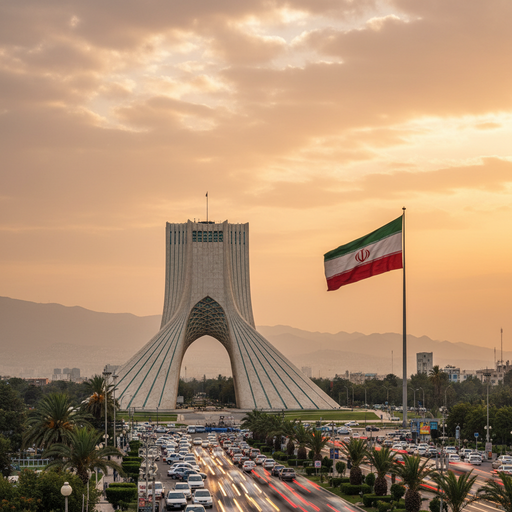
According to Xinhua News Agency, the Israel Defense Forces issued a statement early on the 2nd that the Air Force launched a new round of large-scale strikes on key areas in Tehran. The statement said the operation mainly targeted Iranian regime-related targets.
Additionally, Iran’s Tasnim News Agency reported explosions in parts of Tehran on the same day. The specific locations and casualties from the airstrikes have not been confirmed. Latest reports from CCTV International indicate that early on March 2nd, Tehran’s Nilufer Square was attacked by US and Israeli airstrikes, resulting in at least 20 deaths.
The Israeli military issued a statement on the 1st claiming that during the first round of strikes, they targeted regime targets in central Tehran, killing 40 Iranian military commanders, and that Iran’s defense leadership “has been eliminated.” Reports also indicate that top leaders such as Supreme Leader Khamenei and former President Ahmadinejad were attacked and killed.
On the US side, according to CCTV News, a reporter learned on March 1st that President Trump stated that Iran’s new leadership hopes to resume negotiations, and he has agreed to engage in dialogue.
In a phone interview at Mar-a-Lago, Trump said, “They want to talk, and I agree to talk, so I will talk to them.” He also mentioned that Iran “should have reached an agreement earlier,” calling it “a very practical and easy thing to do, but they waited too long.”
Strait of Hormuz “Cut Off”
According to RIA Novosti on March 1, the Oman Maritime Safety Center announced that a Palau-flagged oil tanker was attacked near the Strait of Hormuz off the coast of Oman, injuring four crew members.
The statement from the center said: “The ‘Skylight’ oil tanker flying the Palau flag was attacked 5 nautical miles north of the port of Haseeb in Musandam Province, Oman. All 20 crew members—15 Indians and 5 Iranians—have been evacuated. Four crew members were injured and are receiving treatment.”
Earlier, Iranian military officials announced the closure of the Strait of Hormuz and repeatedly warned ships that the route is unsafe due to conflicts between Iran, the US, and Israel.
The Strait of Hormuz connects the Persian Gulf with the Oman Gulf, through which about 20% of the world’s oil is transported via this narrow waterway only 40 kilometers wide.
Notably, in response to the current Middle East situation and oil price fluctuations, OPEC has taken measures. On the 1st, the organization issued a statement that representatives from Saudi Arabia, Russia, Iraq, the UAE, Kuwait, Kazakhstan, Algeria, and Oman held an online meeting to discuss the international oil market outlook. The eight major oil-producing countries decided to increase daily output by 206,000 barrels starting in April.
Geopolitical Turmoil Ignites Energy Markets
The sudden escalation of Middle East geopolitical conflicts poses severe risks of supply disruptions to the global energy market. Several institutions point out that the Strait of Hormuz, as the only passage from the Persian Gulf to the Indian Ocean, could be blocked short-term, triggering panic buying of oil and ships, and causing oil prices and shipping costs to rise rapidly due to fear.
According to China Merchants Securities, recent frequent geopolitical conflicts have directly increased crude oil risk premiums, reshaping global energy flow patterns through chain reactions.
First, ongoing tensions in the Middle East and Russia-Ukraine conflict have heightened concerns over supply disruptions, pushing oil prices higher amid volatility, which in turn boosts upstream exploration and development activity in the oil service sector. Second, affected by geopolitical tensions, the shipping market has also become turbulent, with the Baltic Dry Index (BDTI) reaching new highs in stages.
CITIC Construction Investment also believes that restrictions on Hormuz Strait shipping will influence freight rates, especially for VLCCs (Very Large Crude Carriers). Investors should monitor Brent crude prices and beware that prolonged high oil prices could trigger economic volatility, impact oil consumption, and disrupt the oil tanker shipping market.
Goldman Sachs’ latest report indicates that the crude oil market has already priced in an $18 per barrel risk premium over the weekend, equivalent to the impact of a complete six-week blockade of the Strait of Hormuz. The firm’s analysts also noted, “While our risk bias is upward, historical data shows that price surges caused by geopolitical shocks and/or temporary supply disruptions tend to be short-lived.”
Several Oil & Gas Stocks Were Favored by Funds Last Week
According to Eastmoney, 53 A-share stocks are related to oil and gas equipment and services, including the trillion-dollar giant China National Offshore Oil Corporation (CNOOC) and Jereh Group, which has significant progress in gas turbine business. Other notable stocks include China Steel, CNOOC Services, China Oil & Gas, and Sinopec Oilfield Services, each with a market cap exceeding 60 billion yuan.
Since 2026, oil and gas equipment and service stocks have performed strongly, with nearly 90% of stocks seeing gains. Today, Tongyuan Petroleum hit the 20-cent limit-up with a nearly 2.3-fold increase, while Pioneering Energy and Keli Shares doubled in value. Leading gains also include Fangfangda, Zhongman Petroleum, and Jereh.
In just four trading days last week, Tongyuan Petroleum surged over 40%, Fangfangda rose more than 38%, and Changbao Shares, Pioneering Energy, and Chunhui Zhikong all gained over 25%.
In terms of funds, Eastmoney Choice data shows that last week, 22 oil & gas equipment and service stocks received net financing inflows. China Oil & Gas and CNOOC Engineering attracted 140 million and 118 million yuan respectively. Zhongman Petroleum saw leveraged funds increase by about 90 million yuan, and five stocks including Snowman Group, Jiufeng Energy, and Pioneering Energy had net financing between 30 and 70 million yuan.
(Source: Eastmoney Research Center)