Users are drawn to Space because it merges a trading marketplace with prediction mechanisms, allowing participants to both express their views and earn returns from price movements. In traditional prediction markets, information is typically concentrated on a handful of platforms, whereas on-chain protocols aim to boost transparency and participation through open-access frameworks.
This challenge generally spans three dimensions: prediction market mechanisms, order matching logic, and token incentive structures—all of which form the operational backbone of Space.
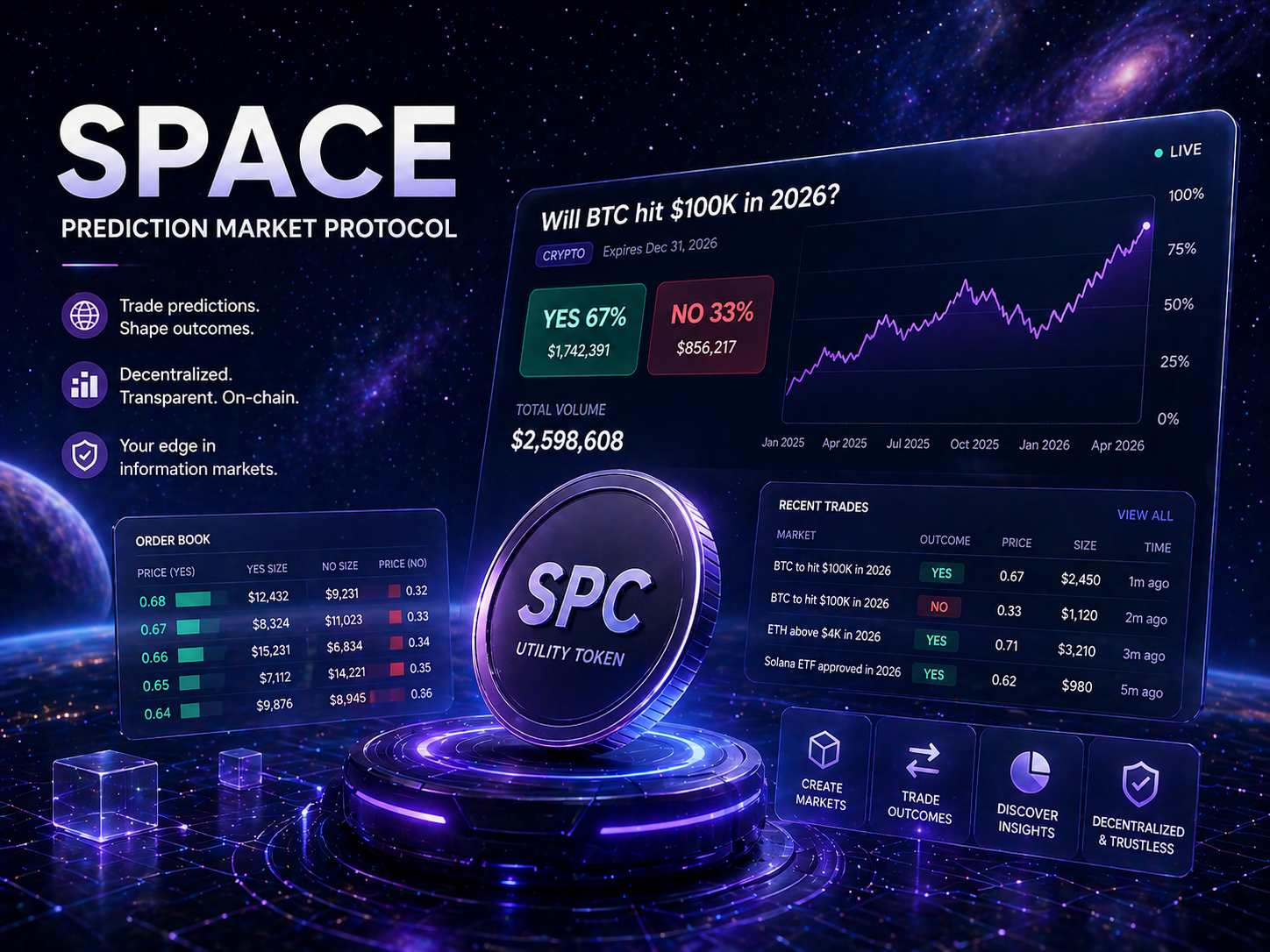
What Is Space (SPC)?
Space is a decentralized prediction market protocol that empowers users to create markets and trade around future events.
In essence, Space converts “event outcomes” into “tradable assets,” enabling users to express their judgments by buying and selling positions on various results. Structurally, Space operates fully on-chain, with all trades, orders, and settlements executed via Smart Contracts.
First, users select or create a prediction event. Next, the marketplace generates tradable assets for each possible outcome. Participants then express their expectations by buying or selling these positions. Once the event result is determined, the system completes settlement.
This design transforms informational judgments into market actions, making prices a direct reflection of probability and enhancing the efficiency of information discovery.
How Space’s Core Mechanism Works
Space’s core mechanism centers on prediction market trading, price discovery, and settlement logic.
Fundamentally, Space is a market system that maps “probability” to “price.” Users adjust prices through trading, and those prices reflect the market’s collective expectations for event outcomes.
First, users enter a specific prediction market. Based on their analysis, they buy or sell a particular outcome. Orders are then routed to the matching system, where a fill price is established. Ultimately, price movements reflect market consensus, and settlement occurs once the event concludes.
This mechanism empowers prediction markets to aggregate information. As participation grows, prices more accurately reflect real probabilities, boosting market efficiency.
The Role and Function of the SPC Token in the Ecosystem
SPC is the core token within the Space ecosystem, serving critical functions in trading, incentives, and ecosystem participation.
SPC is not only a payment instrument, but also an essential medium for market operations. Users leverage SPC to trade, pay fees, and earn incentives.
To participate in prediction market trading, users transact with SPC. The system collects fees during these transactions, allocating a portion to reward market participants or Liquidity Providers. This creates a continuous cycle of SPC circulation throughout the ecosystem.
The value of SPC is directly tied to market activity and trading demand. As prediction market trading increases, so does SPC’s usage and demand.
Order Matching and Settlement Logic in Prediction Markets
Order matching and settlement are at the heart of Space’s trading system.
Like a traditional exchange, but for “event outcomes,” order matching sets the price, while the settlement mechanism determines the final return.
Users submit buy or sell orders, which the system matches based on price and quantity. Trades establish the market price. Once the event outcome is confirmed, the system settles positions accordingly.
The matching engine drives price discovery, while the settlement system manages value allocation. This separation ensures both trading efficiency and robust clearing capabilities.
By standardizing these processes, Space turns complex prediction behaviors into clear, actionable trading and settlement logic.
Market Creation and Participation Process in Space
Space empowers users to create their own prediction markets—a core feature of its decentralized architecture.
Anyone, not just the platform operator, can launch a market. Through this open model, the diversity of markets can continually expand.
Users create a prediction event and define its rules. The system then generates the corresponding marketplace. Other users can join and trade. Once the event is resolved, the market settles.
This user-driven market supply enhances diversity, while also demanding rigorous rule design.
Space vs Polymarket: Mechanism and Architecture Differences in Prediction Markets
Space and Polymarket are both on-chain prediction markets, but differ in architecture, trading mechanisms, and incentive structures.
While both share the same goal, their approaches diverge. Space prioritizes on-chain trading and order matching, whereas Polymarket relies on a pool-based market model.
| Dimension |
Space |
Polymarket |
| Architecture |
Order Matching Model |
Liquidity Pool Model |
| Price Discovery |
Market Matching |
Automated Market Maker Mechanism |
| Trading Method |
Order Book–Style Trading |
Pool-Based Swapping |
| Incentive Mechanism |
Trade-Driven Incentives |
Liquidity Provider Incentives |
| Use Cases |
High-Frequency Trading & Price Discovery |
Simplified Participation & Liquidity |
Structurally, Space aligns more closely with traditional exchange logic, while Polymarket resembles a decentralized trading protocol. These differences result in distinct trade-offs between user experience and market efficiency.
Participants and Value Flow in the Space Ecosystem
The Space ecosystem comprises market creators, traders, and liquidity participants.
Each participant adds value at different stages and receives corresponding returns. Market creators supply events, traders provide liquidity and price discovery, and the system manages matching and settlement.
Creators set up markets. Traders buy and sell positions. The system records trades and updates prices. Returns are distributed based on market outcomes.
This value flow establishes a self-sustaining economic system, enabling continuous market operation.
Advantages and Potential Limitations of Space
Space’s strengths lie in its on-chain transparency and market-driven mechanisms.
All trades and settlements are verifiable, enhancing trust. The order matching system improves price discovery efficiency.
However, limitations exist. Insufficient market liquidity can impact the trading experience, and the system’s complexity may raise the barrier for new users.
Space’s long-term success depends on participant volume, the quality of market design, and the tokenomics of SPC—all critical factors for sustainable growth.
Summary
Space unifies prediction markets with on-chain trading mechanisms, integrating information pricing, asset trading, and value distribution. Its core lies in the synergy of order matching, market creation, and token incentives, while its distinctions from protocols like Polymarket underscore different design philosophies and market positioning.
FAQ
What is Space
Space is a blockchain-based prediction market protocol that lets users trade around future events and express their expectations through price.
What is the function of the SPC token
SPC is used for trading, paying fees, and participating in ecosystem incentives. It is essential for maintaining prediction market operations.
How does Space conduct prediction trading
Users participate by buying and selling assets representing different outcomes. Price changes reflect the market’s collective judgment on event results.
What is the difference between Space and Polymarket
Space uses an order matching engine, while Polymarket employs a liquidity pool model. The two differ in trading methods and price discovery mechanisms.
What are the risks of Space
Key risks include insufficient liquidity, suboptimal market design, and uncertainty in event outcome resolution.







