As the DeFi market evolves rapidly, yield farming and on-chain market making have become central elements of the crypto ecosystem. Unlike traditional financial markets that rely on professional market makers, the AMM model enables retail investors to provide market liquidity by depositing assets into liquidity pools and earn returns from trading fees. However, this mechanism also exposes liquidity providers to risks from on-chain asset price volatility.
Among DeFi protocols, Uniswap stands out for its role in popularizing the liquidity pool model, making “impermanent loss” a key risk concept for DeFi participants.
What Is Impermanent Loss?
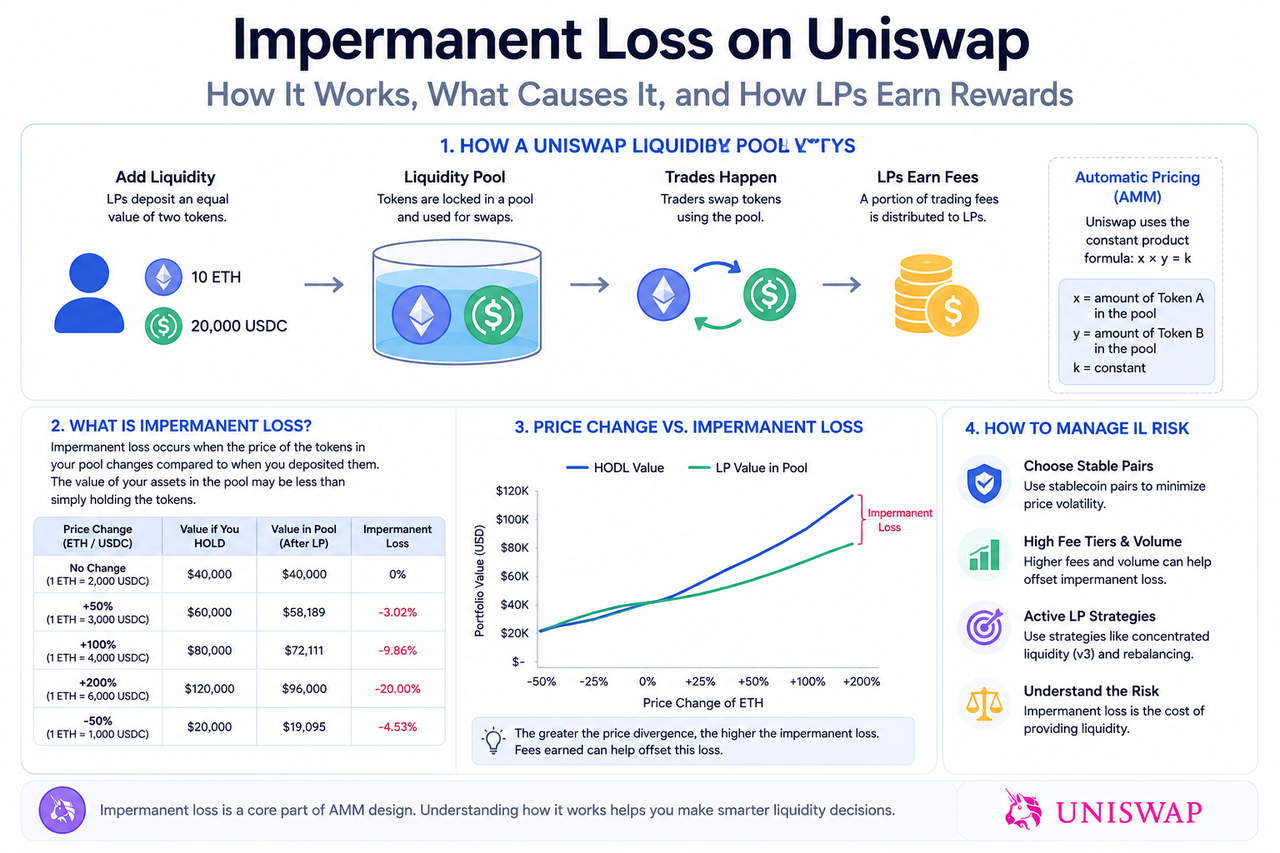
Impermanent Loss occurs when a liquidity provider (LP) deposits assets into a liquidity pool and, due to asset price changes, ends up with a lower asset value than simply holding the assets.
On Uniswap, liquidity pools automatically adjust the asset ratios based on price movements. When an asset’s price rises, that asset is continuously bought from the pool; when its price falls, the pool accumulates more of it.
As a result, when an LP withdraws liquidity, the composition of their assets may have changed, leading to a deviation in value.
Why Does Impermanent Loss Occur?
Impermanent loss is fundamentally caused by the AMM’s automated market making mechanism.
Uniswap v2 uses the constant product formula:
$x×y=k$
This formula ensures the asset ratio in the pool is continuously adjusted during trades to keep the product constant. When market prices shift, arbitrage traders rebalance the pool’s asset prices to align them with external markets.
Throughout this process, the LP’s asset structure changes, which can result in a value below simply holding the assets.
How Do Uniswap LPs Earn Returns?
LPs primarily earn returns from trading fees.
When users swap assets in the liquidity pool, the protocol charges a fee, which is distributed to LPs based on their share in the pool.
In high-volume markets, fee income may partially offset impermanent loss risk. Thus, an LP’s actual return depends on trading volume, market volatility, liquidity size, and asset price changes.
Pools with high trading volumes generally generate more stable fee income, but pools with volatile assets may also see more pronounced impermanent loss.
What Is the Difference in Impermanent Loss Between Uniswap v2 and v3?
Uniswap v3 introduced Concentrated Liquidity, allowing LPs to deploy funds within specific price ranges.
This increases capital efficiency, but also makes LPs more vulnerable to price swings.
In v2, liquidity covers the full price range, dispersing risk. In v3, if the price moves outside the LP’s set range, funds may stop generating fees and become fully exposed to single-sided asset risk.
Therefore, v3 increases earning efficiency but also adds complexity to active liquidity management.
What Factors Affect Impermanent Loss?
Impermanent loss is affected by:
- Asset price volatility: The greater the price swings, the more significant the impermanent loss.
- Asset correlation: Stablecoin trading pairs tend to have lower impermanent loss due to minimal price changes.
- Trading fee income: Higher trading volumes can boost LP returns and partially offset losses.
- Liquidity range settings: In v3, the price range directly impacts the LP’s risk exposure.
How Can You Reduce Impermanent Loss Risk?
LPs use various strategies to mitigate risk.
Some investors prefer:
- Stablecoin pools
- High trading volume asset pools
- Trading pairs with low volatility
Professional strategies may also involve dynamic rebalancing, automated reallocation, and hedging mechanisms to minimize the impact of price fluctuations.
Nevertheless, impermanent loss is inherent to the AMM mechanism and cannot be eliminated entirely.
Does Impermanent Loss Always Materialize?
“Impermanent” means the loss is not realized unless asset prices return to their original levels.
If the market price returns to the LP’s initial deposit ratio, the impermanent loss may shrink or disappear. But if the LP withdraws funds during a price deviation, the loss becomes permanent.
Ultimately, whether impermanent loss occurs depends on price movements and the timing of LP withdrawals.
Summary
Impermanent loss is a core risk in Uniswap and AMM liquidity mechanisms, arising from the automatic adjustment of asset ratios in liquidity pools. While LPs earn returns from trading fees, price volatility can still lead to asset values below simply holding the assets.
With innovations like Uniswap v3 improving capital efficiency, LP earnings have become more complex. Understanding the logic, factors, and risk structure of impermanent loss is essential for participating in DeFi liquidity markets.
FAQs
Why Does Uniswap Generate Impermanent Loss?
Because the AMM automatically adjusts the pool’s asset ratio, causing asset composition to change with market price movements.
Does Impermanent Loss Always Result in Actual Loss?
Not always. If prices return to their original levels, the loss may shrink; if the LP withdraws funds early, it may become permanent.
Is Impermanent Loss Higher in Uniswap v3?
Concentrated liquidity in v3 boosts capital efficiency but also increases price range risk and management complexity.
Can Trading Fees Offset Impermanent Loss?
In some high-volume pools, fee income may partially offset losses, but it does not always fully cover them.
Do Stablecoin Pools Experience Impermanent Loss?
Yes, but due to minimal price fluctuations, impermanent loss in stablecoin pools is typically lower.