As real world assets, RWA, gradually become an important growth direction for the blockchain industry, infrastructure projects built around bringing RWA on-chain are growing rapidly. For traditional financial assets to be represented on-chain, they need more than asset issuance capabilities. They also require efficient transaction processing, clearing mechanisms, and liquidity support. As a result, RWA infrastructure is becoming an important foundation connecting traditional finance with on-chain finance.
Within this sector, different projects are beginning to form distinct positions. Some focus on building underlying networks that provide high performance infrastructure for the circulation of real assets. Others focus more on asset issuance and ecosystem collaboration, helping assets enter on-chain markets more easily. Pharos and Plume represent these two approaches. They enter the RWA market from two different angles, underlying performance and ecosystem coordination, which makes them especially worth comparing.
Pharos and Plume Represent Different Development Directions in RWA Infrastructure
Pharos is positioned as a high performance Layer1 network for real finance, or RealFi, scenarios. Its goal is to provide underlying financial infrastructure support for bringing real assets on-chain. Through parallel execution and modular architecture, Pharos aims to solve performance bottlenecks in the on-chain circulation of real assets, making payment settlement, asset trading, and institutional grade capital flows more efficient. Its core value lies in building a financial grade underlying network that supports the large scale movement of real assets on-chain.
| Comparison Dimension |
Pharos |
Plume |
| Project Positioning |
High performance Layer1 financial infrastructure for RealFi |
Ecosystem collaboration network for RWA asset issuance and liquidity |
| Core Goal |
Provide high throughput, low latency underlying network support for bringing real assets on-chain |
Provide an RWA asset access gateway for asset issuers and DeFi protocols |
| Technical Focus |
Parallel execution, modular design, high performance financial architecture |
Asset issuance support, protocol integration, liquidity connectivity |
| Main Value Logic |
Value growth driven by demand for underlying network usage |
Value growth driven by ecosystem collaboration and scale of asset access |
| Use Cases |
Payment settlement, on-chain clearing, institutional grade financial services |
RWA asset issuance, protocol collaboration, liquidity access |
| Target Users |
Institutional capital, financial protocols, infrastructure developers |
Asset issuers, DeFi protocols, RWA project teams |
| Competitive Advantage |
Strong high performance financial infrastructure capability |
High efficiency in RWA ecosystem collaboration |
| Development Direction |
Build the underlying network for on-chain real finance |
Expand RWA asset access and ecosystem partnerships |
By contrast, Plume is more focused on building an RWA asset ecosystem network. Its emphasis is on connecting asset issuers, DeFi protocols, and end users, providing real assets with an on-chain representation and liquidity gateway. Plume’s core is not underlying performance optimization, but lowering the barrier for RWA assets to enter on-chain markets and improving collaboration efficiency between assets and protocols. This difference in positioning determines their different directions in technical design and ecosystem expansion.
Simply put:
This difference means the two are not necessarily direct competitors. Instead, they occupy different positions in the RWA value chain. As the RWA market expands, both underlying network capabilities and asset access capabilities will become key areas of competition.
How Do the Core Positions of Pharos and Plume Differ?
Pharos’ core positioning is Layer1 financial infrastructure for RWA scenarios. It focuses more on network performance, transaction processing efficiency, and long term value capture logic, with the goal of becoming the underlying network on which real assets operate on-chain. This means Pharos is more like an “on-chain operating environment” for financial assets, with an emphasis on improving transaction efficiency and system scalability.
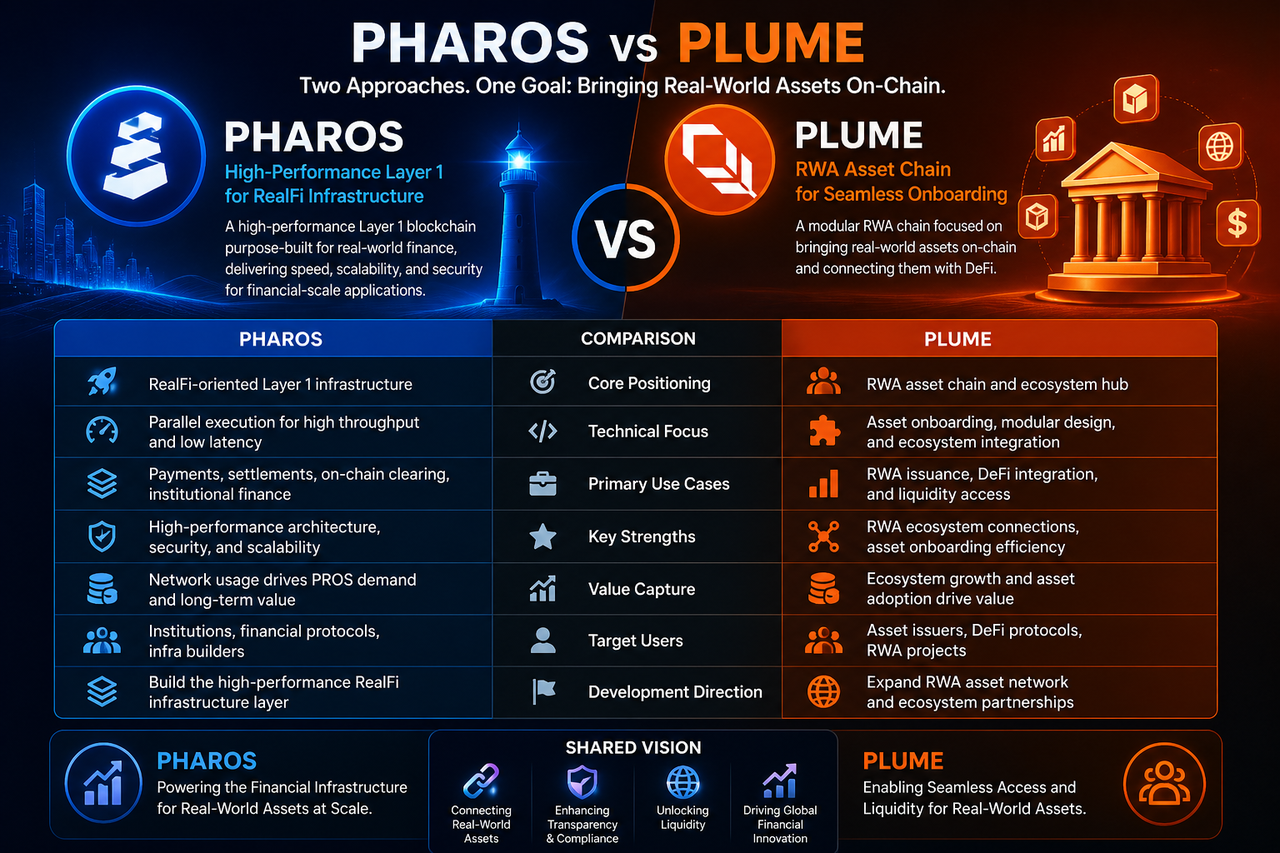
Plume’s core positioning leans more toward an RWA ecosystem gateway. By integrating asset issuers and liquidity protocols, it helps more real assets enter the on-chain ecosystem quickly. Plume places greater emphasis on connectivity after assets move on-chain, rather than on underlying network performance. So, if Pharos is building an “underlying financial network,” Plume is more like an “RWA ecosystem collaboration platform.”
What Are the Technical Architecture Differences Between Pharos and Plume?
In terms of technical architecture, Pharos adopts a high performance Layer1 approach, using parallel execution to improve transaction throughput and modular design to strengthen adaptability for financial scenarios. This architecture is better suited to complex financial operations such as high frequency payments, on-chain clearing, and large scale asset transfers, so its focus is on optimizing underlying performance.
Plume’s technical focus is placed more on asset access and ecosystem integration. By integrating asset issuance processes and protocol connectivity mechanisms, it improves the onboarding efficiency of RWA projects and allows assets to enter on-chain liquidity markets more easily. In comparison, Plume does not emphasize competition at the underlying performance layer. It focuses more on improving coordination efficiency between assets and applications.
How Do Pharos and Plume Differ in Ecosystem Development Direction?
Pharos’ ecosystem development centers on RealFi infrastructure, including payment networks, on-chain settlement, institutional grade financial protocols, and underlying RWA services. Its ecosystem goal is to build a complete on-chain financial operating environment, providing foundational support for real assets from issuance to circulation. Therefore, Pharos leans more toward infrastructure driven ecosystem expansion.
Plume’s ecosystem direction, by contrast, centers on asset issuance and liquidity gateways. Its focus is on bringing in more asset issuers and DeFi protocols to build a connection network between the asset side and the capital side. It is more like an ecosystem collaboration layer built around RWA assets, so its ecosystem growth depends on the scale of asset access and its ability to build protocol partnerships.
How Do the Value Logics of Pharos and Plume Differ?
Pharos’ value logic comes from demand for its underlying network. As more asset transactions and financial activities take place on the network, demand for the native token grows alongside transaction volume. Therefore, Pharos’ value capture mainly comes from the frequency of underlying infrastructure usage, making it a network driven value model.
Plume’s value logic comes more from ecosystem coordination and the scale of asset access. As more assets and protocols join the ecosystem, the platform’s collaboration value increases, which in turn strengthens the overall network value. By comparison, Plume depends more on ecosystem connectivity, while Pharos depends more on network value growth generated by underlying financial activity.
What Development Paths Are Pharos and Plume Best Suited For?
Pharos is better suited to a development path that requires high performance financial infrastructure support, especially RWA scenarios that demand high throughput and strong stability, such as payment settlement, large scale asset trading, and institutional financial applications. Its advantage lies in the capability of its underlying architecture, making it suitable as the operating base for real financial assets.
Plume is better suited to a development path centered on asset access and ecosystem expansion. It fits RWA scenarios that require rapid onboarding of asset issuers and the construction of liquidity networks. Its advantage lies in ecosystem collaboration efficiency, making it more suitable as a bridge platform for assets entering on-chain markets.
Conclusion
Although Pharos and Plume both belong to the RWA infrastructure sector, their development directions differ clearly. Pharos focuses on building a high performance Layer1 financial network, providing infrastructure support for the circulation of real assets by improving underlying performance. Plume, on the other hand, emphasizes asset issuance and ecosystem collaboration, building an RWA liquidity gateway by integrating asset providers and protocol partners.
Over the long term, the two represent different paths within the RWA sector: Pharos represents infrastructure layer value, while Plume represents ecosystem collaboration layer value. As the RWA market continues to expand, underlying performance and ecosystem gateways will both become important competitive directions, and each project’s long term potential will depend on its execution within its own path.
FAQs
What Is the Core Difference Between Pharos and Plume?
Pharos focuses on building high performance Layer1 financial infrastructure, while Plume is more focused on RWA asset issuance and ecosystem connectivity. They represent two paths: the underlying network and ecosystem collaboration.
What Are Pharos’ Advantages?
Pharos’ advantages lie in the high performance network capabilities brought by parallel execution and modular architecture, making it more suitable for payment settlement and large scale asset circulation scenarios.
What Are Plume’s Advantages?
Plume’s advantages lie in asset issuance support and ecosystem collaboration capabilities, making it more suitable for quickly connecting asset issuers with DeFi protocols.
Which Is Better Suited to the Development of the RWA Sector?
The two follow different directions. Pharos is better suited to the financial infrastructure layer, while Plume is better suited to building an asset ecosystem gateway. Their specific potential depends on their respective ecosystem expansion capabilities.







