CFD and Perpetual Futures are both widely used for trading price volatility, which leads users to frequently compare the two. While both products support leverage and two-way trading, they differ significantly in their underlying market structure, price formation mechanisms, and risk models.
As the digital asset market has evolved, Perpetual Futures have become the dominant product in the crypto derivatives space, whereas CFDs have remained prevalent within traditional finance and retail broker ecosystems.
Overview and Key Differences Between CFDs and Perpetual Futures
A CFD (Contract for Difference) is a financial derivative that settles based on changes in an asset’s price. Traders do not need to own stocks, forex, commodities, or cryptocurrencies; instead, profit and loss are determined by the difference between the open and close price. CFDs are typically offered by brokers who provide liquidity and quotes, and they use margin mechanisms to amplify market exposure.
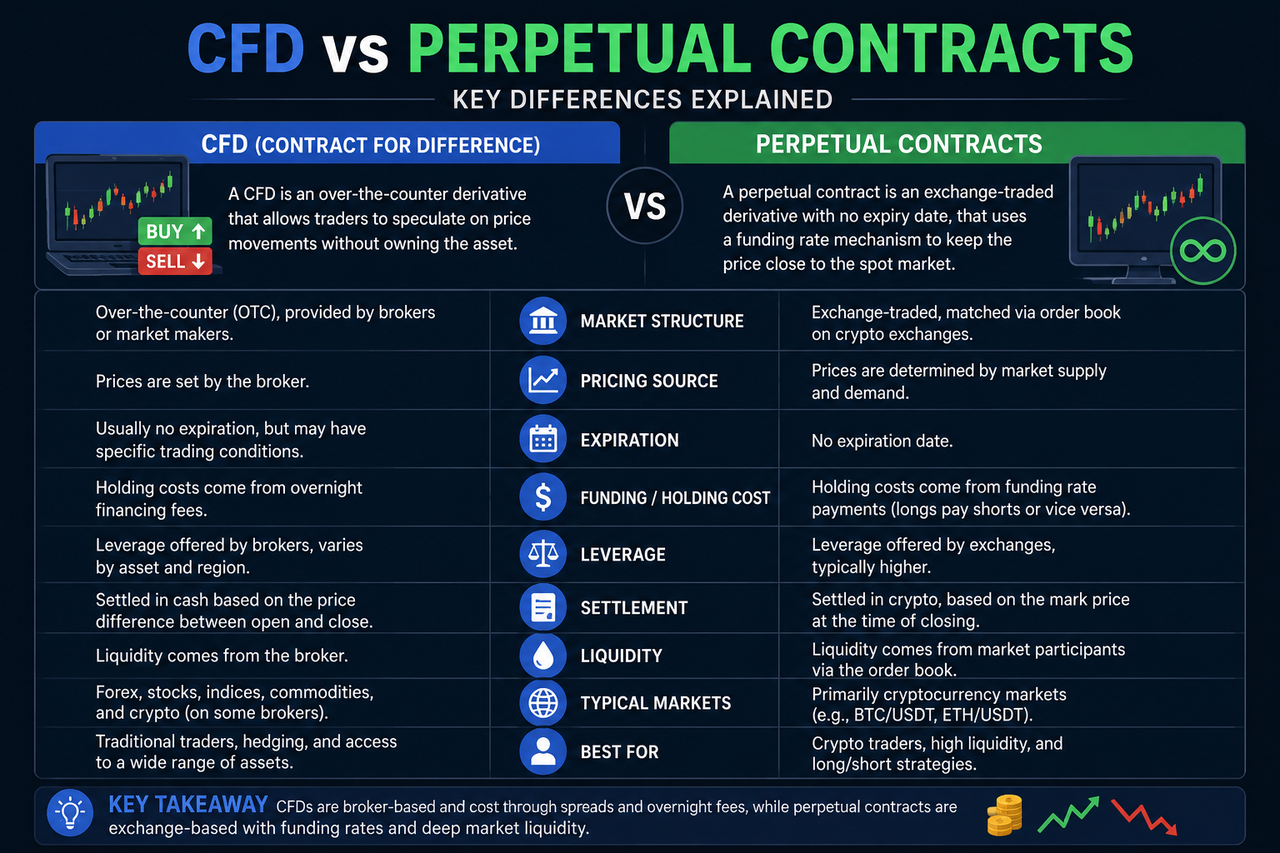
A Perpetual Futures contract is a type of derivative with no expiration date, first popularized by crypto trading platforms. Unlike traditional futures, Perpetual Futures do not settle at expiry; instead, they maintain price alignment with the spot market through the “Funding Rate” mechanism.
| Comparison Dimension |
CFD |
Perpetual Futures |
| Market Structure |
Broker Market |
Exchange Market |
| Liquidity Source |
Market Maker Quotes |
Order Book Matching |
| Expiration Date |
Usually None |
None |
| Main Holding Cost |
Overnight Financing Fee |
Funding Rate |
| Price Formation |
Platform Quoting |
Market Matching |
| Common Markets |
Forex, Stocks, Commodities |
Cryptocurrency |
| User Structure |
Primarily Retail Investors |
Primarily High Frequency and Professional Traders |
| Risk Characteristics |
Platform Liquidity Risk |
Market Volatility Risk |
How Do CFD and Perpetual Futures Market Structures Differ?
CFD markets typically feature brokers or market makers who provide quotes and liquidity. Traders primarily transact with the platform itself, resulting in a more centralized price formation process.
Perpetual Futures, on the other hand, rely on an order book matching model. Prices are determined by both buyers and sellers in the marketplace, with the platform facilitating matching and risk management rather than acting as a direct counterparty.
Key implications include:
-
CFDs are more aligned with broker-based systems
-
Perpetual Futures are more aligned with exchange-based systems
-
Perpetual Futures markets generally offer greater price transparency
-
Market depth for Perpetual Futures is more dependent on actual trading volume
How Do the Fee Structures of CFDs and Perpetual Futures Differ?
Both CFDs and Perpetual Futures are leveraged derivatives, which means both involve holding costs, but their fee structures are distinct.
CFDs typically incur costs such as spreads, trading fees, and overnight financing fees, while Perpetual Futures primarily involve trading fees and a funding rate.
The funding rate mechanism is a defining feature of Perpetual Futures. When the contract price exceeds the spot price, long positions may pay a funding rate to short positions; the reverse occurs when the contract price is below the spot.
$Funding Payment=Position Size×Funding Rate$
In contrast, CFDs usually reflect leveraged holding costs through overnight financing fees.
How Do the Risk Structures of CFDs and Perpetual Futures Differ?
Both CFDs and Perpetual Futures are high-risk leveraged products, which means price swings can be magnified by leverage.
However, their risk profiles are not identical.
CFD risk is primarily linked to broker quoting models, liquidity structure, leverage ratios, and overnight financing costs.
Perpetual Futures are more exposed to market volatility, changes in the funding rate, forced liquidation mechanisms, and fluctuations in market depth.
During extreme market conditions, Perpetual Futures can experience cascading liquidations and rapid volatility spikes, while CFD risk is more reliant on a platform’s risk control systems.
Why Are Perpetual Futures More Prevalent in the Crypto Market?
Perpetual Futures have become the mainstream derivative in the crypto market, largely due to their market structure.
Since crypto markets operate 24/7, the fixed settlement cycle of traditional futures is not well-suited for high-frequency digital asset trading. By eliminating expiration dates and introducing the funding rate mechanism, Perpetual Futures allow traders to maintain positions over the long term and participate continuously in market movements.
Additionally, Perpetual Futures typically feature:
As a result, Perpetual Futures are used more frequently in crypto markets than traditional CFDs.
Summary
CFDs and Perpetual Futures are both derivatives that support leverage and two-way trading, but they differ significantly in market structure, fee models, and risk mechanisms.
CFDs are more closely tied to traditional financial broker systems, offering flexibility and low barriers to entry. Perpetual Futures are primarily used on cryptocurrency exchanges, maintaining market operation through funding rates and order book matching.
With the growth of the digital asset market, Perpetual Futures have become a core component of crypto derivatives markets, while CFDs remain widespread in traditional finance and retail trading.
FAQs
What is the main difference between CFDs and Perpetual Futures?
The primary difference is market structure. CFDs are usually quoted by brokers, while Perpetual Futures are matched via order books.
Why don’t Perpetual Futures have an expiration date?
Perpetual Futures use a funding rate mechanism to keep contract prices aligned with the spot market, eliminating the need for a fixed settlement date.
Do CFDs have a funding rate?
Typically, no. CFDs generally use an overnight financing fee structure instead of a funding rate.
Why are Perpetual Futures more popular in crypto markets?
Perpetual Futures support 24/7 trading, have no expiration, and offer higher liquidity, making them well-suited for digital asset markets.
Do both CFDs and Perpetual Futures support shorting?
Yes. Both allow traders to open positions whether the market is rising or falling.
Which is riskier, CFDs or Perpetual Futures?
Both are high-risk leveraged products, but their risk sources differ. CFD risk depends more on platform risk controls, while Perpetual Futures are more sensitive to market volatility.