The primary questions regarding the ACN token focus on three core areas: whether the token has real-world use cases, if fee payments are directly tied to network services, and whether the deflationary mechanism effectively links platform usage to supply changes.
This topic can be analyzed from six perspectives: network positioning, payment model, AI services, deflationary mechanism, staking rewards, and supply-demand dynamics. Among these, payment and deflation are the two most critical variables in the ACN tokenomics model.
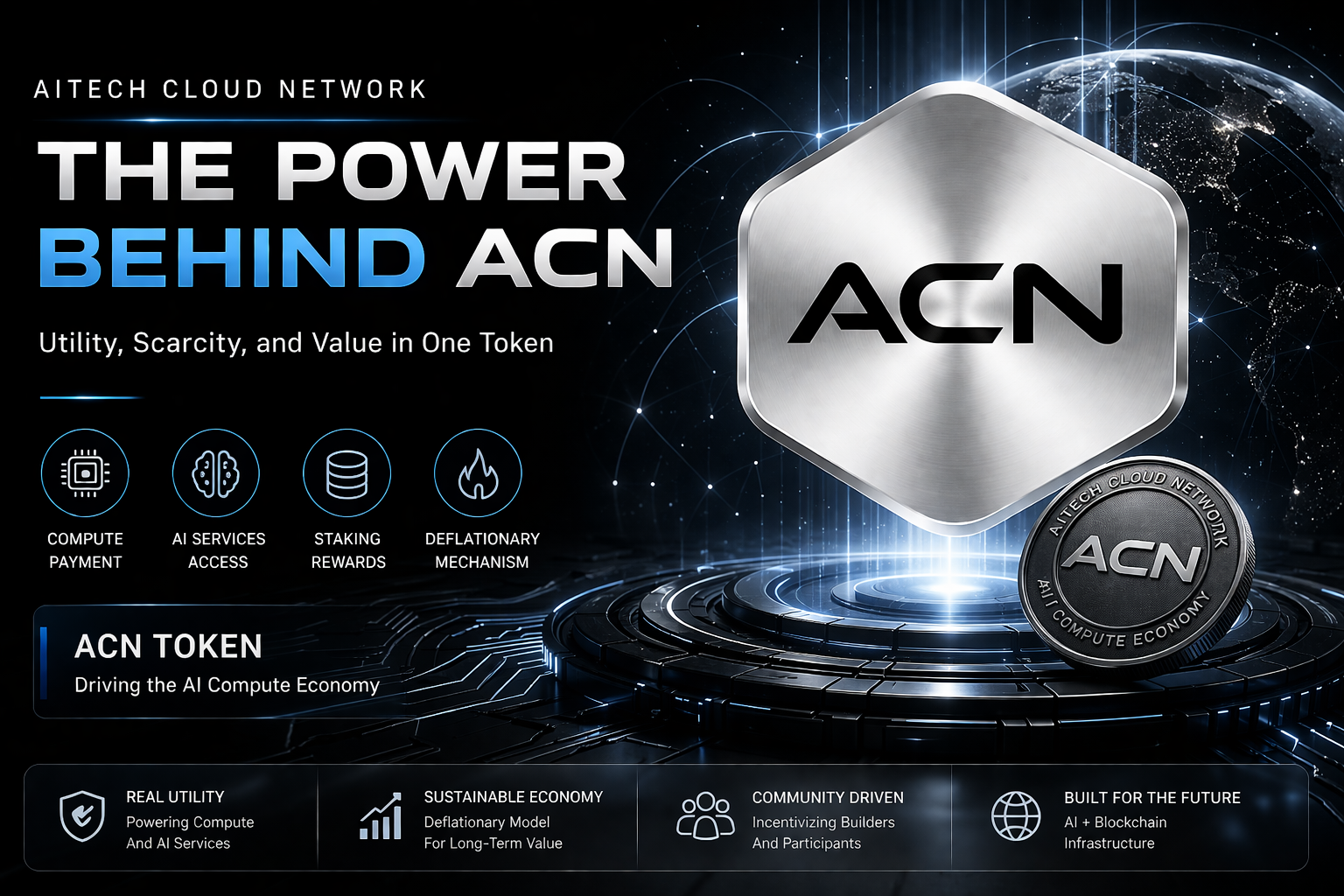
What Is the ACN Token and Its Role in the Network
The ACN token is the native economic asset of AITECH Cloud Network, serving as the backbone for payments, settlement, incentives, and ecosystem coordination. ACN unifies AI hash power usage, Agent service calls, and network economic activities into a single settlement system.
Structurally, ACN operates at the network’s economic layer, working alongside the computation and AI Agent orchestration layers to form a comprehensive AI infrastructure. Users or developers initiate requests for hash power, models, or Agent services. The system then allocates the appropriate resources—such as GPU clusters, AI models, or automated Agents—based on service type. Fees are paid or settled via ACN, enabling value transfer among users, service providers, and ecosystem participants.
This positioning is significant because ACN isn’t a standalone asset separated from the product; it’s a functional token embedded directly in the hash power service workflow. The token’s payment and settlement properties only manifest in the network when hash power, Agent, and AI services are actively used.
Core Functions and Ecosystem Role of the Token
The ACN token’s core functions include hash power payments, AI service access, Agent task settlement, staking incentives, and ecosystem coordination. ACN consolidates different AI infrastructure services into a unified, settleable economic system.
In practice, users access the Compute Marketplace, Agent Forge, or related service portals when they need computing resources or AI tools. The system determines the fee structure based on the task—such as GPU rental, model invocation, Agent deployment, or service subscription. Users pay these fees with ACN, and service providers or network participants receive the corresponding income. The ecosystem maintains service supply through integrated payment, reward, and staking mechanisms.
| Function Category |
Main Purpose |
Use Case Scenario |
| Hash Power Payment |
Pay for GPU resources |
AI training, inference, large-scale tasks |
| AI Service Access |
Invoke models and tools |
Agent Forge, model services |
| Task Settlement |
Pay Agent execution fees |
Automated workflows, on-chain interactions |
| Staking Incentives |
Reward long-term participation |
Network stability, user rewards |
| Deflation Mechanism |
Regulate token supply |
Buyback, burn, supply management |
This table demonstrates that the ACN token is not limited to one-off payments; it supports the entire lifecycle of service usage, resource allocation, ecosystem incentives, and supply management. For an AI hash power network, the ability to bind the token to real services is the foundation for a viable economic model.
How the Token Is Used for Hash Power and AI Service Payments
The ACN payment model transforms AI hash power and service invocations into metered, on-chain economic activities. By paying with ACN, users gain access to resources such as GPU hash power, model deployment, AI inference, and Agent services.
The user flow is straightforward: users select the desired service—GPU hash power, AI models, data processing, or Agent task execution. The system calculates fees based on task complexity, hash power consumption, and service type. Users pay with ACN, and the network allocates the request to the appropriate resource or service module. The system then delivers computation results, model outputs, or Agent execution outcomes, and settles the fees.
This framework transforms hash power from a backend resource to a clearly priced, on-demand service unit. For developers, token payments streamline cross-service settlement; for the network, increased service usage directly boosts payment demand and transaction activity, fueling ecosystem growth.
How the Deflation Mechanism Impacts ACN Token Supply
The ACN deflationary mechanism reduces circulating supply through buybacks or burns, directly linking platform revenue to changes in token supply. This approach acts as a supply adjustment mechanism driven by network usage.
Operationally, users pay fees to access the Compute Marketplace, Agent Forge, or other AI services. The platform allocates a portion of service revenue or transaction fees for token buybacks or burns. Burned tokens are permanently removed from circulation. As network activity grows, the burn mechanism further restricts token supply.
This mechanism directly ties ecosystem revenue to token scarcity. For ACN, deflation is not just a narrative—it depends on whether hash power leasing, AI service calls, and Agent task execution can generate consistent demand. If network usage is low, burn volume is limited; as service revenue grows, the impact of burns on supply becomes more pronounced.
How Staking and Reward Mechanisms Incentivize Network Participants
Staking and reward mechanisms are designed to boost network participation and user retention. By offering returns, discounts, or equity, these systems encourage a stronger connection between token holders and ecosystem service usage.
Users stake tokens through designated mechanisms to gain participation rights or ecosystem equity. Rewards are distributed based on staking amount, duration, or specific rules. These rewards may take the form of returns, service discounts, hash power benefits, or ecosystem access. Staking reduces short-term token circulation and strengthens the bond between users and network services.
Importantly, staking is not just about distributing returns—it also supports real-world use cases. Heavy developers or enterprise users who stake for hash power discounts directly link token holding to GPU resource consumption. For the network, staking increases ecosystem stickiness, though its effectiveness ultimately depends on sustainable service demand and reward sources.
How the Token Model Affects ACN Supply and Demand
The ACN token model shapes supply and demand through four main variables: payment demand, service revenue, staking lock-up, and deflationary burns. Supply and demand are influenced not only by token issuance, but also by network usage and ecosystem revenue.
In practice, users generate demand for hash power or AI services, creating payment-side demand. Revenue from the Compute Marketplace, Agent Forge, and other services is partially allocated to buyback or burn mechanisms. Staking reduces circulating supply. Ultimately, payment demand, burn volume, and staking lock-up collectively determine the market’s effective circulating structure.
| Variable |
Impact on Demand |
Impact on Supply |
| Hash Power Payment |
Increases service usage demand |
No direct reduction |
| AI Service Calls |
Increases application payment demand |
No direct reduction |
| Staking Mechanism |
Boosts holding motivation |
Reduces short-term circulation |
| Deflationary Burn |
Driven by platform revenue |
Permanently reduces supply |
| Ecosystem Growth |
Expands service usage |
Indirectly impacts burn volume |
This table highlights that the ACN token model is not just about “whether deflation exists,” but whether deflation is driven by genuine revenue. Ultimately, the supply-demand dynamic depends on sustained usage of AI hash power, Agent services, and ecosystem applications.
Summary
The ACN token in AITECH Cloud Network enables payment, settlement, staking, incentives, and supply regulation. The core process involves users initiating hash power or AI service requests, the system allocating resources, users paying with tokens, the network delivering services, and ecosystem participation and token supply being shaped by staking and burn mechanisms.
The ACN token’s value proposition is built on the interplay between AI hash power demand, Agent service usage, platform revenue, deflationary mechanisms, and staking incentives. Its functionality is not just a result of token design, but of ongoing network service utilization.
FAQ
What is the function of the ACN token?
The ACN token is primarily used to pay for GPU hash power, AI services, Agent tasks, and ecosystem fees within AITECH Cloud Network. It also supports staking rewards, deflationary mechanisms, and network economic activities.
How is the ACN token used for AI hash power payments?
When users select GPU hash power or AI services, the system calculates fees based on task type and resource usage. Users pay with ACN, and the network reallocates resources and returns the computation results.
What is the ACN deflationary mechanism?
The ACN deflationary mechanism reduces circulating supply through buybacks or burns. It’s typically tied to platform revenue or service usage, ensuring network activity directly impacts token supply.
What is the purpose of ACN staking?
ACN staking incentivizes long-term participation and may offer rewards, hash power discounts, or ecosystem equity. It reduces short-term circulation while strengthening user engagement with network services.
Does the ACN token model affect supply and demand?
Yes. ACN’s supply and demand dynamics are shaped by hash power payments, AI service calls, staking lock-ups, and deflationary burns. Actual service usage is the key variable for assessing the effectiveness of the token model.







