Stacks (STX) is a smart contract layer built on the Bitcoin network. It allows developers to deploy decentralized applications (dApps), DeFi protocols, and digital asset systems without changing Bitcoin’s underlying protocol. Through the Proof of Transfer (PoX) consensus mechanism, Stacks anchors transaction security to the Bitcoin main chain, while the Clarity smart contract language improves predictability and safety. As the Bitcoin ecosystem continues to expand toward programmable finance and on chain applications, Stacks is widely viewed as one of the key infrastructure layers driving the growth of the Bitcoin Economy.
For a long time, Bitcoin was mainly regarded as a store of value network. As the blockchain industry has evolved, however, demand has grown for Bitcoin native DeFi, BTC yield mechanisms, and on-chain asset applications. The emergence of Stacks gives Bitcoin a broader range of use cases, allowing BTC to move beyond simple transfers and take part in smart contracts, NFTs, DAOs, decentralized finance, and other Web3 ecosystem activities.
What Is Stacks?
Stacks is a smart contract network connected to the Bitcoin main chain. By combining an independent execution layer with Bitcoin’s settlement layer, it brings programmability to BTC. Its core goal is not to create a new “Bitcoin alternative,” but to expand Bitcoin’s application capabilities while preserving its security.
In terms of how it works, transactions on Stacks are ultimately anchored to the Bitcoin blockchain, allowing the network to inherit Bitcoin’s decentralization and security properties. At the same time, developers can use the Clarity smart contract language to deploy dApps, DeFi protocols, and NFT applications without modifying Bitcoin’s underlying consensus rules.
The native token of Stacks is STX. It is mainly used to pay network gas fees, participate in the consensus mechanism, and take part in Stacking.
The Background of Stacks
Bitcoin is the earliest large scale decentralized network in the blockchain industry, but its scripting system is relatively limited and is not well suited for running complex smart contracts directly. This design improves network stability, but it also limits application level innovation within the Bitcoin ecosystem.
As Ethereum accelerated the growth of smart contracts and DeFi, the market began exploring how BTC could participate in on-chain finance. This led to the rise of technical approaches built around Bitcoin Layers and Bitcoin Layer2 solutions.
Stacks was one of the earlier projects to introduce smart contracts into the Bitcoin ecosystem. Its origins can be traced back to Blockstack. The project later shifted its focus toward Bitcoin application layer infrastructure and developed around the core theme of the “Bitcoin Economy.”
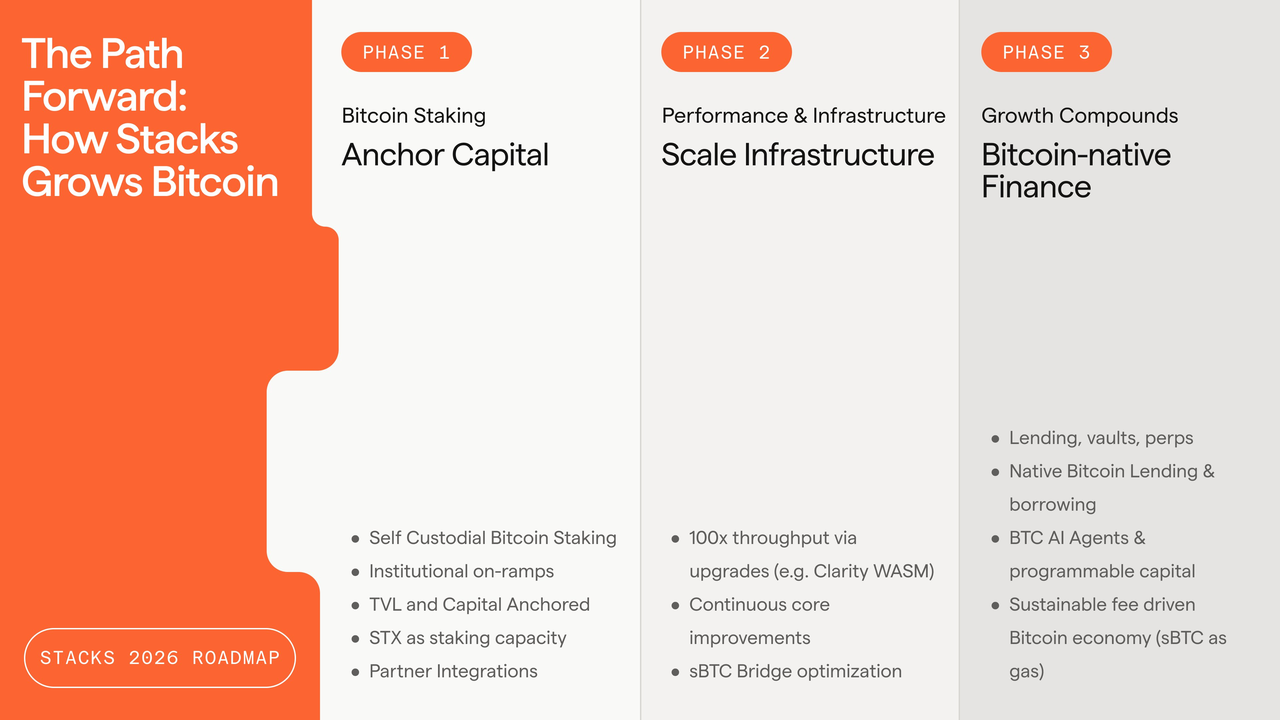
Stacks 2026 Roadmap
How Does Stacks Work?
Stacks uses a “execution layer + Bitcoin settlement layer” structure. Smart contracts and application logic mainly run on the Stacks network, while transaction states are periodically anchored to the Bitcoin main chain. This design improves network flexibility while using the security of the BTC network for final confirmation.
In its block structure, Stacks uses both Anchor Blocks and Microblocks. Anchor Blocks are linked to Bitcoin blocks and are used for final settlement. Microblocks help improve network responsiveness and transaction processing speed. Through this mechanism, Stacks can deliver an experience closer to that of a smart contract platform without changing the Bitcoin protocol.
Type
Function
Anchor Block
Linked to Bitcoin blocks and used for final confirmation
Microblock
Improves transaction throughput and interaction speed
What Is Proof of Transfer (PoX)?
Proof of Transfer (PoX) is the core consensus mechanism of Stacks. It is designed to make use of Bitcoin’s existing hash power and value base rather than building a completely separate security system.
In the PoX model:
Miners participate in block competition by sending BTC
After winning the right to produce blocks, they receive STX rewards
Users who hold STX and participate in Stacking can receive BTC distributions
Unlike traditional PoW or PoS, PoX does not rely on additional hash power or high energy consumption. Instead, it keeps the network running through a value cycle between BTC and STX.
This mechanism allows Bitcoin to provide economic security support for an external application layer without changing its own protocol.
What Is STX Used For?
STX is the core asset of the Stacks network and serves multiple roles across the ecosystem, including transactions, incentives, and network operations.
When users deploy smart contracts, send transactions, or use dApps, they need to pay network fees in STX. STX is also used for Stacking. After locking STX, users can participate in network security and consensus processes and receive BTC distributions.
Beyond transactions and incentives, STX also plays a role in the developer ecosystem, application incentives, and certain governance mechanisms. As the Bitcoin application ecosystem expands, the range of uses for STX continues to grow.
The Clarity Smart Contract Language
Stacks uses Clarity as its smart contract development language. Compared with most smart contract languages, Clarity places greater emphasis on predictability. This means developers can analyze a contract’s behavior and results before execution, reducing the risk of complex vulnerabilities.
Clarity is not compiled into bytecode. Instead, it is interpreted directly, which makes contract logic more transparent. This design is particularly well suited to the Bitcoin ecosystem, where security is a central priority.
Compared with Solidity, Clarity leans more toward safety and auditability rather than complex logic and maximum flexibility.
Main Use Cases of Stacks
As the Bitcoin application ecosystem expands, Stacks has gradually developed several major categories of on-chain applications.
In decentralized finance, developers can build Bitcoin DeFi applications such as lending protocols, DEXs, and liquidity protocols based on BTC. Compared with the traditional “wrapped BTC” model, these solutions place greater emphasis on the participation of Bitcoin native assets in on-chain finance.
In digital assets, Stacks supports NFT minting and digital collectible protocols, and it has some connection with Bitcoin native asset ecosystems such as Ordinals. Some projects also use it for DAOs, on-chain governance, and community collaboration systems.
In addition, applications built around BTC yield mechanisms are also growing, including Bitcoin on-chain yield scenarios explored through Stacking and liquid staking.
What Is the Difference Between Stacks and Lightning Network?
Stacks and Lightning are both important parts of the Bitcoin scaling ecosystem, but they serve different goals.
Lightning focuses more on payment efficiency. It is mainly used to improve the speed of small BTC payments and reduce transaction costs, making it better suited for everyday transfers and instant payments. Stacks, by contrast, emphasizes programmability and aims to enable smart contracts, DeFi, and application ecosystem expansion on top of Bitcoin.
From a technical perspective, Lightning relies on a payment channel network, while Stacks combines an independent execution layer with Bitcoin’s settlement layer. Both work alongside the BTC main chain, but they differ clearly in application direction and ecosystem positioning.
Comparison Dimension
Stacks
Lightning
Core Goal
Smart contracts and application layer
Bitcoin payment scaling
Main Use Cases
DeFi, NFTs, dApps
Small, fast payments
Smart Contract Support
Supported
Limited
Security Anchor
Bitcoin main chain
Bitcoin main chain
Native Asset
STX
BTC
Advantages and Limitations of Stacks
The core advantage of Stacks is that it can use the security of the Bitcoin network while giving BTC smart contract and application layer capabilities. Compared with independent public blockchains, Stacks places stronger emphasis on coordinated development with the Bitcoin ecosystem, which also gives it a strong narrative advantage in Bitcoin DeFi and BTC native assets.
In addition, the security oriented design of the Clarity language, along with the economic connection between the PoX consensus mechanism and BTC, further strengthens Stacks’ differentiated position in the Bitcoin application ecosystem.
However, Stacks still faces certain limitations. For example, compared with some high performance public blockchains, it still has gaps in throughput and interaction efficiency. At the same time, competition in the Bitcoin Layer sector is increasing, while the developer ecosystem and infrastructure remain in an ongoing stage of expansion.
Conclusion
Stacks brings smart contract capabilities into the Bitcoin ecosystem, giving BTC richer use cases and a more diverse on-chain economic model. Its core feature is that it uses Bitcoin as the foundation for security and settlement, while enabling decentralized application deployment through the PoX consensus mechanism and the Clarity language.
With the development of Bitcoin DeFi, Ordinals, and the BTC native asset ecosystem, Stacks has become an important infrastructure layer in the narrative of Bitcoin programmability. In the future, continued competition and innovation around Bitcoin Layers may further drive the expansion of the Stacks ecosystem.
FAQs
Is STX a Bitcoin Layer2?
Stacks is generally classified as part of the Bitcoin Layer or Layer2 ecosystem, but its structure is not exactly the same as a traditional Rollup style Layer2.
How Can STX Earn BTC Rewards?
Users can lock STX by participating in Stacking and receive BTC distributions according to network rules.
Will Stacks Change the Bitcoin Protocol?
No. Stacks expands functionality by working alongside Bitcoin and does not need to modify the rules of the BTC main chain.
What Is the Difference Between Clarity and Solidity?
Clarity places greater emphasis on predictability and security analysis, while Solidity is better suited to complex application ecosystems.
What Are the Main Applications of Stacks?
Current applications mainly include Bitcoin DeFi, NFTs, DAOs, digital asset protocols, and BTC yield related applications.
Author: Jayne
Translator: Jared
Disclaimer
* The information is not intended to be and does not constitute financial advice or any other recommendation of any sort offered or endorsed by Gate.
* This article may not be reproduced, transmitted or copied without referencing Gate. Contravention is an infringement of Copyright Act and may be subject to legal action.
Yala inherits the security and decentralization of Bitcoin while using a modular protocol framework with the $YU stablecoin as a medium of exchange and store of value. It seamlessly connects Bitcoin with major ecosystems, allowing Bitcoin holders to earn yield from various DeFi protocols.
Solana faces both opportunities and challenges in its development. Recently, severe network congestion has led to a high transaction failure rate and increased fees. Consequently, some have suggested using Layer 2 and appchain technologies to address this issue. This article explores the feasibility of this strategy.
Sui is a PoS L1 blockchain with a novel architecture whose object-centric model enables parallelization of transactions through verifier level scaling. In this research paper the unique features of the Sui blockchain will be introduced, the economic prospects of SUI tokens will be presented, and it will be explained how investors can learn about which dApps are driving the use of the chain through the Sui application campaign.
This article introduces the technical principles, framework, and applications of Zero-Knowledge (ZK) technology, covering aspects from privacy, identity (ID), decentralized exchanges (DEX), to oracles.
Tronscan is a blockchain explorer that goes beyond the basics, offering wallet management, token tracking, smart contract insights, and governance participation. By 2025, it has evolved with enhanced security features, expanded analytics, cross-chain integration, and improved mobile experience. The platform now includes advanced biometric authentication, real-time transaction monitoring, and a comprehensive DeFi dashboard. Developers benefit from AI-powered smart contract analysis and improved testing environments, while users enjoy a unified multi-chain portfolio view and gesture-based navigation on mobile devices.



 Stacks 2026 Roadmap







