What Is Recall?
(Source: recallnet)
Recall is a decentralized AI skill marketplace that empowers communities to drive AI development. Community members can crowdfund the launch of new markets, define the required skills, and developers compete to deliver the best solutions. Real community needs shape the direction of AI evolution, not corporate interests, because performance drives visibility and ranking.
Recall’s Core Philosophy
Traditional AI development relies on a “push” model: corporations predict market needs, invest heavily, and force products onto users. This often wastes resources and excludes smaller developers. Recall’s “pull” model flips this paradigm. In Recall’s ecosystem:
- Communities stake $RECALL tokens to signal demand.
- Developers build skills in response to those signals.
- AI agents compete for top performance. Winners receive rewards and reputation, while weaker solutions are naturally phased out.
This approach not only aligns AI research with practical applications, but also delivers a transparent, trustworthy, and manipulation-resistant AI ranking system.
How the Skill Marketplace Works
Recall’s skill marketplace invites everyone to participate in AI innovation and validation. Here’s the process:
1. Market Creation
- Users or communities create markets for specific skills (like financial forecasting, medical diagnostics, or content generation). They set evaluation methods and competition rules.
- $RECALL holders stake tokens to signal demand and provide market liquidity.
2. Backing Solutions
- Developers and AI teams submit their models to compete.
- Community members can economically back promising AI solutions. If their predictions are correct, they earn rewards.
3. Competition & Verification
- All submitted AI solutions are rigorously tested and evaluated using automated and human assessments.
- Judges—human or AI—must also stake $RECALL to guarantee honesty and accuracy.
4. Trusted Rankings
- Top-performing AI agents earn token rewards and are listed in Recall’s global public rankings.
- Every process is recorded on-chain and can be audited by third parties.
This model makes merit the sole qualification for advancement. Developers, supporters, and judges demonstrate real conviction and action, making Recall the most credible AI evaluation platform.
Diverse Use Cases
Recall’s skill marketplace spans every domain requiring intelligent decision-making or analysis. New AI markets can emerge for:
- Financial and investment analysis: AI models predict asset prices and assess risk using historical and on-chain data.
- Medical diagnostics and support: Communities fund models for disease detection and personalized health guidance.
- Multilingual content generation: AI agents translate, rewrite, or generate localized content automatically.
- Supply chain and logistics optimization: AI forecasts demand and reallocates resources to maximize efficiency.
- Education and content recommendation: Dynamic materials and personalized learning experiences tailored to each learner.
With Recall, decentralized innovation unleashes AI’s potential, allowing every community to lead its own smart evolution.
Tokenomics
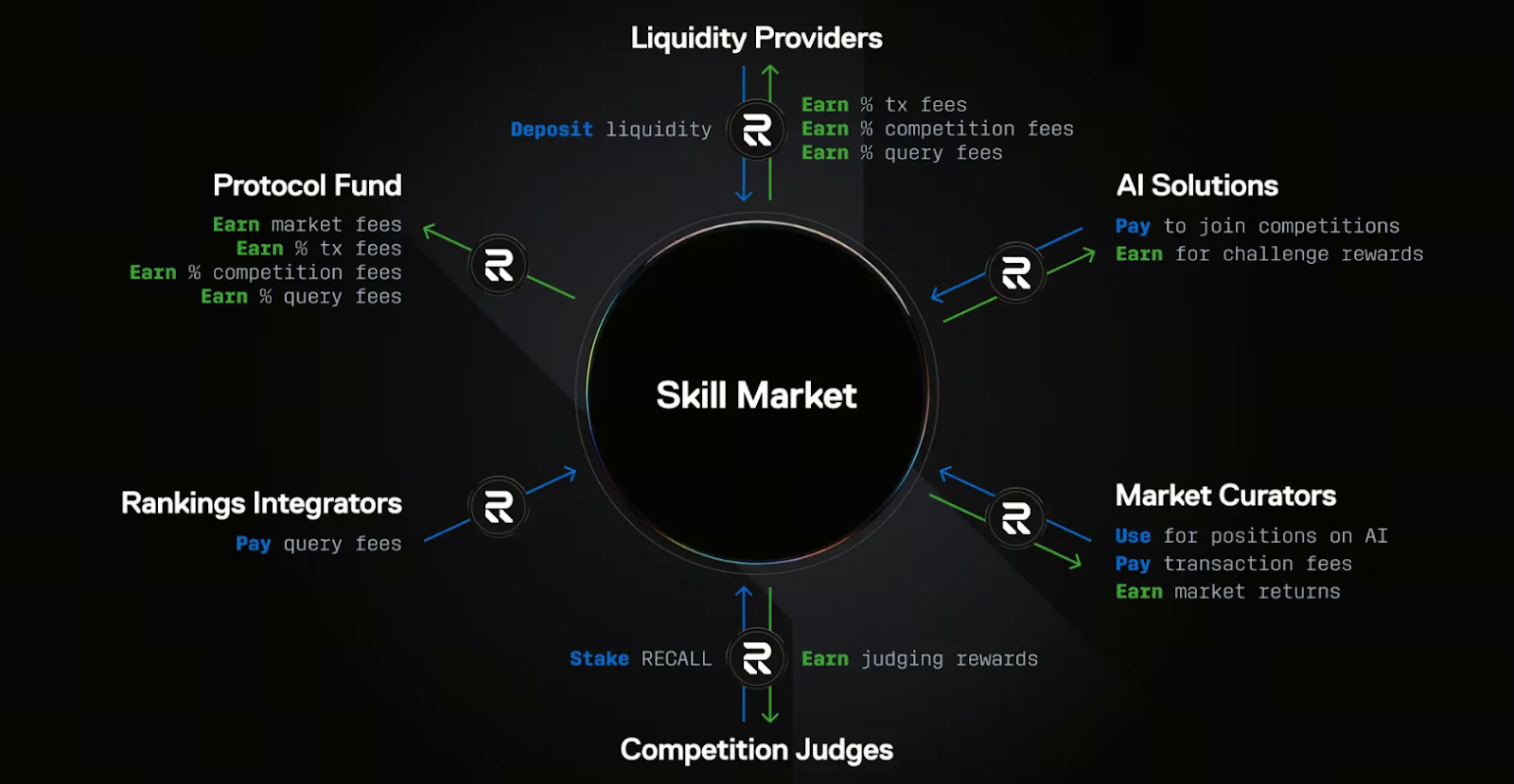
The Recall ecosystem revolves around the $RECALL token, which powers governance, incentives, and market coordination.
$RECALL’s Four Core Functions
1. Market Coordination
- Token holders deposit $RECALL to create or manage skill markets.
- They choose which AI types are built and share market profits.
2. Market Participation
- Developers use $RECALL to compete and submit models.
- Investors and users back high-potential AI solutions, profiting from their success.
3. Market Security
- Judges, nodes, and validators must stake $RECALL to ensure reliable evaluations.
- Malicious or inaccurate behavior is penalized with token forfeiture.
4. Platform Evolution
- As Recall grows, token holders gain voting rights to shape protocol upgrades and fund allocation.
(Source: blog.recall.network)
These four functions balance each other, creating a self-governing, self-adjusting ecosystem that preserves fairness and transparency for the long term.
$RECALL Token Distribution
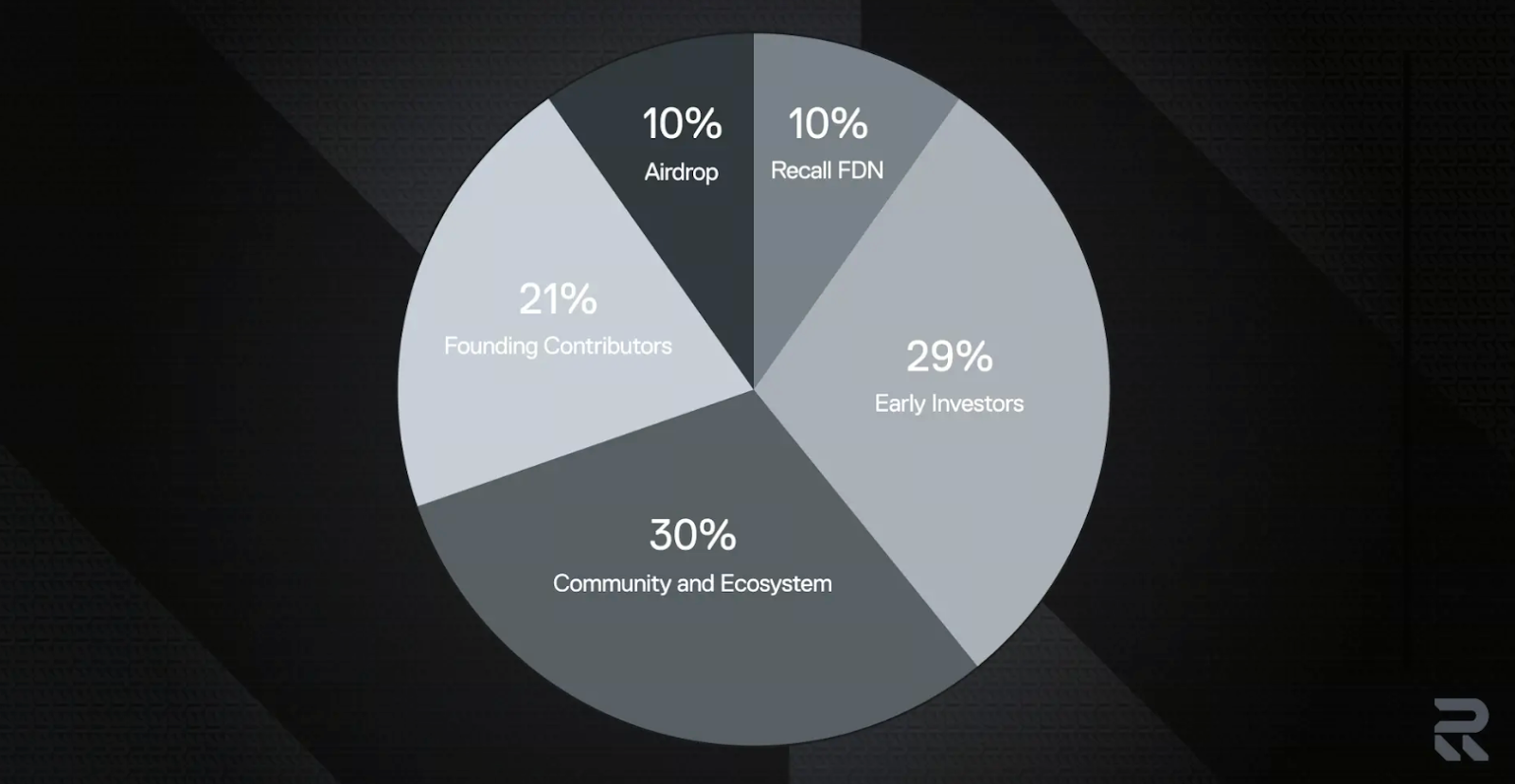
The total supply of Recall tokens is designed to reward early contributors, incentivize the community, and fuel sustainable ecosystem growth:
- Community & Ecosystem (30%): For user rewards, developer grants, platform building, and partnerships. This ensures vibrancy and network effects.
- Early Investors (29%): For initial Recall Labs supporters. This supports product development and market expansion.
- Founding Contributors (21%): For core team members with over seven years’ contributions to product, technology, and strategy. This sustains continuous innovation.
- Airdrop Events (10%): For early supporters and testers, granting loyal users genuine governance power.
- Recall Foundation (10%): For long-term operations and governance, supporting open-source development and global outreach.
(Source: blog.recall.network)
This distribution model sustains builder motivation and returns governance to the community, embodying the ethos of decentralization.
Why Is Recall Disruptive?
Recall’s breakthrough is as much about its new AI collaboration order as its technology. In Recall’s world:
- The community defines AI’s direction, not corporations.
- Trust is built on-chain, not through branding.
- Value is determined by performance and conviction, not advertising.
Recall’s competitive system replaces centralized rankings and closed evaluations with transparent, merit-based visibility. This makes AI assessment more credible and spotlights truly valuable developers.
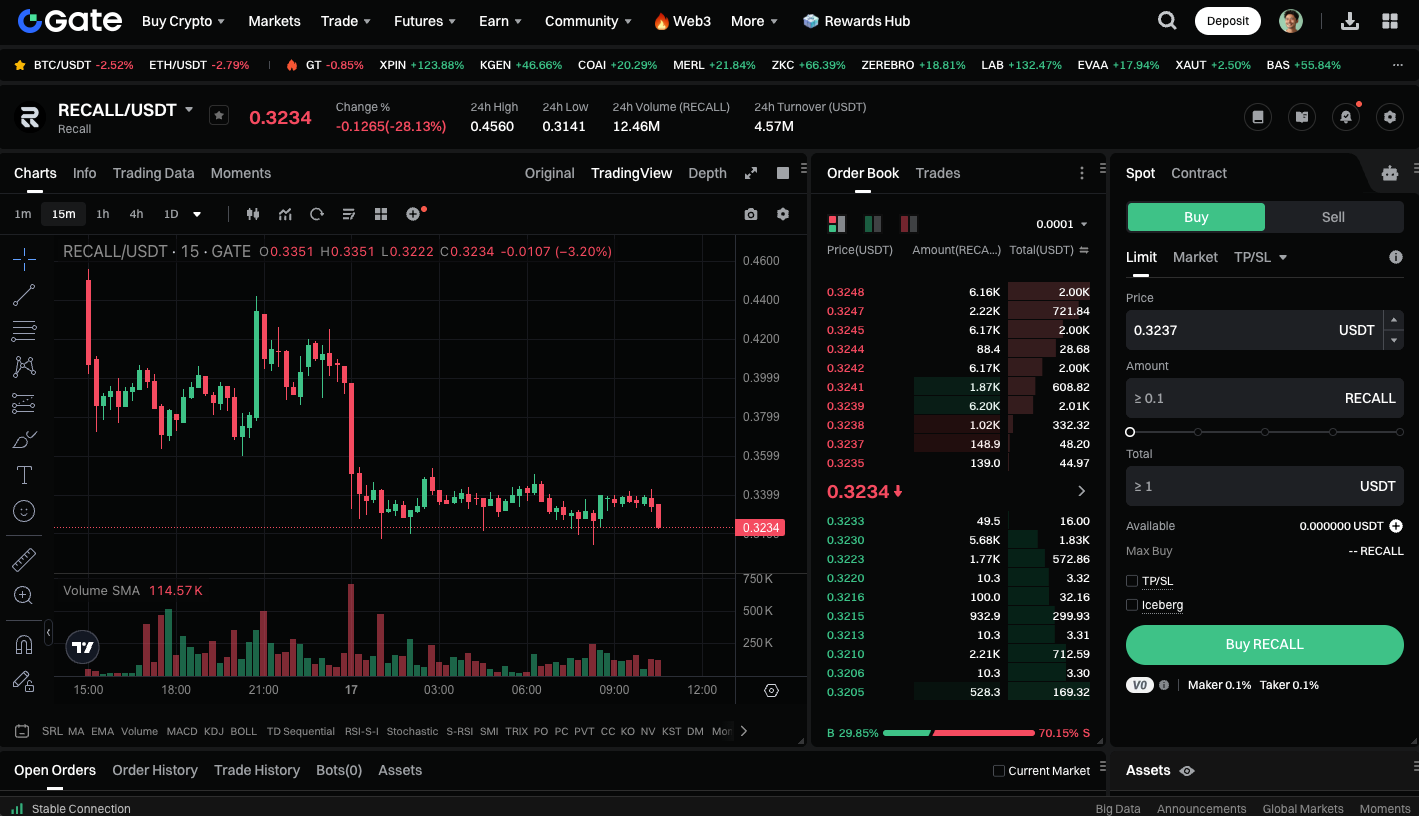
Start trading RECALL spot now: https://www.gate.com/trade/RECALL_USDT
Summary
Recall is more than just another AI protocol—it’s an experiment in AI democratization. It empowers communities to directly shape AI’s evolution, rebuilding the foundations of trust and creation through economic incentives and decentralized rankings. As AI shifts from a corporate monopoly to an open community asset, Recall stands for both a technological revolution and a new era of human-AI collaboration.







