As a protocol engineered for on-chain computation and distributed task execution, Golem is widely deployed in AI processing, CGI rendering, scientific computing, and a range of other high-performance computing scenarios.
With the rapid growth of artificial intelligence, on-chain applications, and the expansion of Web3 infrastructure, global demand for computing resources is accelerating. While traditional cloud computing delivers stable hash power services, its resource allocation, pricing mechanisms, and platform governance are highly centralized. In this context, decentralized hash power networks are becoming a critical vector for blockchain infrastructure. Golem’s distributed computing model seeks to lower the barriers to compute access through open market dynamics, boosting global resource utilization.
Within the digital asset and blockchain ecosystem, Golem serves not only as a “shared hash power platform” but also as an economic network built on decentralized computing. The GLM token acts as the vehicle for payments, settlements, and incentives, while node collaboration, task distribution, and on-chain payment mechanisms together form its operational foundation. This approach allows computing resources to be traded and orchestrated like digital assets, driving Web3 infrastructure toward greater openness.
Golem (GLM) Fundamentals: What Is a Decentralized Hash Power Network?
At its core, Golem is a “decentralized hash power network.” In essence, Golem aggregates idle CPUs, GPUs, and server resources worldwide into an open compute marketplace. When users require complex computational workloads, they can rent hash power directly from other nodes in the network rather than relying on a single cloud service provider.
Traditionally, compute resources on the internet are controlled by large cloud platforms—enterprises lease servers from centralized data centers. In the Golem network, anyone—individual or institution—can become a Provider by connecting their devices and offering resources to the network.
This model mirrors the “sharing economy” as applied to computing. Just as ride-sharing platforms match idle vehicles with users, Golem connects idle computing resources with users in need of computation.
Golem’s positioning straddles Infrastructure-as-a-Service (IaaS) and Platform-as-a-Service (PaaS): it furnishes foundational compute resources while also enabling developers to build and deploy distributed applications, expanding its software ecosystem through an open registration mechanism.
Concepts such as “decentralized hash power marketplace,” “on-chain computing network,” and “Web3 infrastructure” all emerge from Golem’s architecture, collectively defining the decentralized computing sector.
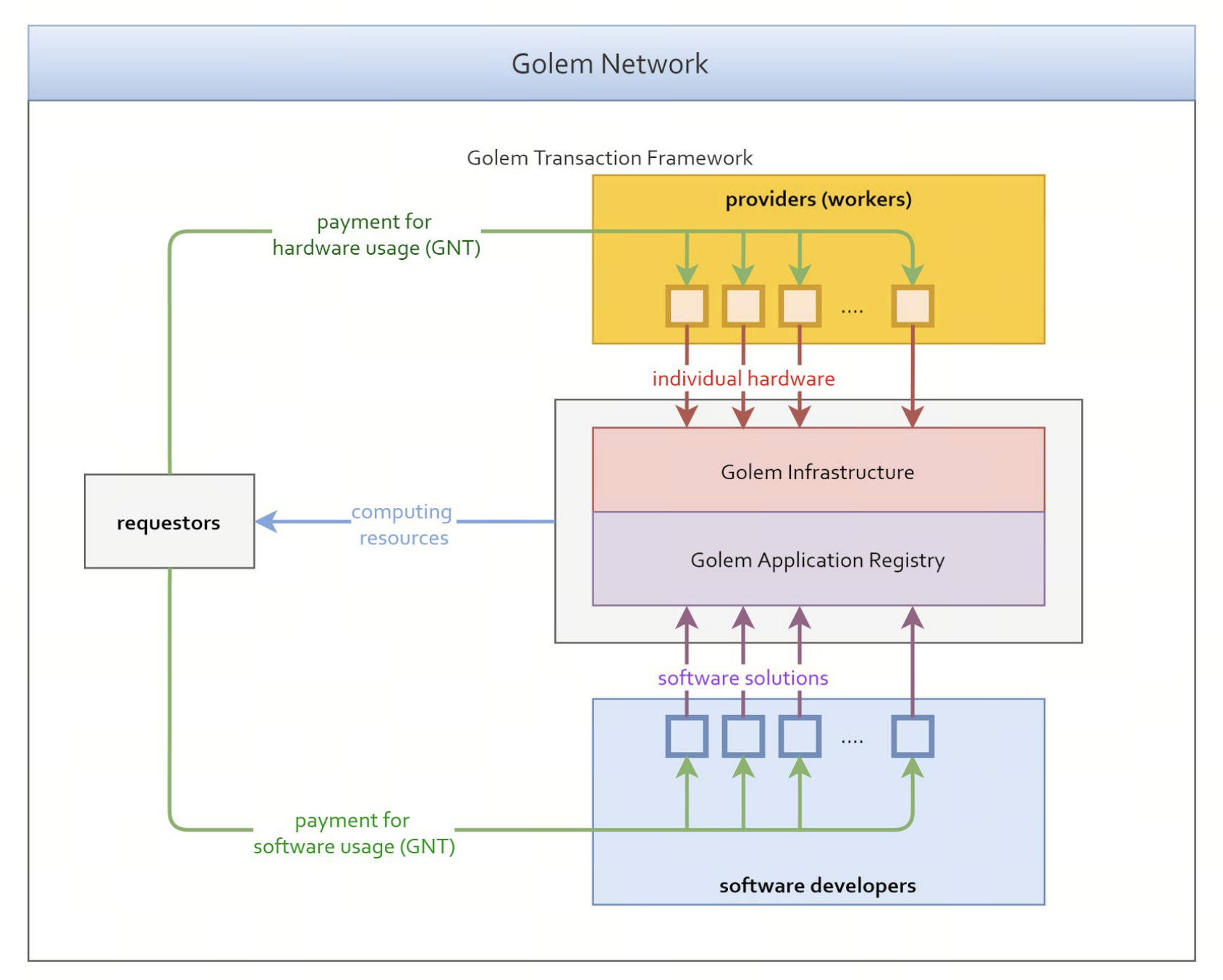
Source: golem.network
Golem’s Background: Why Does Blockchain Need Distributed Computing Resources?
Blockchain networks are inherently unsuited for direct execution of high-performance computing tasks. Take Ethereum—security and decentralization are its core priorities, not computational throughput. As a result, many AI inference, 3D rendering, or scientific simulation workloads are impractical to run directly on-chain.
Meanwhile, vast amounts of global hash power sit idle across personal computers, enterprise servers, and specialized GPU hardware. Although traditional cloud providers aggregate some of this supply, the market remains dominated by a handful of large technology companies.
This centralized structure creates several issues:
- Platform-dictated hash power pricing
- Reliance on a single provider
- Inefficient resource allocation
- Lack of an open market for developers
Golem’s emergence is fundamentally a restructuring of the global compute resource marketplace. Its aim is not to build yet another centralized server platform, but to enable an open, peer-to-peer hash power collaboration network.
As AI model training, machine learning, and off-chain data processing requirements surge, distributed computing’s importance is rising. Within the Web3 ecosystem, many use cases demand low-cost, open compute resources—decentralized hash power networks like Golem are positioned to fill this need.
In this respect, Golem is not just a project—it is a new paradigm for organizing compute resources.
GLM’s Role and Tokenomics in the Golem Network
GLM is the Golem network’s native token and serves as the principal medium of payment and settlement.
Within Golem, users (Requestors) who need compute resources pay Providers (nodes) for their hash power in GLM. Once a task is completed, the node receives a corresponding GLM reward.
Unlike conventional cloud platforms that rely on fiat payments, Golem utilizes an Ethereum-based on-chain payment system. This enables:
- Payment without centralized intermediaries
- Direct settlement between nodes
- Automated network incentive mechanisms
Beyond basic payments, GLM is vital for fueling the network’s economic cycle. Providers are incentivized by GLM rewards, while Requestors acquire computational capacity by paying GLM.
This creates a classic two-sided market structure:
| Role |
Action |
Reward |
| Requestor |
Submit compute tasks |
Receive hash power |
| Provider |
Supply idle hash power |
Earn GLM rewards |
| Developer |
Deploy apps and tools |
Capture ecosystem value |
Viewed holistically, GLM functions more as a “resource settlement asset” than a pure governance token.
Consequently, GLM’s value is directly linked to real network demand for hash power. As more applications launch on Golem, the compute marketplace expands, and the token becomes the linchpin of value exchange.
How Golem’s Decentralized Hash Power Marketplace Works
Golem’s backbone is its task distribution and distributed execution mechanism.
When a user submits a complex computing job, the system splits it into multiple independent subtasks, allocating them to different nodes for execution.
The typical workflow comprises:
- User submits compute request
- Network splits the job
- Provider nodes accept tasks
- Nodes perform computations
- Results are returned and verified
- GLM settlement and payment
For example, a CGI rendering job may consist of thousands of image frames. Traditionally, such tasks are handled by a single server cluster; with Golem, different frames are distributed to multiple nodes for parallel execution.
Key advantages of this model include:
- Enhanced resource utilization
- Global-scale parallel computation
- Reduced reliance on centralized servers
Golem also supports asynchronous task execution, so nodes do not need to remain online or in sync—they can complete computations independently based on task status.
This approach contrasts sharply with the “full node synchronous computation” model of typical blockchain networks and is better suited for high-performance compute scenarios.
Supporting mechanisms such as “task verification,” “decentralized scheduling,” and “node reputation systems” further determine the efficiency of the network.
Golem Network Participants: Requestors, Providers, and Developers
Three primary roles shape the Golem network:
Requestor
Requestors are users or application developers seeking compute resources. They submit tasks to the network and pay GLM for hash power.
Common use cases include:
- AI model inference
- Image rendering
- Scientific simulation
- Data analysis
Requestors are typically aiming to access compute resources more openly and at lower cost.
Provider
Providers contribute idle hash power to the network.
Any user with computing hardware can act as a Provider, including:
- Personal computer owners
- GPU holders
- Professional server operators
Providers compete on the basis of device performance, uptime, and resource configuration, and are rewarded in GLM for completed tasks.
Developer
Developers build software tools and expand the application ecosystem.
Golem allows developers to post applications on the network and grow the ecosystem through its app registration mechanism. Thus, Golem is not just a hash power marketplace—it’s also an open network for distributed software deployment.
Together, these roles form Golem’s self-sustaining ecosystem:
- Requestor creates demand
- Provider supplies resources
- Developer expands the application landscape
Golem Use Cases: AI, Rendering, Scientific Computing, and Off-Chain Processing
Golem’s most prominent applications are in high-performance computing.
Its architecture excels at parallelizable workloads, making it ideal for “divisible tasks.”
AI and Machine Learning
AI model training and inference are GPU-intensive, and decentralized hash power networks offer developers broader access to such resources.
With GPU demand surging, distributed hash power markets are fast becoming a foundational pillar of Web3 AI infrastructure.
CGI and 3D Rendering
CGI rendering was one of Golem’s first focus areas.
In animation, film, and gaming, large-scale rendering jobs often monopolize GPU resources for extended periods. Golem divides these tasks across multiple nodes, dramatically improving efficiency.
Scientific Computing
Tasks such as scientific simulations, data analysis, and mathematical modeling are also well-suited to distributed execution.
Their highly parallel nature allows decentralized hash power networks to be maximally leveraged.
Off-Chain Computing and Web3 Applications
Certain Web3 applications require complex off-chain computation, such as:
- Zero-knowledge proof generation
- Data processing
- AI inference
- Off-chain automation
Such needs are driving networks like Golem to become integral to Web3 infrastructure.
Golem is often compared to cloud platforms such as AWS or Google Cloud, but their architectures are fundamentally different.
Traditional cloud platforms are centralized, relying on data centers. Golem employs a peer-to-peer node network.
| Dimension |
Golem |
Traditional Cloud Platform |
| Network Structure |
Decentralized node network |
Centralized data center |
| Resource Source |
Global idle devices |
Enterprise servers |
| Scheduling |
Market-based matching |
Centralized scheduling |
| Payment |
GLM on-chain |
Fiat currency |
| Control |
Open network |
Platform-controlled |
From a DePIN (Decentralized Physical Infrastructure Network) perspective, Golem is a prototypical decentralized infrastructure project. In contrast to some DePIN projects specialized in GPU or AI networks, Golem emphasizes general-purpose compute rather than a single use case.
In summary:
- Golem targets an open compute marketplace
- AI-focused networks are GPU-optimized
- Storage DePIN projects focus on data storage resources
Each project serves a distinct infrastructure market segment.
Golem (GLM) Strengths, Limitations, and Common Misconceptions
Golem’s strengths are its openness and resource efficiency.
By aggregating global idle devices, Golem can reduce barriers to compute access and maximize resource utilization. Its decentralized model also lowers dependence on single platforms.
However, limitations exist. Node stability can affect task execution; Providers span the globe, so network quality and uptime are inconsistent. Additionally, complex real-time tasks may not be suitable for distributed execution—applications requiring ultra-low latency are better served by centralized servers.
Another misconception is that Golem is simply a “blockchain cloud server.” In reality, it is more akin to an open compute marketplace, not a direct replacement for traditional cloud providers.
A further misconception is that “decentralized hash power is always cheaper than traditional clouds.” In practice, pricing depends on task type, network supply and demand, and node resource structure. Golem and traditional cloud platforms are best seen as complementary, not mutually exclusive, models for organizing resources.
Conclusion
Golem (GLM) is an open hash power network built around decentralized compute resources, aiming to restructure the global computing market through peer-to-peer collaboration. Unlike traditional cloud platforms that rely on centralized data centers, Golem interconnects idle device resources to create a tradable distributed compute network, with on-chain payments and node incentives facilitated by the GLM token.
As demand for AI, Web3, and high-performance computing accelerates, decentralized hash power networks are emerging as a key pillar of blockchain infrastructure. The open compute model pioneered by Golem extends the off-chain capabilities of the blockchain ecosystem and propels the advancement of DePIN and distributed resource markets.
FAQ
What is Golem (GLM)?
Golem is a decentralized hash power network that forms an open compute marketplace by connecting idle computing resources globally. GLM is the network’s native payment token.
What is GLM’s role within the Golem network?
GLM is primarily used to pay for compute resources and serves as the Provider nodes’ reward asset.
How does Golem differ from traditional cloud computing?
Traditional cloud platforms depend on centralized servers, while Golem uses a decentralized node network for task distribution and computation.
What tasks are best suited for the Golem network?
AI inference, CGI rendering, scientific computing, and other divisible high-performance computing tasks are ideal candidates for distributed execution.
Is Golem a DePIN project?
Yes. Golem is part of the Decentralized Physical Infrastructure Network (DePIN), focusing on distributed compute resource markets.
Does Golem completely replace traditional cloud platforms?
No. Golem is optimal for open, parallel computation, while traditional cloud platforms retain advantages in stability and enterprise-grade real-time services.







