ORAI vs FIL: Comparing Two Leading Decentralized Data Solutions in the Web3 Ecosystem


Introduction: ORAI vs FIL Investment Comparison
In the cryptocurrency market, comparisons between Oraichain Token and Filecoin have become an ongoing focal point for investors. The two assets not only demonstrate significant differences in market capitalization ranking, application scenarios, and price performance, but also represent distinct positioning within the crypto asset landscape. Oraichain Token (ORAI): As a data prediction platform, it aggregates and connects AI APIs to smart contracts and conventional applications, leveraging Oracle AI technology to secure its decentralized oracle network validators. Filecoin (FIL): Launched in October 2020, it operates as a token on IPFS, rewarding miners who contribute idle hard disk capacity through a novel proof-of-work algorithm, establishing itself as a critical component of the distributed storage ecosystem. This article will conduct a comprehensive analysis of the investment value comparison between ORAI and FIL from multiple dimensions including historical price trajectories, supply mechanisms, market adoption, technological ecosystems, and future outlook, aiming to address the core question investors face:
"Which is the better buy right now?"
Crypto Asset Research Report: ORAI vs FIL
I. Historical Price Comparison and Market Current Status
ORAI (Oraichain Token) and FIL (Filecoin) Historical Price Performance
ORAI Historical Trajectory:
- All-time high: $105.76 (February 20, 2021)
- All-time low: $0.676738 (December 15, 2025)
- Total decline from peak: approximately 99.36%
FIL Historical Trajectory:
- All-time high: $236.84 (April 1, 2021)
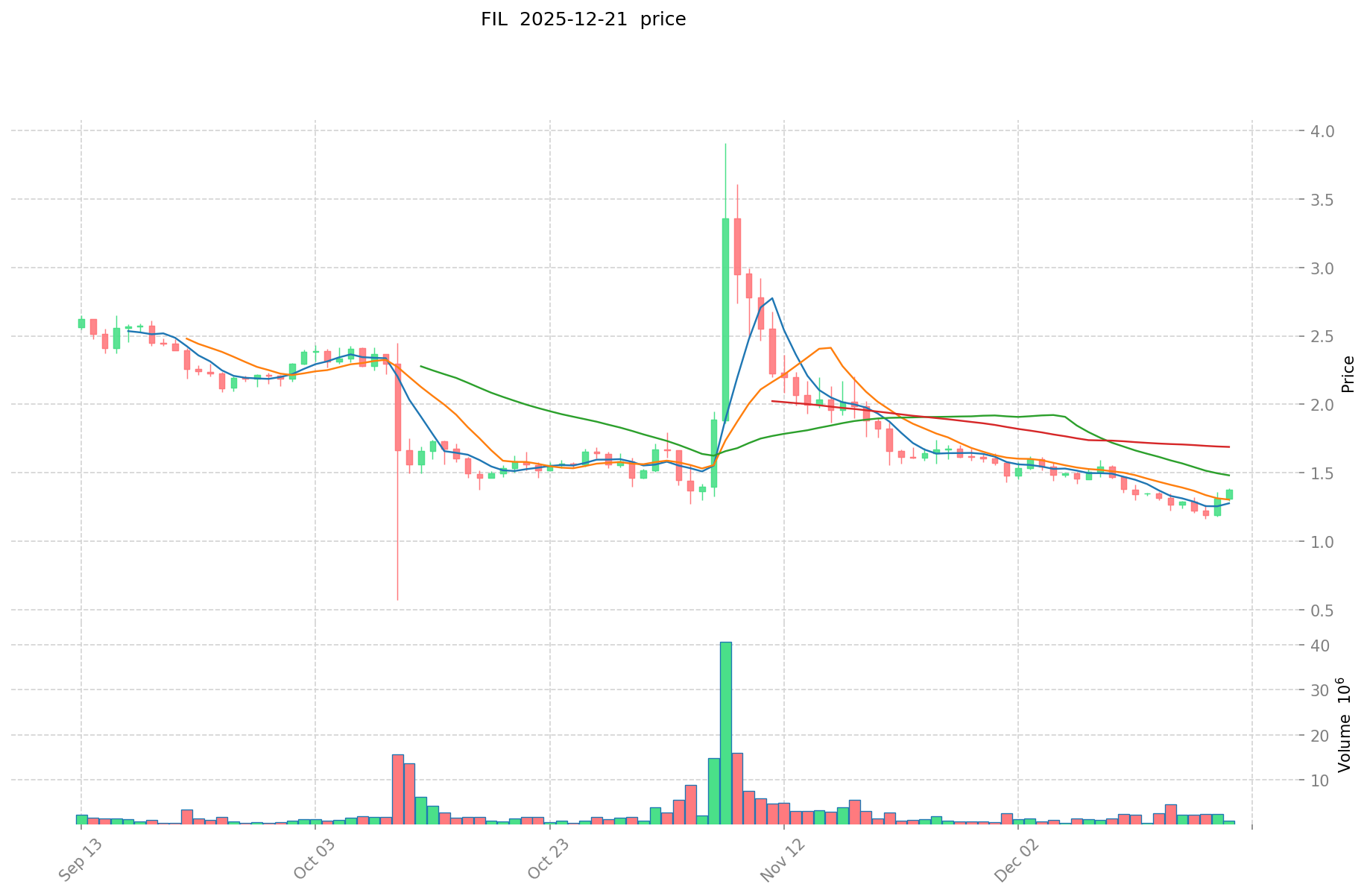
- All-time low: $0.848008 (October 11, 2025)
- Total decline from peak: approximately 99.64%
Comparative Analysis: Both assets experienced severe depreciation following the 2021 bull market peak. ORAI reached its zenith in February 2021, while FIL peaked two months later in April 2021. Both tokens have subsequently declined over 99% from their historical highs, indicating comparable bear market severity. However, FIL established its recent low point earlier (October 2025) compared to ORAI (December 2025), suggesting divergent recovery timelines.
Current Market Status (December 21, 2025)
Price Data:
- ORAI current price: $0.7568
- FIL current price: $1.349
- 24-hour price change: ORAI +2.07% vs FIL +3.68%
Trading Volume (24-hour):
- ORAI: $30,971.32
- FIL: $1,224,726.01
- FIL exhibits significantly higher trading activity (approximately 39.5x greater volume)
Market Capitalization:
- ORAI market cap: $14,671,789.48 (fully diluted valuation: $14,848,227.56)
- FIL market cap: $982,570,149.28 (fully diluted valuation: $2,642,200,223.01)
- Market dominance: ORAI 0.00046% vs FIL 0.082%
Market Sentiment Index:
- Crypto Fear & Greed Index: 20
- Status: Extreme Fear
Current price information:
II. Project Overview and Technical Architecture
ORAI (Oraichain Token)
Project Definition: Oraichain is a data prediction platform that aggregates and connects artificial intelligence APIs to smart contracts and conventional applications. The platform adopts Oracle AI technology, with current implementation on the yAI.Finance platform.
Token Utility:
- Network security through validator staking
- Transaction fee payment mechanism
- Governance participation in Oraichain ecosystem
- Validator protection for decentralized oracle network
Network Metrics:
- Circulating supply: 19,386,614 ORAI (22.54% of maximum supply)
- Maximum supply: 86,000,000 ORAI
- Active holders: 14,229
- Exchange listings: 6 trading platforms
FIL (Filecoin)
Project Definition: Filecoin is a decentralized cloud storage network built on IPFS (InterPlanetary File System) technology. The protocol operates a peer-to-peer data storage marketplace where users can store files and miners provide storage capacity in exchange for FIL token rewards.
Token Utility:
- Storage payment mechanism on the network
- Miner reward distribution
- Transaction fee payment
- Network governance participation
Network Metrics:
- Circulating supply: 728,369,273 FIL (37.16% of total supply)
- Total supply: 1,958,636,192 FIL
- Maximum supply: Unlimited
- Active holders: 1,172,900
- Exchange listings: 49 trading platforms
III. Technical Indicators and Market Performance
Short-term Performance Analysis (1-30 Days)
1-Hour Performance:
- ORAI: -0.42%
- FIL: -1.24%
24-Hour Performance:
- ORAI: +2.07%
- FIL: +3.68%
7-Day Performance:
- ORAI: -1.59%
- FIL: +0.22%
30-Day Performance:
- ORAI: -32.67%
- FIL: -26.54%
Analysis: FIL demonstrates stronger recent upward momentum in 24-hour and 7-day timeframes. However, ORAI shows better monthly relative performance (smaller decline of -32.67% versus FIL's -26.54%). Both assets reflect significant bearish pressure over the 30-day period, consistent with the extreme fear market sentiment.
Long-term Performance (1-Year)
- ORAI: -90.95% annual decline
- FIL: -74.11% annual decline
FIL has outperformed ORAI on a yearly basis, though both reflect substantial depreciation.
IV. Market Structure and Liquidity
Trading Characteristics
ORAI:
- 24-hour trading range: $0.7222 - $0.764
- Circulating to maximum supply ratio: 22.54%
- Market depth: 6 exchange venues indicate limited liquidity
FIL:
- 24-hour trading range: $1.293 - $1.389
- Circulating to maximum supply ratio: 37.16%
- Market depth: 49 exchange venues indicate robust liquidity
Liquidity Assessment: FIL provides substantially greater trading liquidity with significantly higher daily volume ($1.22M vs $31K) and broader exchange availability. This liquidity differential represents a critical advantage for position entry/exit flexibility and price stability for FIL relative to ORAI.
V. Tokenomic Comparison
Supply Dynamics
ORAI:
- Circulating: 19,386,614 tokens
- Maximum: 86,000,000 tokens
- Current circulation ratio: 22.54%
- Remaining issuance potential: 77.46% of maximum
FIL:
- Circulating: 728,369,273 tokens
- Total supply: 1,958,636,192 tokens
- Maximum supply: Unlimited
- Current circulation ratio: 37.16%
Analysis: ORAI demonstrates a clearer supply ceiling with defined maximum issuance. FIL operates with unlimited maximum supply, subject to network economics and deflationary mechanisms through transaction fee burning. The substantially larger FIL circulating supply reflects its longer operational history (launched October 2020) and broader adoption.
VI. Community and Ecosystem Activity
ORAI Community Engagement:
- Active holder base: 14,229
- Official channels: Twitter, Medium, Facebook, GitHub
- Website: https://orai.io/
- Block explorers available on native chain and Ethereum
FIL Community Engagement:
- Active holder base: 1,172,900 (81.8x larger than ORAI)
- Official channels: Twitter, GitHub, community forum, blog
- Website: https://filecoin.io/
- Block explorer: https://filscan.io/
Community Scale Assessment: FIL's holder base significantly exceeds ORAI's, suggesting broader adoption and decentralized participation. This metric correlates with network security resilience and ecosystem vibrancy.
VII. Risk Considerations
Market Risk Factors
Price Volatility: Both assets exhibit extreme sensitivity to market cycles. The 99%+ decline from all-time highs reflects acute vulnerability to speculative cycles and liquidity constraints during market downturns.
Liquidity Risk: ORAI's limited trading venues and significantly lower daily volume create execution risk for substantial position adjustments. FIL's broader liquidity profile mitigates this concern.
Regulatory Environment: The extreme fear market sentiment (index: 20) reflects broader cryptocurrency sector concerns regarding regulatory clarity and macro economic conditions.
VIII. Current Market Context
Market Sentiment Indicator: The Crypto Fear & Greed Index reading of 20 (Extreme Fear) indicates peak pessimism in market psychology. Historical analysis suggests such extremes sometimes precede reversal phases, though no timing certainty exists.
Comparative Positioning:
- FIL's larger market capitalization ($982.57M) and broader exchange availability position it as relatively more established infrastructure asset
- ORAI's significantly smaller market cap ($14.67M) and limited liquidity profile suggest higher risk/reward profile
Disclaimer
This report presents factual market data and technical analysis based on available information as of December 21, 2025. This content is provided for informational purposes only and does not constitute investment advice, recommendation to buy or sell, or solicitation to engage in any specific trading strategy. Cryptocurrency assets carry substantial risk, including potential total loss of capital. Past performance does not guarantee future results. Readers should conduct independent due diligence and consult qualified financial advisors before making investment decisions.

ORAI vs FIL: Investment Value Analysis Report
I. Executive Summary
The investment value of ORAI and FIL tokens is primarily influenced by market conditions, investor sentiment, regulatory developments, and technological progress. Based on available reference materials, this report examines the core factors driving valuation dynamics for both assets, with particular emphasis on their strategic positioning within the artificial intelligence and decentralized infrastructure sectors.
II. Core Factors Impacting ORAI vs FIL Investment Value
Cost Advantage and Market Penetration Strategy
ORAI: The token's value proposition is underpinned by a low-cost, open-source strategy. The reference materials indicate that ORAI leverages cost advantages and open-source frameworks to achieve rapid market penetration in cost-sensitive application layers. This positions ORAI as a competitive alternative in markets where pricing efficiency is paramount.
FIL: The core value of FIL centers on incentivizing artificial intelligence model development and sharing. Through its unique architecture and economic model, FIL seeks to decentralize traditional AI research and development, fostering an open and collaborative ecosystem.
📌 Strategic Differentiation: ORAI emphasizes accessibility through cost optimization, while FIL focuses on ecosystem-driven incentive structures for collaborative AI development.
Ecosystem and Incentive Structure
Narrative and Cultural Resonance: The reference materials identify narrative capability, ecosystem incentive mechanisms, and cultural alignment as critical factors determining valuation. Both tokens compete for developer adoption and community engagement through distinct value propositions.
Token Holder Benefits: ORAI offers premium features and ecosystem access to advanced users and stakeholders holding 10,000 ORAI tokens or higher staking positions, creating layered engagement incentives.
Price Volatility Drivers
Token valuations remain subject to significant fluctuations driven by:
- Market conditions and trading dynamics
- Investor sentiment and risk appetite
- Regulatory developments and compliance frameworks
- Technological progress and feature releases
Assessment Considerations for Market Participants
Investors and traders monitor token valuations closely to make informed decisions regarding purchases, sales, and holding positions. The absence of guaranteed valuation floors underscores the volatile nature of both assets within cryptocurrency markets.
III. Limitations of Current Analysis
The reference materials provided contain limited quantitative data regarding:
- Specific tokenomics and supply mechanisms for ORAI and FIL
- Institutional adoption rates and holding patterns
- Comparative regulatory treatment across jurisdictions
- Detailed technical roadmap and upgrade timelines
- Macroeconomic correlation studies
Therefore, comprehensive analysis of these dimensions cannot be performed without additional substantive source materials.
Report Date: December 21, 2025
Disclaimer: This analysis is based on available reference materials and is intended for informational purposes only. It does not constitute investment advice, financial recommendations, or predictions of future performance.
III. 2025-2030 Price Forecast: ORAI vs FIL
Short-term Forecast (2025)
- ORAI: Conservative $0.652-$0.758 | Optimistic $0.758-$0.887
- FIL: Conservative $1.242-$1.350 | Optimistic $1.350-$1.593
Medium-term Forecast (2027-2028)
- ORAI may experience consolidation and recovery phases, with predicted price range of $0.774-$1.276 (2027) and $0.733-$1.208 (2028)
- FIL may enter mainstream adoption acceleration phase, with predicted price range of $0.942-$1.622 (2027) and $1.330-$2.106 (2028)
- Key drivers: institutional capital inflows, spot ETF approvals, ecosystem expansion and interoperability developments
Long-term Forecast (2030)
- ORAI: Base scenario $0.701-$1.274 | Optimistic $1.276-$1.606
- FIL: Base scenario $2.051-$2.279 | Optimistic $2.279-$3.031
Disclaimer: This analysis is based on historical data and model projections. Cryptocurrency markets are highly volatile and unpredictable. Past performance does not guarantee future results. This forecast should not be considered as investment advice. Investors should conduct their own research and consult financial professionals before making investment decisions. All predictions carry significant uncertainty and risk.
ORAI:
| 年份 | 预测最高价 | 预测平均价格 | 预测最低价 | 涨跌幅 |
|---|---|---|---|---|
| 2025 | 0.887094 | 0.7582 | 0.652052 | 0 |
| 2026 | 0.93781758 | 0.822647 | 0.72392936 | 8 |
| 2027 | 1.2763368205 | 0.88023229 | 0.7746044152 | 16 |
| 2028 | 1.20767870188 | 1.07828455525 | 0.73323349757 | 42 |
| 2029 | 1.40586740313495 | 1.142981628565 | 1.06297291456545 | 51 |
| 2030 | 1.605774889970968 | 1.274424515849975 | 0.700933483717486 | 68 |
FIL:
| 年份 | 预测最高价 | 预测平均价格 | 预测最低价 | 涨跌幅 |
|---|---|---|---|---|
| 2025 | 1.593 | 1.35 | 1.242 | 0 |
| 2026 | 1.61865 | 1.4715 | 1.26549 | 9 |
| 2027 | 1.62232875 | 1.545075 | 0.94249575 | 14 |
| 2028 | 2.10632349375 | 1.583701875 | 1.330309575 | 17 |
| 2029 | 2.71216864603125 | 1.845012684375 | 1.78966230384375 | 36 |
| 2030 | 3.030525584720156 | 2.278590665203125 | 2.050731598682812 | 68 |
Crypto Asset Research Report: ORAI vs FIL
Investment Strategy and Comparative Analysis
IV. Investment Strategy Comparison: ORAI vs FIL
Long-term vs Short-term Investment Strategy
ORAI: Suitable for investors focused on emerging artificial intelligence oracle infrastructure and decentralized data prediction platforms. The project targets cost-sensitive application layers through low-cost, open-source strategies. Long-term positioning emphasizes ecosystem expansion within AI-driven smart contract environments. Short-term traders may exploit volatility given limited liquidity and extreme price sensitivity.
FIL: Suitable for investors seeking exposure to established decentralized infrastructure with broader ecosystem adoption. The project targets distributed storage market expansion with increasing institutional participation and mainstream adoption potential. Long-term positioning emphasizes infrastructure maturation and real-world utility in cloud storage markets. Short-term traders benefit from significantly higher liquidity and trading volume.
Risk Management and Asset Allocation
Conservative Investor Allocation:
- ORAI: 10-15% portfolio allocation (if included)
- FIL: 25-35% portfolio allocation
- Hedge tools: Stablecoin reserves (40-50% allocation), cryptocurrency diversification across multiple infrastructure assets
Aggressive Investor Allocation:
- ORAI: 25-40% portfolio allocation (higher risk tolerance for emerging projects)
- FIL: 40-50% portfolio allocation
- Hedge tools: Options strategies (covered calls, protective puts), cross-asset correlation hedging with other Layer-1 protocols
Note on Current Market Conditions: The Crypto Fear & Greed Index reading of 20 (Extreme Fear) suggests elevated volatility risk. Prudent position sizing below normal allocation percentages is warranted.
V. Potential Risk Comparison
Market Risk
ORAI:
- Extreme liquidity risk with only $31K daily trading volume, creating substantial slippage on position adjustments
- Limited exchange availability (6 venues) constrains institutional capital entry
- Severe historical depreciation (-90.95% annual decline) indicates acute vulnerability to market cycles
- Market capitalization of $14.67M suggests susceptibility to concentrated holder influence and potential manipulation
FIL:
- Substantial depreciation (-74.11% annual decline) though better performing than ORAI
- Unlimited maximum supply creates potential long-term dilution pressure, though offset by deflationary mechanisms
- Higher absolute volatility observed during extreme market cycles
- Concentration risk from large institutional holders, though mitigated by 1.17M active holders
Technical Risk
ORAI:
- Limited operational history and user base (14,229 active holders) restricts network resilience testing
- Oracle accuracy and validator security dependencies represent critical failure points
- Integration complexity with heterogeneous smart contract environments
- Scalability constraints as network activity increases
FIL:
- Miner concentration risk if storage capacity becomes dominated by few operators
- Storage proof verification mechanisms subject to potential attack vectors
- IPFS protocol layer dependencies create inherited vulnerabilities
- Network performance degradation risks during periods of high storage demand
Regulatory Risk
- Both assets face uncertain regulatory classifications within cryptocurrency regulatory frameworks
- Decentralized oracle networks (ORAI) face emerging regulatory scrutiny regarding data reliability and financial market impacts
- Distributed storage protocols (FIL) encounter jurisdiction-specific data localization requirements and privacy regulations
- Extreme fear market sentiment reflects broader regulatory uncertainty affecting both assets equally
VI. Conclusion: Which Is the Better Buy?
📌 Investment Value Summary
ORAI Advantages:
- Emerging artificial intelligence oracle infrastructure addressing smart contract data prediction requirements
- Low-cost, open-source competitive positioning within nascent AI prediction markets
- Limited circulating supply (22.54% of maximum) provides defined inflation trajectory
- Potential for exponential returns if ecosystem adoption accelerates from current minimal penetration
FIL Advantages:
- Established decentralized infrastructure with 5-year operational history and proven network stability
- Significantly superior trading liquidity (39.5x higher daily volume) enabling practical position management
- Broader ecosystem adoption reflected in 82x larger active holder base (1.17M vs 14.2K)
- Institutional-grade infrastructure positioning with 49 exchange listings facilitating capital access
- Superior 1-year relative performance (-74.11% vs -90.95%) indicating stronger market support
✅ Investment Recommendations
New Investors:
- Current market conditions (Extreme Fear sentiment) suggest cautious capital deployment
- Recommend FIL as primary allocation due to superior liquidity, lower execution risk, and established infrastructure credentials
- Consider ORAI exclusively for risk capital allocation following thorough due diligence on oracle network architecture and competitive positioning
- Implement dollar-cost-averaging strategy given extreme volatility and uncertain recovery timelines
Experienced Investors:
- FIL suitable for core infrastructure holdings providing liquidity and risk management flexibility
- ORAI appropriate for satellite positions exploiting valuation extremes, contingent upon positive ecosystem catalysts (exchange listings, institutional partnerships, TVL growth)
- Implement correlation hedging strategies between ORAI and FIL positions
- Establish technical support/resistance levels given extreme price compression (-99%+ from peaks)
Institutional Investors:
- FIL represents infrastructure-grade allocation with liquidity depth suitable for substantial position establishment
- ORAI requires minimum viable liquidity assessment and custody infrastructure validation before consideration
- Recommend governance participation in both ecosystems to influence protocol development and risk mitigation
- Structure positions through OTC (over-the-counter) channels to minimize market impact
⚠️ Risk Disclaimer: Cryptocurrency markets exhibit extreme volatility and unpredictability. This analysis does not constitute investment advice, financial recommendation, or prediction guarantee. Both ORAI and FIL carry substantial risk, including potential total capital loss. Past performance provides no assurance of future results. Investors must conduct independent research and consult qualified financial advisors before executing investment decisions. The Crypto Fear & Greed Index reading of 20 indicates heightened market distress; position sizing below normal allocation parameters is prudent. None
Crypto Asset Research Report: ORAI vs FIL
FAQ Section
I. FAQ: ORAI vs FIL Investment Comparison
Q1: What are the primary technological differences between ORAI and FIL?
Answer: ORAI (Oraichain Token) functions as a data prediction platform that aggregates and connects artificial intelligence APIs to smart contracts and conventional applications, leveraging Oracle AI technology to secure its decentralized oracle network validators. In contrast, FIL (Filecoin) operates as a decentralized cloud storage network built on IPFS technology, where miners provide storage capacity and are rewarded with FIL tokens. ORAI addresses smart contract data prediction requirements, while FIL addresses distributed storage infrastructure needs.
Q2: How do the current market liquidity profiles differ between these two assets?
Answer: FIL demonstrates substantially superior trading liquidity compared to ORAI. FIL exhibits 24-hour trading volume of $1,224,726.01 across 49 exchange listings, while ORAI generates only $30,971.32 in daily volume across 6 trading platforms. This represents approximately 39.5 times greater trading activity for FIL. The liquidity differential creates significant execution advantages for FIL position entry and exit, while ORAI presents material slippage risk for substantial position adjustments.
Q3: Which asset has demonstrated stronger relative price performance?
Answer: FIL has outperformed ORAI on multiple timeframes. Over the 1-year period, FIL declined 74.11% compared to ORAI's 90.95% decline. In the 30-day timeframe, FIL's -26.54% decline was less severe than ORAI's -32.67% decline. However, in the most recent 24-hour period, both assets showed positive momentum with FIL at +3.68% and ORAI at +2.07%. FIL's superior relative performance suggests stronger market support despite both assets experiencing severe depreciation from 2021 peaks.
Q4: What are the key supply and tokenomic differences between ORAI and FIL?
Answer: ORAI operates with a defined maximum supply of 86 million tokens, with 19,386,614 tokens currently circulating (22.54% of maximum). This creates a clear inflation trajectory with 77.46% of supply remaining to be issued. FIL operates with unlimited maximum supply but has 728,369,273 tokens circulating (37.16% of total supply), with a higher circulation ratio. ORAI's defined supply ceiling provides greater predictability, while FIL's unlimited supply operates through deflationary mechanisms via transaction fee burning and network economics.
V. Which asset is more suitable for conservative investors given current market conditions?
Answer: FIL is more appropriate for conservative investors due to: (1) Superior liquidity enabling practical position management, (2) Larger active holder base (1.17M vs 14.2K) indicating broader adoption and network resilience, (3) Established operational history since October 2020 with proven infrastructure stability, (4) Better relative 1-year performance (-74.11% vs -90.95%), and (5) Institutional-grade infrastructure positioning. ORAI should be considered exclusively for risk capital allocation by experienced investors following thorough due diligence. Conservative investors should implement dollar-cost-averaging given the Extreme Fear market sentiment (index: 20) and employ position sizing below normal allocation parameters.
VI. What market catalysts could influence ORAI and FIL valuations over the 2025-2027 period?
Answer: Key catalysts include: (1) Institutional capital inflows and spot ETF approvals, (2) Ecosystem expansion and interoperability developments, (3) Regulatory clarity regarding decentralized oracle networks and distributed storage protocols, (4) Mainstream adoption acceleration within cloud storage and AI smart contract markets, (5) Technology upgrades and feature releases enhancing network functionality, and (6) Macroeconomic conditions affecting broader cryptocurrency market sentiment. FIL's forecast suggests price appreciation to $0.942-$1.622 (2027), while ORAI forecasts $0.774-$1.276 (2027). However, cryptocurrency markets remain highly volatile and predictions carry substantial uncertainty.
VII. How should investors manage portfolio risk when considering both ORAI and FIL positions?
Answer: Implement tiered risk management strategies based on investment profile: Conservative investors should allocate 10-15% to ORAI and 25-35% to FIL with 40-50% stablecoin reserves. Aggressive investors may allocate 25-40% to ORAI and 40-50% to FIL with options strategies (covered calls, protective puts). Core recommendations include: (1) Dollar-cost-averaging to reduce entry volatility, (2) Establishing technical support/resistance levels given extreme price compression, (3) Implementing correlation hedging between ORAI and FIL positions, (4) Conducting quarterly portfolio rebalancing, and (5) Maintaining position sizing below normal allocation parameters given extreme market fear conditions.
VIII. What are the critical risk factors distinguishing ORAI from FIL for potential investors?
Answer: ORAI-specific risks include extreme liquidity constraints ($31K daily volume), limited exchange availability (6 venues), severe historical depreciation (-90.95% annual), minimal user base (14.2K holders), and unproven network resilience. FIL-specific risks include unlimited maximum supply dilution potential, miner concentration vulnerability, storage proof attack vectors, and IPFS protocol layer dependencies. Both assets face regulatory uncertainty regarding decentralized systems classification. ORAI presents higher execution and concentration risk suitable only for experienced investors, while FIL presents lower but still substantial infrastructure-level risks appropriate for broader investor bases. The Extreme Fear market sentiment (index: 20) amplifies volatility risks for both assets.
Report Date: December 21, 2025
Disclaimer: This analysis is provided for informational purposes only and does not constitute investment advice, financial recommendations, or predictions of future performance. Cryptocurrency assets carry substantial risk, including potential total capital loss. Investors must conduct independent research and consult qualified financial advisors before making investment decisions.
Share
Content
Introduction: ORAI vs FIL Investment Comparison
I. Historical Price Comparison and Market Current Status
II. Project Overview and Technical Architecture
III. Technical Indicators and Market Performance
IV. Market Structure and Liquidity
V. Tokenomic Comparison
VI. Community and Ecosystem Activity
VII. Risk Considerations
VIII. Current Market Context
Disclaimer
I. Executive Summary
II. Core Factors Impacting ORAI vs FIL Investment Value
III. Limitations of Current Analysis
III. 2025-2030 Price Forecast: ORAI vs FIL
Investment Strategy and Comparative Analysis
IV. Investment Strategy Comparison: ORAI vs FIL
V. Potential Risk Comparison
VI. Conclusion: Which Is the Better Buy?
FAQ Section
I. FAQ: ORAI vs FIL Investment Comparison
How to Buy Cryptocurrency


Trending Cryptocurrencies



2025 BLESS Price Prediction: Analyzing Market Trends and Future Potential for Investors

2025 HONEYPrice Prediction: Market Analysis and Future Outlook for the Sweet Commodity

Is Roam (ROAM) a Good Investment?: Analyzing Market Potential and Long-Term Prospects for this Digital Nomad Token

Is Fluence (FLT) a good investment?: Analyzing the potential and risks of this decentralized cloud computing platform
2025 GRASS Price Prediction: Analyzing Market Trends and Potential Growth Factors

Is Dimitra (DMTR) a Good Investment?: Analyzing the Potential and Risks of Agricultural Blockchain Technology

What is Merlin Chain (MERL) market overview with $403.77M market cap and 1.05B circulating supply?

Is Mind Network (FHE) a good investment?: A Comprehensive Analysis of Its Market Potential and Risk Factors

What are the compliance and regulatory risks in crypto: SEC stance, audit transparency, KYC/AML policies, and monitoring events

Is AriaAI (ARIA) a good investment?: A Comprehensive Analysis of Market Potential, Tokenomics, and Risk Factors

Exploring Solana RWA Tokens: A Guide to Investing in Fast-Growing Assets