Exploring IOTA: How Decentralized Ledger Technology Works

IOTA Blockchain Explained: Decentralized Ledger Technology for the Internet of Things
IOTA blockchain represents a revolutionary approach to distributed ledger technology, specifically engineered to address the unique challenges faced by the Internet of Things (IoT) ecosystem. Born from the need to overcome limitations in traditional blockchain networks—particularly issues related to interoperability, scalability, and energy consumption—IOTA has positioned itself as a groundbreaking solution that delivers an efficient, scalable, and environmentally sustainable network infrastructure.
What is IOTA Blockchain and How Does It Work?
IOTA blockchain is fundamentally a distributed ledger technology (DLT) purpose-built for the Internet of Things ecosystem. As an open-source platform, IOTA blockchain provides robust solutions across multiple domains, including supply chain tracking, digital identity management, secure value transfer, and decentralized finance (DeFi) applications. What distinguishes IOTA blockchain from conventional blockchain systems is its unique architectural foundation.
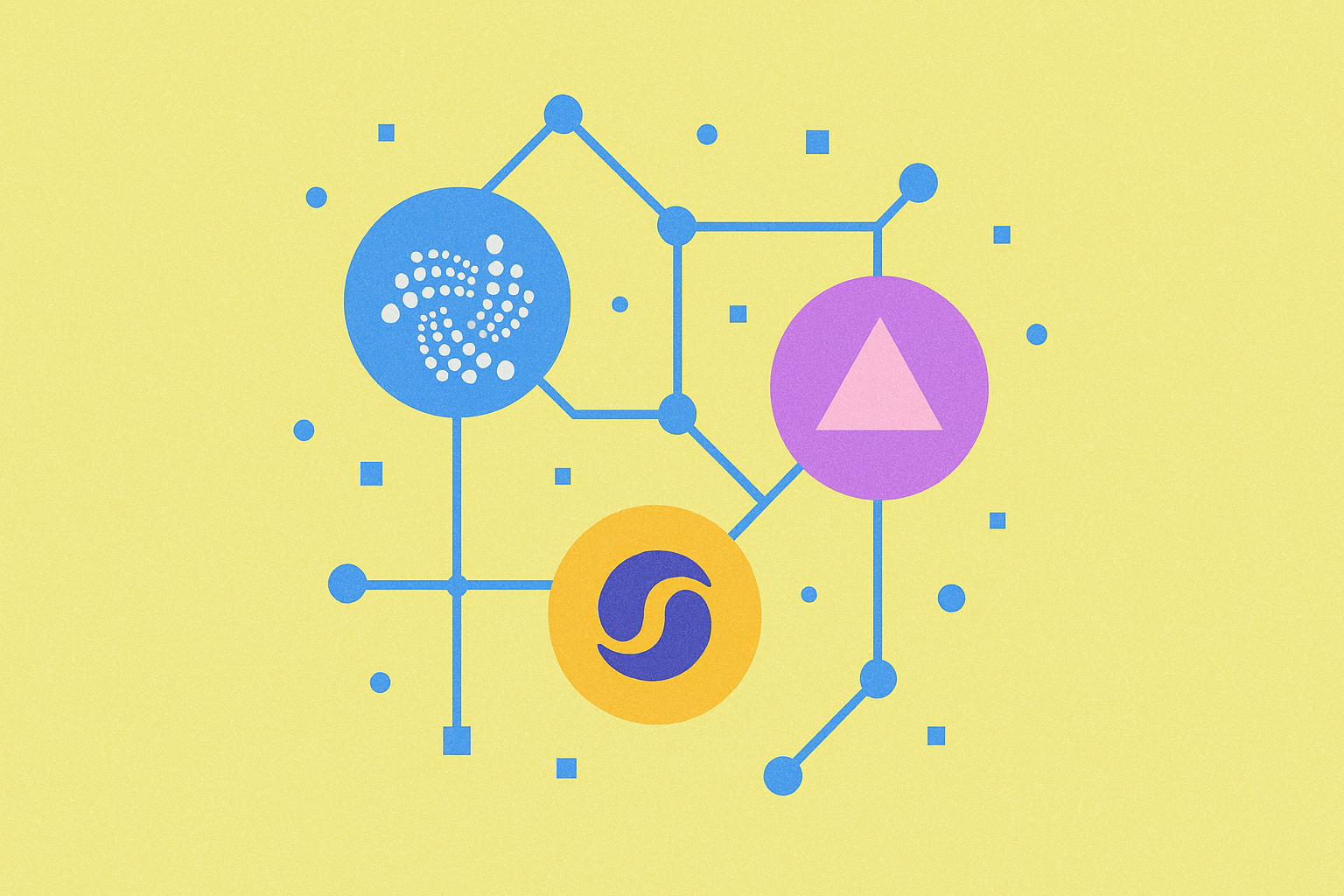
At the core of IOTA blockchain's innovation lies the Tangle—a directed acyclic graph (DAG) that fundamentally reimagines the traditional linear blockchain structure. Unlike conventional blockchains where transactions are sequentially organized in blocks, the Tangle allows transactions to be interlinked within a network of nodes, creating a web-like structure. In this architecture, each new transaction must validate two previous transactions before being confirmed, establishing a mesh of interconnected transactions that grows organically with network activity.
This innovative design delivers several compelling advantages. First, the Tangle offers superior scalability and efficiency, as the network's throughput increases with the number of participants—a stark contrast to traditional blockchains that face congestion as usage grows. Second, IOTA blockchain enables completely feeless transactions, eliminating the cost barriers that plague other cryptocurrency networks. Third, the system operates with remarkable energy efficiency, consuming far less power than proof-of-work blockchains. Finally, IOTA blockchain's architecture excels at processing minuscule transactions, making it ideal for machine-to-machine micropayments in IoT environments.
Complementing the Tangle is Shimmer, IOTA blockchain's production-grade staging network. Shimmer functions as a critical testing ground where upcoming protocol changes and new features are validated before deployment to the IOTA mainnet, ensuring stability and reliability in the production environment.
IOTA Blockchain 2.0
IOTA blockchain 2.0 marks a transformative milestone in the protocol's evolution, representing a comprehensive architectural rebuild designed to achieve full decentralization. This major upgrade is guided by five fundamental principles that shape its development trajectory.
Accessibility ensures that the network remains open and usable for all participants, regardless of their technical sophistication or resource availability. Parallelism enables simultaneous transaction processing, dramatically enhancing network throughput and reducing confirmation times. The principle of volume and velocity focuses on the network's capacity to handle massive transaction volumes at high speeds, essential for IoT environments generating continuous data streams.
Social dynamics recognizes the importance of community governance and stakeholder participation in network evolution. Finally, sustainable economics establishes a tokenomics model that incentivizes beneficial network behavior while ensuring long-term viability without relying on transaction fees.
IOTA Blockchain Use Cases
IOTA blockchain's versatility extends across numerous industries, serving as a foundational trust layer and underlying protocol for secure data and asset sharing. Real-world implementations demonstrate the technology's practical value and transformative potential.
In Industry 4.0 applications, IOTA blockchain has collaborated with major technology partners including Dell Technologies and Intel to tackle critical challenges in data reliability. As automated decision-making systems become increasingly prevalent in manufacturing and industrial operations, confirming the trustworthiness of large datasets becomes paramount. IOTA blockchain's immutable ledger provides verifiable data integrity, enabling confident automated decisions based on trustworthy information.
The travel and e-health sectors have benefited from IOTA blockchain's capabilities through partnerships with companies like Zebra Technologies. Together, they developed an open, secure, and interoperable infrastructure for digital health certificates. This system demonstrates IOTA blockchain's ability to create globally accessible verification systems while maintaining individual privacy and data security.
Smart city initiatives have leveraged IOTA blockchain to enhance urban infrastructure. ETO Gruppe implemented IOTA blockchain technology to upgrade smart traffic infrastructure through sensor modules embedded in traffic delineators. These sensors collect and transmit real-time traffic data securely and efficiently, enabling cities to optimize traffic flow, reduce congestion, and improve urban mobility without compromising data integrity or security.
The IOTA Blockchain Team
The IOTA Foundation, established in 2015, operates as a charitable non-profit organization headquartered in Berlin, Germany. This organizational structure reflects IOTA blockchain's commitment to developing technology for public benefit rather than private profit. The Foundation coordinates a global network of talented developers, designers, engineers, and entrepreneurs who collectively advance the protocol's development and adoption.
This distributed team approach enables IOTA blockchain to tap into diverse perspectives and expertise from around the world, fostering innovation while maintaining the project's non-profit ethos and commitment to open-source development.
IOTA Blockchain Tokens: IOTA, Mana, SMR
The IOTA blockchain ecosystem utilizes three distinct tokens, each serving specific functions within the network architecture.
The IOTA token serves as the primary medium for transferring value within the IOTA mainnet. Its defining characteristic is the complete absence of transaction fees, making it exceptionally attractive for microtransactions—a critical requirement for IoT applications where devices may need to exchange tiny amounts of value frequently. This feeless model enables use cases that would be economically impractical on fee-based networks.
Mana represents a crucial resource for accessing the IOTA blockchain ledger and updating its state through block creation. Rather than functioning as a traditional cryptocurrency, Mana operates as a reputation system within the IOTA blockchain network. Participants accumulate Mana based on their holdings and network activity, which then determines their influence in network consensus and their access to network resources during periods of high demand.
SMR is the native token exclusive to the Shimmer staging network. Unlike testnet tokens on other platforms, SMR holds real economic value and is traded on various cryptocurrency platforms. This design creates genuine incentives for participants to actively test and validate protocol changes on Shimmer, ensuring thorough evaluation before mainnet deployment while rewarding early adopters and contributors to network development.
Conclusion
IOTA blockchain represents a paradigm shift in distributed ledger technology, specifically engineered to meet the unique demands of the Internet of Things ecosystem. Through its innovative Tangle architecture, the protocol successfully addresses the critical challenges of scalability, transaction costs, and energy efficiency that have limited the application of traditional blockchain technology to IoT scenarios. The ongoing development of IOTA blockchain 2.0 demonstrates the project's commitment to achieving full decentralization while maintaining the performance characteristics essential for real-world IoT applications.
With proven use cases across industries ranging from manufacturing and healthcare to smart cities, IOTA blockchain has moved beyond theoretical promise to practical implementation. The strategic use of the Shimmer staging network and the thoughtful tokenomics involving IOTA, Mana, and SMR tokens create a sustainable ecosystem that incentivizes participation while enabling feeless transactions. As IOTA blockchain continues advancing toward scalability enhancements through technologies like sharding, it presents compelling opportunities for digital autonomy and decentralization, potentially revolutionizing how devices, systems, and organizations interact in an increasingly connected world. The IOTA Foundation's non-profit structure and global collaborative approach position the project to deliver on its vision of creating a trust layer for the machine economy, enabling secure, scalable, and sustainable data and value exchange for all participants in the IoT ecosystem.
FAQ
What is the IOTA blockchain?
IOTA is a decentralized blockchain for the Internet of Things, designed to facilitate feeless, scalable transactions. It uses a directed acyclic graph instead of traditional blockchains, enabling secure data management for IoT devices.
Is IOTA on Ethereum?
No, IOTA is not on Ethereum. It operates on its own unique distributed ledger technology called the Tangle, which is fundamentally different from blockchain-based networks like Ethereum.
What is the difference between IOTA and Bitcoin?
IOTA uses a DAG structure, enabling feeless and fast transactions, while Bitcoin relies on blockchain with mining and fees. IOTA focuses on IoT and microtransactions, Bitcoin on store of value.
Does IOTA have a future?
Yes, IOTA has a promising future. Its innovative technology and real-world applications position it well for growth. Continued development and adoption could lead to significant success by 2025.
Share
Content
How to Buy Cryptocurrency


Trending Cryptocurrencies



XZXX: A Comprehensive Guide to the BRC-20 Meme Token in 2025

Bitcoin Fear and Greed Index: Market Sentiment Analysis for 2025

Top Crypto ETFs to Watch in 2025: Navigating the Digital Asset Boom
5 ways to get Bitcoin for free in 2025: Newbie Guide

Bitcoin Market Cap in 2025: Analysis and Trends for Investors

2025 Bitcoin Price Prediction: Trump's Tariffs' Impact on BTC
Xenea Daily Quiz Answer December 14, 2025

Beginner's Guide to Understanding Crypto Terminology

Understanding Soulbound Tokens: A New Frontier in NFTs

Understanding Tendermint's Consensus Mechanism in Blockchain Technology

How to Purchase and Manage Ethereum Name Service Domains