Author: Fenrir, Crypto City
Florida Leads the U.S. in Stablecoin Regulation
Florida demonstrates its leadership in the digital asset industry by officially establishing the first state-level stablecoin regulatory framework in the United States. On March 6, 2026, the Florida Senate overwhelmingly passed the bill known as SB 314 with a vote of 37-0. This legislative milestone marks a significant step forward in promoting transparency and legitimacy within the cryptocurrency sector.
Samuel Armes, founder and president of the Florida Blockchain Business Association (FBBA), described this as a historic achievement on social media. The bill is expected to be signed into law by Governor Ron DeSantis within the next 30 days. Although a spokesperson from the governor’s office stated that the final text is still pending formal submission by the legislature, industry observers widely anticipate that the governor will sign the bill, making Florida a new benchmark for crypto regulation nationwide.
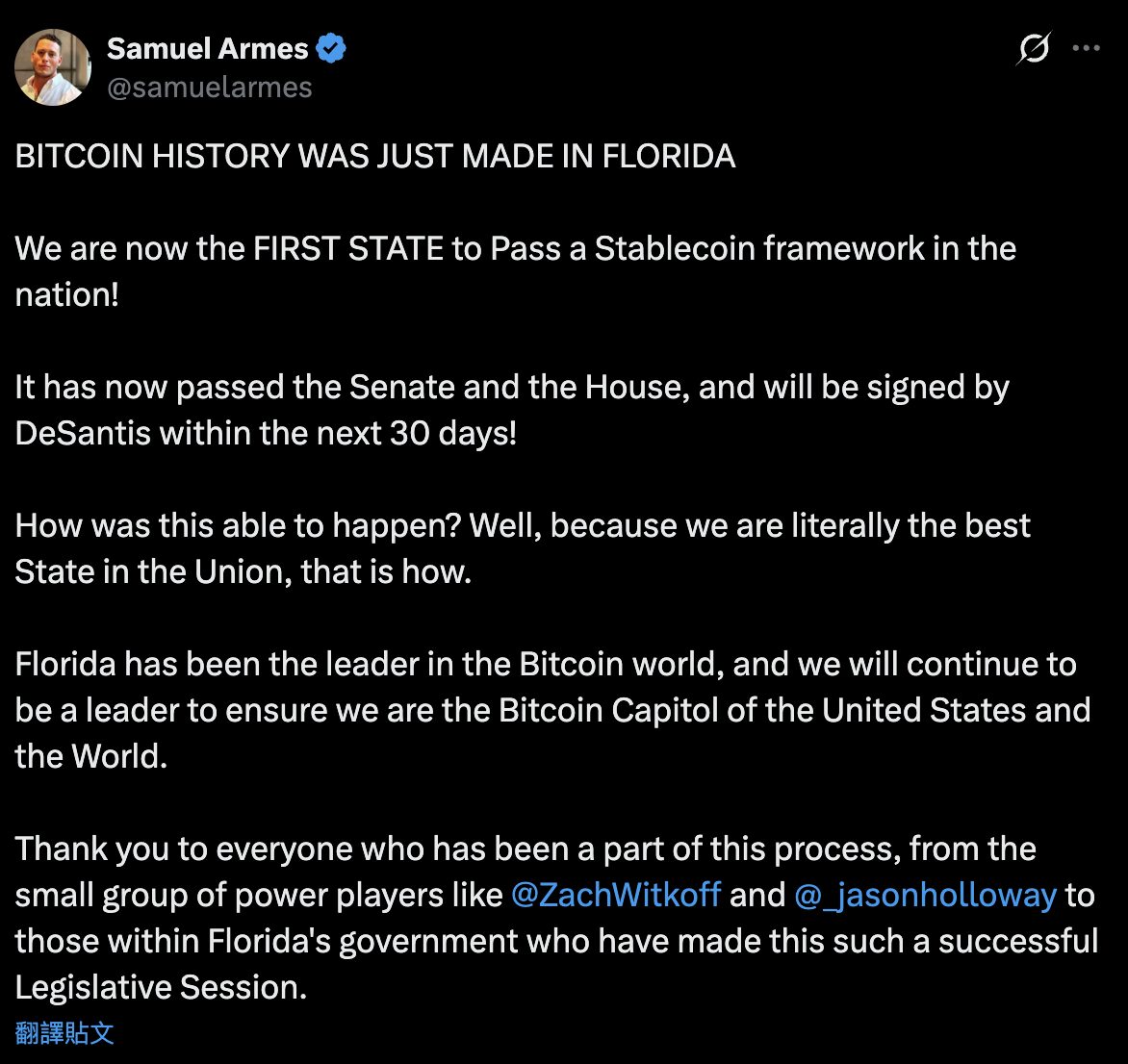
Image source: X/@samuelarmes | Samuel Armes, founder and president of the Florida Blockchain Business Association (FBBA), describes this as a historic milestone on social media.
Florida’s move reflects the current disconnect between local and federal regulators. While Washington D.C. continues to debate the definition of cryptocurrencies, Florida has chosen to proactively establish clear industry boundaries.
Samuel Armes emphasizes that Florida will continue to serve as a global leader in Bitcoin and blockchain innovation. This legal framework will attract more Web3 companies to set up shop. It’s not just a regulatory update but a concrete endorsement of digital assets’ future development, aiming to build a solid foundation for the digital economy.
Integrating Stablecoins into the Money Services Regulatory System
The core of SB 314 involves amending the existing Florida Money Services Business Anti-Money Laundering Act. The new law explicitly defines stablecoins as a form of “Monetary Value,” which is a significant legal development. This means stablecoin issuers must comply with standards equivalent to those for traditional money service providers.
Under the bill, stablecoin issuers operating within Florida must obtain relevant licenses and implement strict consumer protection and AML procedures. Additionally, the bill complements the House’s HB 175, which clarifies that certain payment stablecoins meeting specific criteria are not considered securities. This clarification provides issuers with valuable legal certainty. In the context of ongoing conflicts between federal regulators and the crypto industry over securities classification, Florida’s stance offers a safe harbor for businesses.
The bill also sets clear thresholds for interstate operations. Qualified issuers based outside Florida must submit written notice to the Florida Office of Financial Regulation (OFR) before conducting business, ensuring effective local oversight. Furthermore, transactions involving stablecoins over $10,000 must be fully recorded, aligning with traditional banking regulatory standards. By incorporating digital assets into the existing monetary regulatory framework, Florida effectively reduces compliance risks associated with innovative technologies and provides a legislative template for other states.
Federal Framework Alignment: Revenue-Generating Stablecoin Regulation
This legislation demonstrates Florida’s strategic foresight by linking with the federal GENIUS Act, which takes effect in July 2025. The bill establishes a dual oversight system: some issuers will be fully regulated by the Florida Office of Financial Regulation, while others will be jointly overseen by state and federal agencies such as the OCC.
A particularly notable aspect is how the bill addresses interest payments on stablecoins. According to the regulation, if federal law prohibits stablecoin issuers from paying yields or interest to holders, qualified Florida issuers must comply with this restriction. This design directly responds to the most heated debates in the U.S. financial sector.
Traditional banks view interest-bearing stablecoins as a threat to deposit bases and systemic financial stability. In fact, federal legislation like the Clarity Act remains stalled in the Senate due to strong opposition from the banking industry. Florida’s conservative stance on revenue-generating products aims to balance innovation with financial stability, reducing institutional resistance during implementation. This pragmatic approach reflects the attitude of Florida lawmakers, prioritizing the legitimacy of stablecoins as a means of payment over unrestricted feature expansion.
From Government Pilot Programs to Data Protection Measures
Beyond the core regulatory framework, Florida’s SB 314 also reveals ambitions to incorporate blockchain technology into public administration. The bill authorizes the state’s Department of Financial Services to launch a pilot program exploring the acceptance of approved stablecoins for paying licensing fees, taxes, and other government services.
This signifies official recognition of digital assets as legitimate payment methods. To further enhance the investment environment, Florida also passed CS/CS/SB 1440, which significantly strengthens confidentiality protections for data related to digital asset service providers.
These protections apply to crypto companies, trust companies acting as issuers, and qualified stablecoin issuers, aiming to safeguard trade secrets and sensitive operational data from regulatory scrutiny. Supporters argue that robust confidentiality measures are key to attracting top-tier companies, as businesses need assurance that their core technologies and trade secrets are legally protected while complying with regulations.
Despite ongoing disagreements at the federal level over regulatory rulings, Florida has chosen to solidify its position as a global hub for digital asset innovation through prudent local legislation. In the future, the integration of government services and digital assets in Florida will serve as a critical case study for blockchain application practices.
Disclaimer: The information on this page may come from third parties and does not represent the views or opinions of Gate. The content displayed on this page is for reference only and does not constitute any financial, investment, or legal advice. Gate does not guarantee the accuracy or completeness of the information and shall not be liable for any losses arising from the use of this information. Virtual asset investments carry high risks and are subject to significant price volatility. You may lose all of your invested principal. Please fully understand the relevant risks and make prudent decisions based on your own financial situation and risk tolerance. For details, please refer to
Disclaimer.
Related Articles
US-Iran Conflict Accelerates Wall Street's Shift to Tokenized Assets, RWA Market Surges
U.S.-Iran tensions push Wall Street toward tokenized real-world assets and on-chain futures, expanding tokenized Treasuries and DeFi hedges to manage off-hours volatility and energy-supply risks.
Abstract: The article assesses how the U.S.-Iran conflict is accelerating Wall Street’s adoption of tokenized real-world assets and on-chain futures to manage geopolitical volatility. It notes a surge in tokenized U.S. Treasuries, broader institutional integration, and the use of blockchain pricing during market closures. IMF projections of higher oil prices and slower growth frame the case for tokenized oil and DeFi hedges as prudent responses to energy shocks and supply disruptions.
GateNews14m ago
Trump Signals Openness: Consider a Currency Swap With the UAE, Extending “Wartime Dollar Diplomacy” Further
CNBC reported that Trump publicly said he would help if needed, considering establishing a currency swap channel with the UAE, marking the White House’s first public response on the issue. The UAE central bank governor visited the U.S. last week to raise the possibility, but the actual decision still rests with the U.S. Federal Reserve. Fighting in the Strait of Hormuz disrupts dollar liquidity; if it goes ahead, it would broaden the impact of dollar diplomacy and on crypto, stablecoins, and global inflation/exchange rates.
ChainNewsAbmedia1h ago
Ripple Joins BIS Taskforce for Cross-Border Payments Interoperability
Summary: Ripple joins a BIS Payments taskforce to improve cross-border payment interoperability, contributing blockchain expertise to cut delays, fees, and opacity in global transfers.
Abstract: This note reports that Ripple has joined a BIS taskforce under the Payments and Market Infrastructure committee to address cross-border payment interoperability. The taskforce seeks to reduce delays, fees, and opacity across international settlements, with Ripple contributing its blockchain-based technology to help design scalable global frameworks.
GateNews2h ago
Bank of Korea Prioritizes CBDCs Under New Governor Shin, Maintains 2.5% Rate Amid Regional Uncertainty
Gate News message, April 22 — South Korea's central bank has entered a new monetary phase with newly appointed governor Shin Hyun-song placing central bank digital currencies (CBDCs) at the forefront of the country's financial system. In his inaugural address, Shin positioned CBDCs and bank-issued d
GateNews2h ago
Iran's Revolutionary Guards Vow Swift Response to Any Future Aggression
IRGC says it is on high alert and ready to deliver a decisive, swift response to threats and potential aggression, reaffirming its commitment to confronting hostile forces.
Abstract: Iran's Islamic Revolutionary Guard Corps states its forces are on high alert and prepared to mount a decisive, comprehensive, and swift response to threats or potential future aggression, underscoring deterrence and its ongoing confrontation of hostile forces as reported by Tasnim News Agency.
GateNews3h ago
Russia's State Duma Passes Cryptocurrency Regulation Bill on First Reading, Allows Cross-Border Crypto Settlement to Bypass Sanctions
Gate News message, April 22 — Russia's State Duma passed a cryptocurrency regulation bill on first reading, classifying cryptocurrencies as "property" and designating the Central Bank of Russia to oversee market participants' licensing and supervision. The bill introduces a tiered access mechanism f
GateNews3h ago


