
According to the crypto financing overview released by Messari on Sunday, from March 2025 to March 2026, crypto financing amounts increased by nearly 50% compared to the previous 12 months, but the number of completed transactions decreased by 46%. The average transaction size rose to $34 million, a 272% annual increase. Venture capital firms are focusing on later-stage and strategic large funding rounds rather than broad participation in early-stage projects.
Structural Shift in Financing Growth: Capital Concentration Replaces Broad Participation
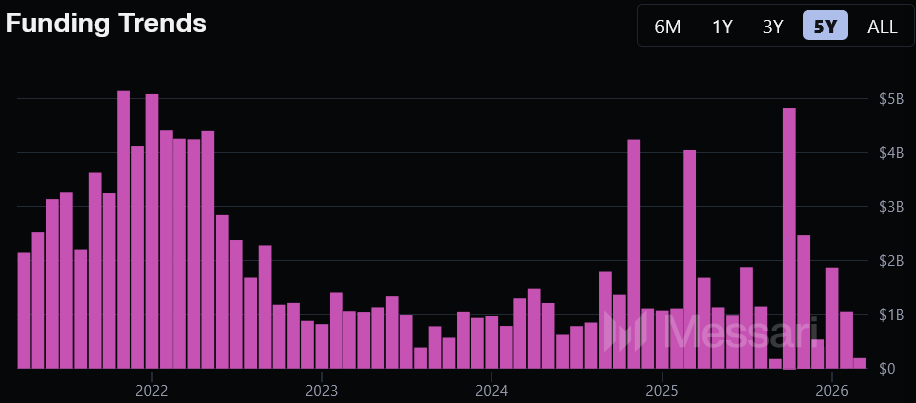
(Source: Messari)
Messari’s data presents a market picture of “total growth but declining participation”:
Total Financing: Nearly 50% annual increase, significant expansion in capital size
Number of Transactions: Down 46% year-over-year, overall market activity contracts
Average Transaction Size: Increased to $34 million, up 272% annually, with a substantial rise in top-tier deals
Number of Active Investors: Down 34.5%, to 3,225, indicating a shrinking market participant base
Eric Turner pointed out, “Capital concentration is heavily skewed toward later-stage and strategic large funding rounds,” illustrating this with February data: the total crypto financing in that month was $795 million, with 44% concentrated in three deals, clearly showing a concentration effect.
February’s Top Three Financing Deals: Structural Dominance of Large Rounds
These three deals exemplify the current structural features of the crypto financing market—large, late-stage, strategic:
Tether invested $200 million in the online marketplace Whop, the largest single deal of the month, indicating that crypto-native institutions, represented by stablecoin giants, are strategically extending into traditional tech sectors.
Sports prediction market Novig raised $75 million in a Series B funding round led by Pantera Capital, a representative case of institutional capital recognition in the prediction industry.
ARQ, a Latin American fintech focused on stablecoins, completed a $70 million Series B funding round led by Sequoia Capital, demonstrating top-tier Silicon Valley VCs’ continued focus on crypto fintech in emerging markets.
Notably, the $795 million figure for February decreased by 65.3% compared to the previous 30 days, indicating high monthly volatility, with data heavily influenced by top deals.
Industry Funding Gap: Stagnation of Large VC Funding and AI Diversion Effects
Eric Turner also highlighted a structural issue worth noting: aside from Dragonfly Capital, no other major crypto venture firms have completed new funding rounds recently. He directly stated, “This industry needs some new capital.” This suggests that while the market’s capital stock is growing, the primary market’s new capital pool has relatively stagnated, raising concerns about long-term sustainability.
Meanwhile, some investment firms are shifting funds toward artificial intelligence and high-performance computing (HPC), leading to capital competition from adjacent sectors. Messari data shows that over the past three months, the most active crypto investors were Coinbase Ventures, QUBIC Labs, and Somnia.
In early-stage funding, Messari notes that the number remains relatively high but “quite dispersed,” such as Interstate raising $1.5 million from over 15 participants—including Bloccelerate VC and angel investor Sergey Gorbunov—indicating broad but relatively small early-market activity.
Frequently Asked Questions
What is the main driver behind the 50% growth in crypto financing over the past 12 months?
According to Messari data, the core driver is the expansion of late-stage and strategic large funding rounds, with the average deal size increasing to $34 million (up 272% annually). Capital concentration effects mean that even with a 46% decrease in transaction count, total financing still grew by about 50% annually.
How does current crypto financing compare to the peak periods of 2021-2022?
November 2021 and May 2022 marked historic peaks, with monthly financing reaching $4 billion. Since then, this milestone has only been achieved three times. While there has been annual growth in the past 12 months, the overall scale remains far below the levels of 2021-2022.
What impact does the stagnation of large crypto VC funding have on the industry?
Eric Turner pointed out that aside from Dragonfly Capital, no other major crypto VC firms have completed new funding rounds recently. The stagnation of primary market capital pools could pressure long-term investment funding, and Turner directly stated that “the industry needs some new capital.”
Disclaimer: The information on this page may come from third parties and does not represent the views or opinions of Gate. The content displayed on this page is for reference only and does not constitute any financial, investment, or legal advice. Gate does not guarantee the accuracy or completeness of the information and shall not be liable for any losses arising from the use of this information. Virtual asset investments carry high risks and are subject to significant price volatility. You may lose all of your invested principal. Please fully understand the relevant risks and make prudent decisions based on your own financial situation and risk tolerance. For details, please refer to
Disclaimer.
Related Articles
Deutsche Bank Survey: U.S. Crypto Retail Participation Rate Rebounds to 12% in March
Deutsche Bank released a research report on April 20, citing db DataInsights survey data covering 3,400 consumers in the United States, the European Union, and the United Kingdom. The report shows that the retail adoption rate of cryptocurrencies in the U.S. rebounded to 12% in March, returning to the level of July 2025. The report also indicates that 70% of respondents who hold cryptocurrencies said they hold Bitcoin, the highest share among all types of crypto assets.
MarketWhisper2h ago
a16z latest report: Why blockchain is the missing infrastructure piece that AI agents need?
a16z crypto’s latest report says that AI agents are evolving from support tools into economic actors, yet there are still major gaps in core infrastructure such as identity, payments, and cross-platform collaboration. The report emphasizes that as AI becomes involved in governance and transactions, verification mechanisms become the key to trust, and blockchain technology can provide verifiable infrastructure to address these challenges. The future will require cryptographic mechanisms to ensure that AI agents truly represent users’ intent and to change traditional payment systems.
ChainNewsAbmedia10h ago
Three Major Platforms Control 75% of Stock Perpetual Futures Market in Q1 2026
TokenInsight’s Q1 2026 report reveals that the stock perpetual futures market is dominated by a few top platforms, which collectively hold about 75% market share. Major exchanges are increasingly offering U.S. stock and finance products to enhance cross-asset trading.
GateNews16h ago
Cross-Asset Hedging Emerges as Mainstream Strategy, Q1 Report Shows
A report by Block Scholes reveals rising correlations between crypto assets and traditional markets, noting increased demand for unified trading platforms as traders manage diverse assets. Trading volumes have surged, reflecting a shift towards multi-asset strategies.
GateNews17h ago
Digital Asset Investment Products Record $1.4B Net Inflows Last Week, Highest Since January
CoinShares reported $1.4 billion in net inflows for digital asset investment products last week, marking the largest increase since January. Bitcoin led with $1.116 billion, while Ethereum saw $328 million inflow. The U.S. contributed significantly, though Switzerland experienced outflows.
GateNews17h ago
DeFi hackers stole $600 million in April; Kelp DAO and Drift accounted for 95% of the monthly losses
In April 2026, within just 20 days, cryptocurrency protocols suffered losses of more than $606 million due to hacker attacks, becoming the worst single-month loss record since the February 2025 exchange incident in which $1.4 billion in data was leaked. The two attacks by KelpDAO and Drift Protocol accounted for 95% of April’s losses, and 75% of the total $771.8 million losses as of now in 2026.
MarketWhisper21h ago


