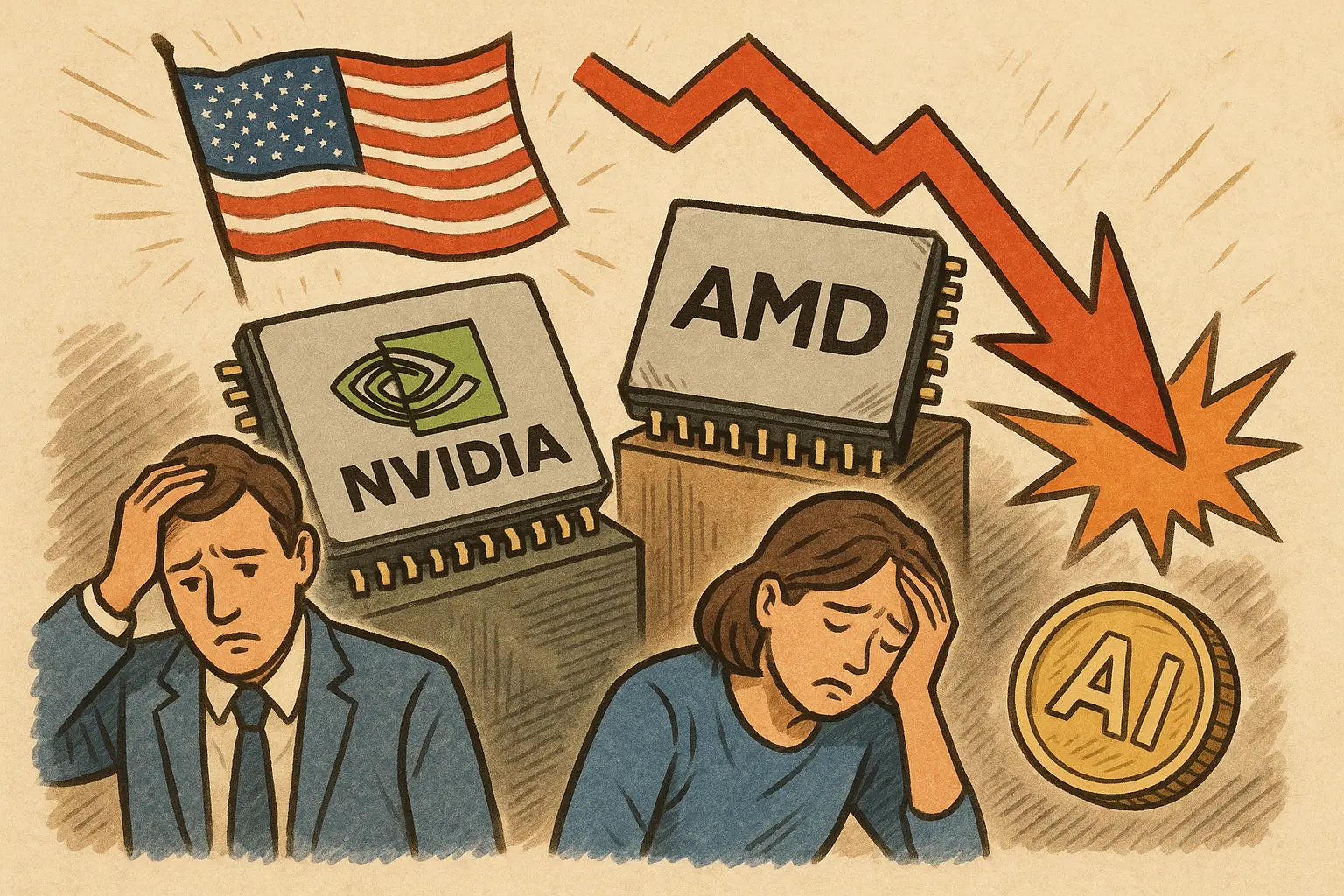
According to Bloomberg, a draft regulation proposed by the Trump administration in the United States plans to require companies to obtain prior approval from the U.S. Department of Commerce before exporting nearly any AI accelerators worldwide, directly impacting the global AI chip supply chain. Following the announcement of the draft, Nvidia’s stock price dropped 1.8%, AMD fell 2.2%, and several AI-related crypto tokens declined by approximately 5% simultaneously.
Core Provisions of the Draft Regulation: An Analysis of the Tiered Licensing System
This draft introduces a three-tier licensing mechanism based on the scale of chip exports, using Nvidia’s GB300 GPU as a benchmark:
Small-scale exports (≤1,000 units of GB300 GPU): Simplified review process with relatively low administrative hurdles.
Medium to large clusters (more than 1,000 units): Require prior approval from the Department of Commerce and may involve on-site inspections.
Very large deployments (over 200,000 units, equivalent to the scale of NScale and Microsoft’s contracts): Require formal agreements with the host country’s government and matching “co-investment” from the U.S. government.
Notably, this draft effectively overturns the Biden administration’s “AI proliferation rules.” Previously, officials criticized Biden’s rules as overly cumbersome, but the new draft’s licensing system creates administrative bottlenecks that observers believe could cause even greater practical friction than the previous policies.
Market Chain Reaction: Chip Stocks Decline and AI Crypto Tokens Face Dual Pressure
The market reaction in chip stocks directly reflects investor concerns about the impact of export restrictions on corporate revenue prospects. Nvidia, the world’s largest AI accelerator supplier, fell 1.8%, AMD declined 2.2%, and Micron, a major memory chip manufacturer, dropped the most at 3.4%.
The decline in AI crypto tokens reveals a clear logical chain: export restrictions → slowdown in overseas data center construction → narrowing expectations for growth in decentralized AI computing networks → downward pressure on related tokens’ valuations. Tokens such as Bittensor (TAO), Near Protocol (NEAR), Render, and Virtuals Protocol (VIRTUAL) each declined about 5%, confirming the direct transmission of AI infrastructure policies to the crypto market.
Reshaping the Global AI Chip Landscape: A Binary Dilemma
The deeper impact of this draft extends beyond short-term stock market fluctuations, involving structural adjustments in global AI infrastructure investment patterns. If the draft is officially enacted, countries building AI data centers will face a significant binary dilemma: either purchase U.S.-authorized American-made AI chips or turn to Huawei accelerators—though U.S. warnings suggest the latter may violate trade restrictions.
The licensing system’s bureaucratic approval bottlenecks could cause substantial delays to hundreds of millions of dollars in data center expansion plans across Europe, the Middle East, and Asia, reshaping the geographic distribution of global AI infrastructure investments. Previously, the Trump administration also used chip export controls as leverage in negotiations with the EU over digital service taxes, further embedding AI chip policies into broader geopolitical strategic frameworks.
Frequently Asked Questions
Q: What are the core requirements of the new U.S. AI chip export regulation draft?
The draft mandates that companies must obtain prior approval from the U.S. Department of Commerce before exporting nearly any AI accelerators globally. Nvidia’s GB300 GPU exports are categorized into three tiers based on volume: under 1,000 units for simplified review; larger volumes require pre-approval plus on-site inspections; over 200,000 units require formal agreements with the host government and matching U.S. government investments.
Q: Why did AI crypto tokens decline after the announcement of the new chip export regulation?
The valuation logic of AI crypto tokens (such as Bittensor, Render, Near Protocol) partly depends on the continued expansion of global AI computing infrastructure. Export restrictions slow down overseas data center construction, reducing expectations for growth in decentralized AI networks, leading to a roughly 5% decline in related tokens.
Q: What does the Pentagon listing Anthropic as a “supply chain risk” imply?
This is the first time a U.S. government agency has labeled a domestic tech company as a “supply chain risk,” indicating that federal oversight of AI has expanded from external threats to include domestic AI companies. While specific policy impacts remain unclear, this move is seen as a significant signal of the broadening scope of U.S. AI regulation.
Disclaimer: The information on this page may come from third parties and does not represent the views or opinions of Gate. The content displayed on this page is for reference only and does not constitute any financial, investment, or legal advice. Gate does not guarantee the accuracy or completeness of the information and shall not be liable for any losses arising from the use of this information. Virtual asset investments carry high risks and are subject to significant price volatility. You may lose all of your invested principal. Please fully understand the relevant risks and make prudent decisions based on your own financial situation and risk tolerance. For details, please refer to
Disclaimer.
Related Articles
TradFi Fall Alert: XAGUSD (Silver) Falls Over 2%
Gate News: According to the latest Gate TradFi data, XAGUSD (Silver) has dropped by 2% in a short period. Current volatility is significantly higher than recent averages, indicating increased market activity.
GateNews28m ago
Bitcoin falls below 74K; U.S. former defense secretary: A U.S.-Iran agreement may be difficult to reach before the deadline
With tensions rising in the Middle East geopolitical landscape, the Strait of Hormuz has become the focal point of military conflict between the U.S. and Iran. Attacks and seizures of cargo ships have been occurring frequently, and crude oil prices have risen. The U.S.-Iran ceasefire agreement is set to expire soon; peace talks have fallen into a stalemate due to irreconcilable positions, making it difficult to reach an agreement. As a result, the price of Bitcoin has dropped below 74K.
ChainNewsAbmedia1h ago
ETH drops 0.69% in 15 minutes: large on-chain transfer outflows trigger a rebound of spot sell pressure
During the period from 2026-04-19 22:00 to 2026-04-19 22:15(UTC), the ETH price fell from 2275.98 USDT to 2252.72 USDT. The return over 15 minutes was -0.69%, and the amplitude reached 1.02%. During this round of unusual price movement, short-term market volatility increased, attention on major coins rose, trading activity improved, and volatility was clearly tilted bearish.
The main driver behind this unusual move is the frequent occurrence of on-chain ETH large transfers with both high frequency and notable volume concentrated in a short period. Using a certain well-known hot wallet as a hub, more than 20,000 ETH were transferred out in a short time, and some of it has been traced on-chain and confirmed to have flowed to other exchanges’ receiving addresses. After funds briefly flowed into trading platforms, the number of sell orders in the spot market increased significantly, bringing about a phase of liquidity pressure and further intensifying the downward move in price. In addition, the futures market is linked to spot volatility; during the decline, highly leveraged long positions were liquidated passively, pushing short-term prices to release more downside pressure.
At the same time, the pace of ETF capital inflows has slowed since mid-April. Within the latest range, continuous net inflows have been trending steadily, and coupled with some funds making small redemptions, this weakens the market’s institutional support. Global risk sentiment is also facing synchronized pressure—repeated swings in macro-level expectations for the Federal Reserve’s policy and heightened geopolitical tensions have driven inflows into safe-haven assets. The U.S. Dollar Index strengthened in the short term, global equity markets came under pressure, and this further reinforced ETH’s ongoing downside pressure. In addition, the 24-hour trading volumes for spot and futures were 21.75 billion USD and 42.76 billion USD, respectively; futures open interest was 30.93 billion USD. The liquidation size showed no abnormality, indicating a structural adjustment under multi-dimensional market convergence.
Going forward, it is necessary to stay alert to risks such as continued large outflows on-chain and ETF capital movements shifting from inflows to outflows. If the macro environment deteriorates further, ETH may further intensify volatility. For short-term support, watch the 2250 USDT area; resistance is at 2275 USDT. The ETF trend, the direction of on-chain transfers, and macro news remain the key indicators to monitor for the next stage. Please closely follow subsequent market developments and the flow of large on-chain funds, and promptly capture relevant trading information.
GateNews2h ago
BTC falls 0.44% in 15 minutes: ETF fund outflows and derivatives shorts add to the slide
From 21:45 to 22:00 (UTC) on April 19, 2026, the BTC price dropped by 0.44% within 15 minutes. The candlestick range was 74,366.1 to 74,789.3 USDT, with an amplitude of 0.57%. Short-term volatility was concentrated. During this period, the trading volume for large orders rose significantly, market attention increased, and volatility intensified.
The main driving force behind this deviation was that U.S. spot Bitcoin ETFs saw a large net outflow of $291 million over two days from April 18 to April 19. This reflected institutional funds pulling away in the short term, which led to a marked increase in sell pressure in the spot market. At the same time, BTC perpetual contract
GateNews2h ago
BTC falls below 74000 USDT
Gate News bot message, Gate market data shows that BTC has fallen below 74000 USDT, with a current price of 73979.6 USDT.
CryptoRadar2h ago
Elon Musk's Response Triggers ASTEROID Memecoin Price Surge to $170M
The ASTEROID memecoin soared from a $50,000 to $170 million market cap after Elon Musk engaged with a project linked to a deceased teen's character. However, it remains an unlisted, high-risk speculative asset.
GateNews3h ago


