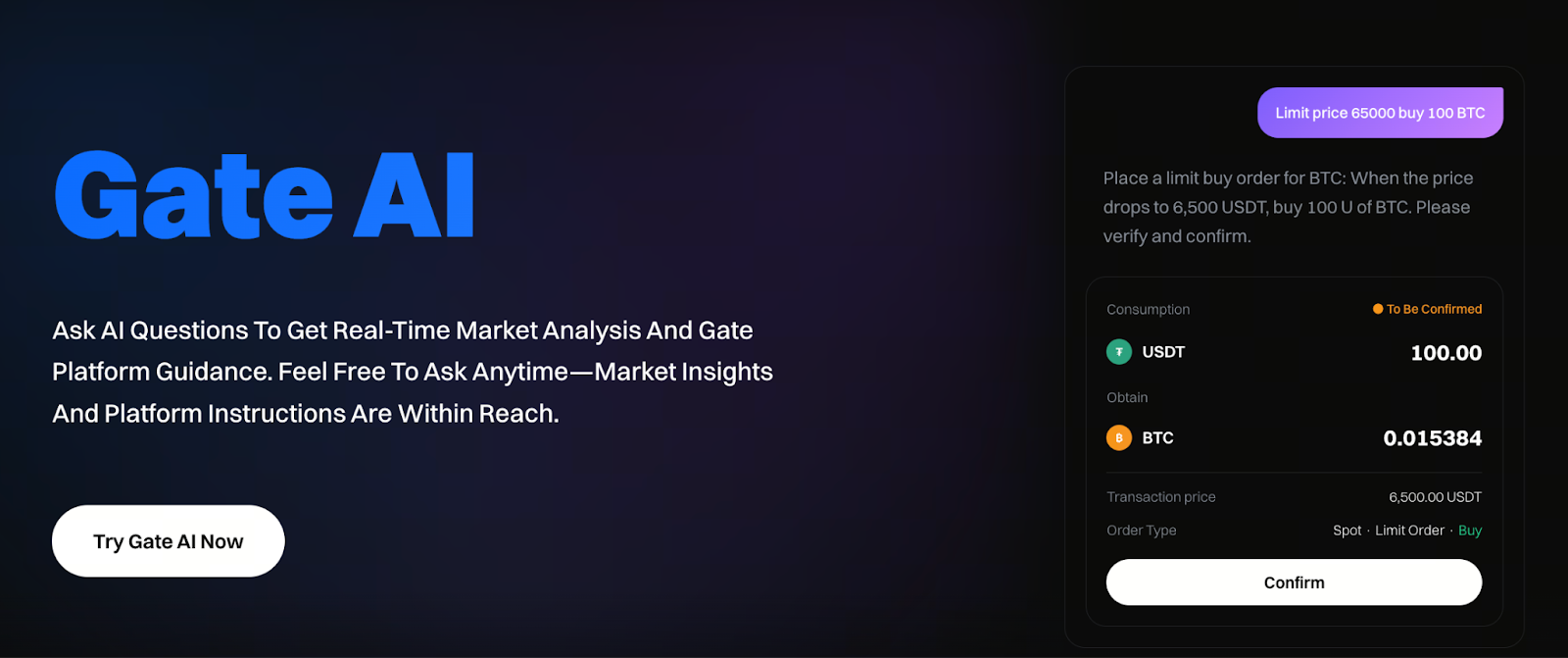
Gate AI: Reframing Market Analysis in an Information-Dense Crypto Landscape

Beginner
Quick Reads
Last Updated 2026-03-23 08:13:12
Reading Time: 1m
With the continued growth of the crypto market, information sources have become more diverse and dense. Traders must process a wide range of signals daily—from price fluctuations and on-chain data to community sentiment and macroeconomic developments. Gate AI streamlines this process by aggregating market data from various sources and presenting analysis and insights in a conversational format, enabling users to understand market dynamics and underlying factors more efficiently. This article explores Gate AI’s design principles, its methods for data integration, and the emerging role of AI in market analysis.

The Era of Information Explosion in the Crypto Market

The Era of Information Explosion in the Crypto Market

The digital asset market’s growth is reflected not only in rising trading volumes and an expanding range of assets, but also in the accelerating speed of information generation. Price movements, on-chain activity, project updates, and community discussions now surface almost simultaneously across multiple platforms, creating a highly real-time information environment.

While investors have access to a broader range of data sources, this information overload introduces new challenges: it is increasingly difficult to identify truly important insights amid the flood of signals. For many traders, the core challenge is no longer a lack of information, but how to quickly understand what’s happening in the market.

When volatility surges, relying on manual review of news, charts, and community activity makes it nearly impossible to capture the full picture in real time. As a result, tools that organize and analyze data are becoming essential components of the trading landscape.

From Data Accumulation to Information Integration

In traditional market analysis, investors typically focus on a handful of core indicators—such as price, trading volume, or capital flows. While these metrics reflect market outcomes, they provide limited insight into the underlying drivers of market behavior.

Gate AI is designed not just to deliver more data, but to integrate information from diverse sources and establish meaningful connections between data points. This approach enables the system to transform fragmented market signals into a more structured analytical framework.

Users can engage directly with the system through conversational queries, such as:

  • What recent events might be linked to the volatility of a particular token?

  • Is market capital concentrating in specific sectors?

  • Are there signs of increased trading activity in a certain industry?

The system aggregates and synthesizes data from multiple sources, presenting market information in a clearer and more actionable format.

Making Price Movements More Understandable

For many newcomers to the crypto market, price charts can be difficult to interpret. When an asset surges or plummets, simply watching price lines offers little clarity about the underlying causes.

By systematically organizing data, Gate AI breaks down market volatility into possible contributing factors, such as:

  • Shifts in capital flows

  • Market impact from news related to specific industries or projects

  • Changes in investor sentiment or confidence

This approach reveals that price is not just a single figure, but the result of multiple market forces at work. When traders understand these relationships, their decisions are grounded in analysis rather than short-term market swings.

Striking a Balance Between Speed and Reliability

As generative AI becomes more widespread, rapid response has become a hallmark of many tools. However, in financial markets, reliability often outweighs speed. Analysis based on unverified sources or uncertain information can mislead investment decisions. For this reason, Gate AI employs a more conservative approach to information processing.

When data sources are insufficient or information remains uncertain, the system flags these limitations rather than generating speculative analysis. While this may reduce the speed of some real-time responses, it helps preserve the overall quality of information. In trading, verified data is typically more valuable than fast but unreliable insights.

Seamless Integration with the Trading Environment

Many market analysis tools require users to switch between different websites or platforms, adding friction in fast-paced trading environments.

Gate AI addresses this by integrating analytical capabilities directly into the platform’s market and search systems. When users view an asset or browse market information, they can ask questions through a conversational interface without leaving the current page. This seamless integration forges a natural link between market analysis and trading operations. Users can access relevant background information while analyzing trends, making research an organic part of the trading decision process rather than an extra step.

The Evolving Role of AI in Market Analysis

AI applications in financial markets are still evolving. As technology advances, AI tools could expand into additional analytical domains, such as:

  • Market risk alerts and notifications

  • Cross-verification of multi-source data

  • Analysis of community sentiment and market trends

In an environment of ever-growing information density, AI acts as a signal filter, helping traders extract truly valuable insights from massive data flows.

By reducing information noise, traders can focus more on understanding market logic rather than being overwhelmed by excessive data.

Conclusion

In the fast-moving crypto market, information itself is no longer scarce—what’s truly scarce is the ability to interpret and organize it. When market signals stream in from diverse sources at high speed, traders need more than just additional data—they need tools that can structure and clarify information. By integrating multi-source market data with conversational analysis, Gate AI restructures fragmented information into a clearer framework for market observation. As the volume of market information continues to rise, intelligent tools that can efficiently filter, organize, and verify data will become indispensable in the crypto trading environment.

Author:  Allen
Disclaimer
* The information is not intended to be and does not constitute financial advice or any other recommendation of any sort offered or endorsed by Gate.
* This article may not be reproduced, transmitted or copied without referencing Gate. Contravention is an infringement of Copyright Act and may be subject to legal action.

Related Articles

AI-Native Settlement Layers: How United Stables Is Building the Next Financial Rail
Beginner

AI-Native Settlement Layers: How United Stables Is Building the Next Financial Rail

Stablecoins were originally designed as dollar substitutes within exchanges, primarily used for asset pricing and trade settlement. As on-chain financial ecosystems have matured, their role has expanded beyond simple payments to include collateral assets, cross-chain liquidity mediums, and unified settlement units. In particular, as AI systems and automated agents begin to participate directly in economic activity, demand has risen sharply for programmable value units capable of instant settlement. This shift is pushing stablecoins toward the role of foundational financial infrastructure.
2026-03-25 03:16:17
DePIN Identity Network and Real World Applications: How Humanity Protocol Brings on-chain Identity Into the Physical World
Beginner

DePIN Identity Network and Real World Applications: How Humanity Protocol Brings on-chain Identity Into the Physical World

Most Web3 identity systems remain confined to on-chain environments and struggle to achieve meaningful adoption in real world settings. Through a DePIN architecture and physical verification hardware, Humanity Protocol aims to bring decentralized identity into access control systems, hospitality, public services, and offline events, allowing on-chain identity to function not just as a digital credential, but as foundational infrastructure for real world access.
2026-03-25 07:40:53
Gold Price Forecast for the Next Five Years: 2026–2030 Trend Outlook and Investment Implications, Could It Reach $6,000?
Beginner

Gold Price Forecast for the Next Five Years: 2026–2030 Trend Outlook and Investment Implications, Could It Reach $6,000?

Analyze current gold price trends alongside authoritative five-year forecasts, integrating an evaluation of market risks and opportunities. This gives investors insight into the potential trajectory of gold prices and the main drivers expected to shape the market over the next five years.
2026-03-25 18:13:30
Aster vs Hyperliquid: Which Perp DEX Will Prevail?
Beginner

Aster vs Hyperliquid: Which Perp DEX Will Prevail?

Aster and Hyperliquid are the two representative protocols of the "purpose-built L1 path" within the current decentralized perpetual exchange (Perp DEX) sector. As a pioneer in the field, Hyperliquid has built a deep liquidity moat through its highly mature order book architecture and strong community consensus. Conversely, Aster, as a rising challenger, seeks to leapfrog the competition in high-performance trading through more aggressive multi-chain aggregation logic, private transaction modules, and an underlying execution environment optimized for 2026 market demands.
2026-03-24 11:58:33
Aerodrome Tokenomics: How ve(3,3) Powers Base's Most Profitable DEX
Beginner

Aerodrome Tokenomics: How ve(3,3) Powers Base's Most Profitable DEX

AERO is the native token of Aerodrome Finance, a core decentralized exchange and liquidity protocol in the Base ecosystem. It is primarily used for liquidity incentives and ecosystem operations. veAERO is a governance NFT that users receive by locking AERO, representing both voting power and the right to share protocol revenue. Through a dual track structure of AERO as a utility token and veAERO as a governance credential, Aerodrome separates liquidity usage value from long term governance power, allowing participants to act as liquidity providers, governance decision makers, and revenue sharers within the same system.
2026-03-25 06:40:31
The ve(3,3) Flywheel Explained: How AERO Tokenomics Powers Aerodrome’s DeFi Economy
Beginner

The ve(3,3) Flywheel Explained: How AERO Tokenomics Powers Aerodrome’s DeFi Economy

In the competition for DeFi liquidity, high-inflation mining alone is no longer enough to build lasting advantages. Aerodrome applies the ve(3,3) economic model to redesign token emissions, voting mechanisms, and revenue distribution, creating a liquidity flywheel centered on governance and cash flow. This article examines AERO tokenomics, the veAERO locking mechanism, and protocol revenue models to explain how Aerodrome builds a sustainable DeFi economic system.
2026-03-25 06:41:58





