As the cryptocurrency market transitions into a more institutional era, trading volumes and complexity are rising in tandem. Unlike the early days, which were dominated by retail investors, today’s market experiences larger and more frequent capital flows, along with increasingly sophisticated trading behavior. Still, a defining feature remains: liquidity is fragmented across numerous trading platforms and market makers, with market depth showing significant fluctuations across different timeframes.
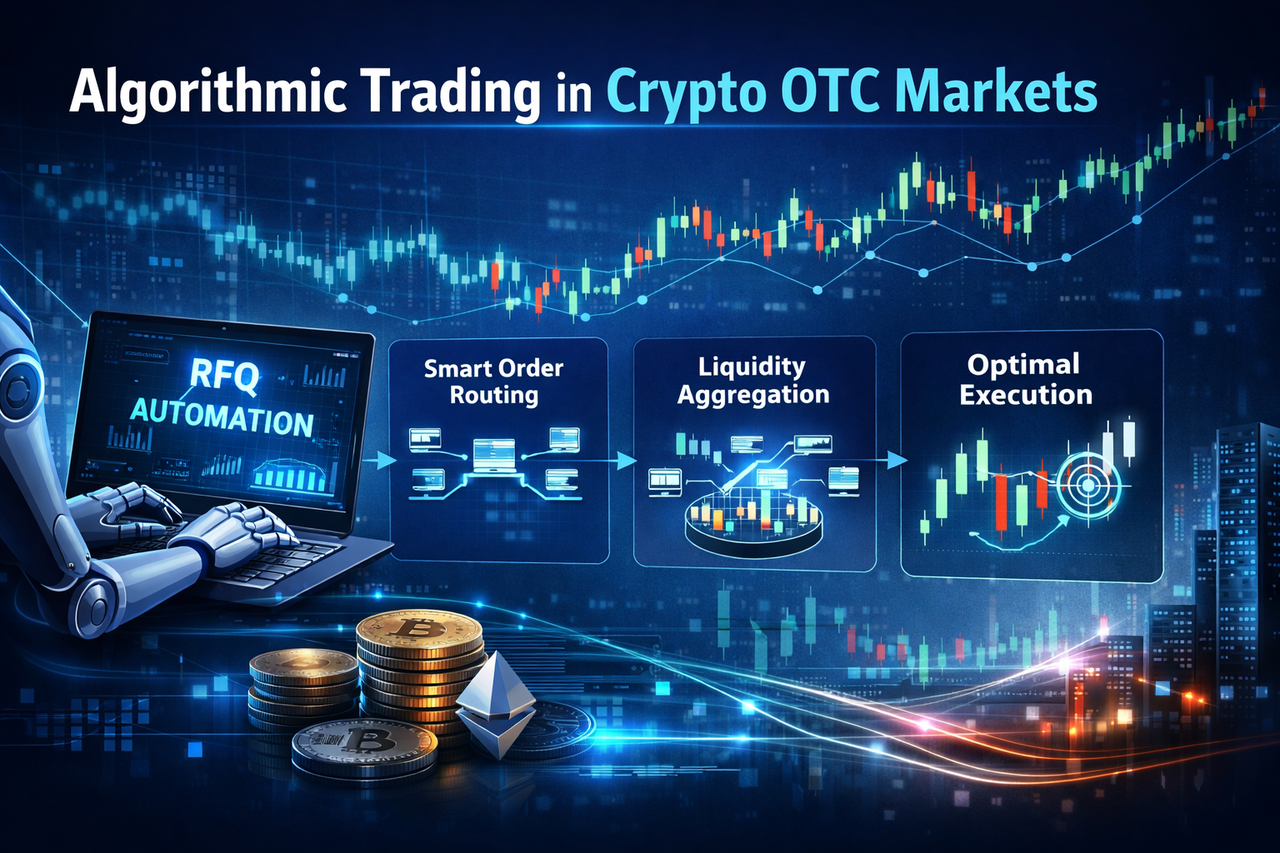
Algorithmic trading has emerged as the backbone of the crypto OTC market in this environment. More than just an execution tool, it serves as a critical bridge for price discovery, liquidity access, and trade execution. In today’s OTC ecosystem, algorithmic trading is integrated throughout—from RFQ requests creation and distribution to offer filtering and the final selection of execution paths. Structurally, algorithmic trading is enabling the OTC market to move beyond manual communication, driving the shift toward electronic and systematic operations.
What Is Algorithmic Trading?
Algorithmic trading is the process by which computer systems automatically make trading decisions and execute orders based on predefined rules or models. These rules may incorporate various factors, including price movements, market depth, time windows, and historical data patterns. Compared to manual trading, algorithmic trading’s core strengths are speed and consistency.
In the crypto space, algorithmic trading is applied far more broadly than in traditional finance. The market operates around the clock, making continuous human monitoring impractical. Additionally, high volatility and complex price structures give algorithms a clear advantage in seizing opportunities and managing risk.
Within OTC scenarios, algorithmic trading does not directly participate in public market order matching. Instead, it is primarily used to optimize the execution process, especially when navigating multiple liquidity sources and maximizing decision efficiency.
The Core Role of Algorithmic Trading in OTC
In OTC trading, algorithmic trading’s core mission is “execution optimization.” Unlike exchanges, where matching is central, OTC focuses on trade routing and execution quality—making the role of algorithms even more pronounced.
Algorithms can rapidly compare offers from multiple sources. Since OTC liquidity providers (such as market makers) may quote different prices, traders must identify the best price in milliseconds—something algorithms excel at through parallel processing.
Algorithms also leverage real-time market data to make dynamic decisions. For example, if volatility spikes, the system can automatically adjust execution strategies to avoid unfavorable trades. This level of adaptability is difficult, if not impossible, to achieve manually.
RFQ Automation: The Gateway to Algorithmic Trading
RFQ (Request for Quote) is the core mechanism for OTC trading, and algorithmic trading transforms it from a manual workflow into an automated system. Traditionally, traders had to manually send quote requests to multiple market makers and compile responses—a process that is both time-consuming and prone to delays.
With algorithms, the RFQ process is fully automated. The system can dispatch requests and receive offers from multiple liquidity sources within milliseconds. This automation dramatically improves efficiency and reduces errors caused by manual intervention.
Crucially, algorithms can normalize offers, making data from different sources directly comparable and laying the groundwork for effective decision-making.
Smart Routing and Optimal Execution
Once multiple offers are received, selecting the best execution path becomes paramount. Smart Order Routing (SOR) is the technology at the heart of this process. By factoring in price, liquidity depth, fill probability, and execution speed, it dynamically selects the optimal path.
In practice, optimal execution is not simply about securing the lowest price—it also means ensuring the trade is completed with high certainty. In some cases, a slightly higher offer may correspond to a higher fill probability, making it the better overall choice.
Algorithmic trading quantifies these variables, making the decision process systematic and repeatable, which elevates execution quality across the board.
Liquidity Aggregation: Tackling Market Fragmentation
A defining characteristic of the crypto OTC market is fragmented liquidity, with significant discrepancies among market maker offers. Algorithmic trading aggregates liquidity by unifying these fragmented sources into a single framework, creating a deeper “virtual liquidity pool.”
This aggregation enables institutions to access multiple liquidity sources through a single interface, managing them seamlessly via algorithms. Compared to relying on one market maker, this approach delivers greater price competitiveness and improved trade stability.
How Algorithmic Trading Differs from Traditional OTC Execution
Traditional OTC trading relies heavily on the trader’s experience and communication skills. While this offers flexibility, it comes at the cost of efficiency and consistency—manual processing often becomes a bottleneck, especially in high-frequency or complex scenarios.
Algorithmic trading standardizes execution through automation and data-driven processes. Regardless of market conditions, the system operates according to established rules, reducing uncertainty. This stability is a primary reason institutions adopt algorithmic trading.
Advantages and Challenges
Algorithmic trading in OTC delivers significant advantages in efficiency and execution quality. Automated workflows enable faster trades while minimizing slippage and market impact. The ability to process data from multiple sources empowers traders to achieve optimal results in complex environments.
However, challenges remain. System stability is critical—technical failures can directly impact execution. Algorithmic models require ongoing refinement to adapt to changing market structures. Additionally, reliance on liquidity providers means system performance is subject to external factors.
Application Scenarios
Algorithmic trading in OTC is best suited for scenarios demanding high execution quality—such as institutional asset allocation, large-scale capital movements, and long-term portfolio rebalancing. In these cases, trade sizes are substantial, and price stability and execution certainty are paramount.
For retail investors, due to smaller trade sizes and higher operational complexity, algorithmic trading is generally not the preferred solution.
Summary
Algorithmic trading is fundamentally transforming the operational landscape of the crypto OTC market. Through automated RFQ processes, smart routing, and liquidity aggregation, it not only enhances trading efficiency but also provides institutions with more stable and controllable execution. As the market evolves and technology advances, algorithmic trading will play an increasingly central role in the OTC ecosystem, driving the industry toward greater maturity.
FAQs
Is algorithmic trading the same as automated trading bots?
Not exactly. Algorithmic trading focuses on strategy and execution optimization, not just automated order placement.
What is the most important role of algorithmic trading in OTC?
Its primary role is to optimize execution paths, boost trading efficiency, and minimize slippage.
Do all institutions use algorithmic trading?
Most institutions use it, but the extent depends on their technical capabilities.
Does algorithmic trading increase risk?
If poorly designed, it can add risk, but mature systems are typically used to reduce execution risk.
Will OTC become fully automated in the future?
It will not be fully automated, but automation will continue to increase, with humans focusing more on strategy.