


Highlights
①. The Gate Learn Futures Advanced Course will equip users with the skills to develop a professional trading system, focusing on investment strategies, trading tools, and comprehensive system planning;
②. This article highlights risk management, a key element in futures trading. We'll start with basic concepts and strategies, then move to practical applications to show you how to manage risk efficiently.
1. What is Risk Management in Futures Trading?
①.What is Risk?
Risk in the trading market refers to the uncertainty surrounding future investment returns. This includes potential losses in earnings or even the initial capital. While risks can be mitigated through preventive measures, they cannot be entirely eliminated, making risk management crucial in trading.
②.What is Risk Management?
Risk management involves taking effective measures to reduce the probability of risk events occurring or, after a risk event occurs, effectively minimizing the losses caused by the event and keeping the losses within a manageable range for the funds. Traders with less experience often focus excessively on technical analysis and strategies, placing too much trust in strategy indicators.
These traders frequently ignore the probability of risk events occurring, using their entire position as margin for orders. Such heavy and full-position traders, if they do not adopt effective risk management measures, will find themselves in a very dangerous situation in the market.
**2. Key Elements of Risk Management in Futures Trading
①.Win Rate
Win rate is calculated as: Win rate= the number of profitable trades / (profitable trades + losing trades + breakeven trades). In an effective trading system, win rate and risk-reward ratio are closely linked. A low win rate, even with an excellent risk-reward ratio, can lead to significant capital losses over time. Conversely, an excessively high risk-reward ratio cannot compensate for a low win rate.
②.Risk-Reward Ratio
The risk-reward ratio= the average profit / the average loss. A low risk-reward ratio can result in losing more than you gain. For instance, if our risk management strategy sets the risk-reward ratio at 1:1, we need to maintain a win rate of at least 50% to ensure stable profitability. Incorporating a higher risk-reward ratio in your trading strategy can effectively counterbalance a win rate below 50%.
③.Trading Costs
This includes fees, funding rates, interest, and other potential costs. All these factors need to be considered and evaluated in your trading strategy.
3. How to Effectively Manage Risk in Practical Futures Trading?
①. Assess Your Risk Tolerance
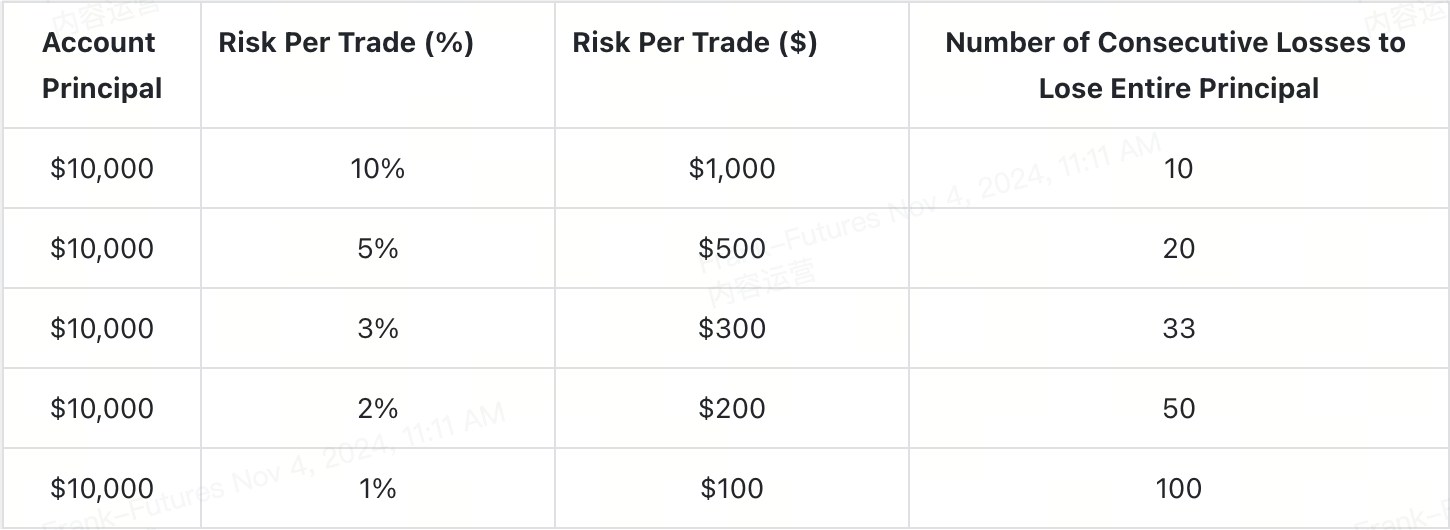
Before engaging in futures trading, it's crucial to determine the proportion of your account funds that you're willing to risk on a single trade. For example, if you trade once daily and risk 10% of your total assets per trade, ten consecutive losing trades could wipe out your entire account. This level of risk is unacceptable for futures traders.
However, if you limit the risk per trade to 5%, 3%, or even 1% of your total account, the probability of losing your entire capital significantly decreases.
②. Strictly Follow Your Trading Plan
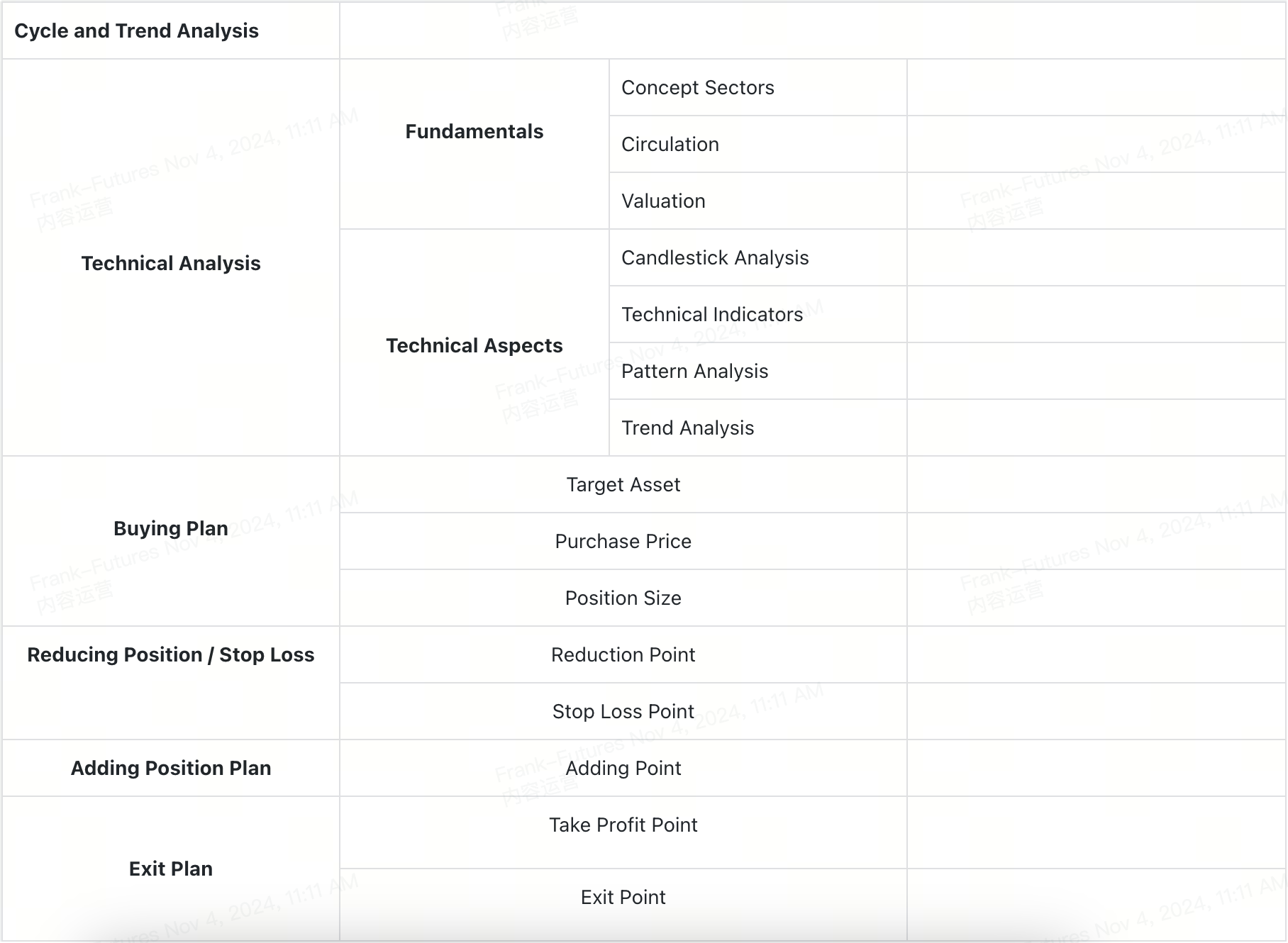
The diagram below outlines a comprehensive trading plan, which can be adjusted based on the cryptocurrency market conditions. It starts with assessing the market's macro cycle, followed by identifying opportunities through technical analysis, and concludes with a detailed action plan for specific trades.
③. Effective Position Management
After assessing your risk tolerance, effective position management is crucial. There will be a dedicated topic on "How to Manage Positions in Futures Trading" in future discussions, so it won't be elaborated on here.
④. Dynamic Take-Profit and Static Stop-Loss; Maintain a Good Mindset and Avoid FOMO
a. The market is volatile and unpredictable, with a probability of less than 5% for five consecutive correct trades;
b. Investment itself is not risky; uncontrolled investment is the greatest risk.
In futures trading, it is a strict discipline for excellent traders to set [take-profit and stop-loss] levels. Ensure that every position opened is logical and includes a stop-loss. Use dynamic take-profit and static stop-loss methods to limit risk exposure and let profits run. By adhering to your trading plan within your risk tolerance, allocating position funds reasonably, and setting take-profit and stop-loss levels for each trade, you will maintain a relaxed trading mindset and be better prepared for unexpected market conditions.
4. Summary
Risk management in trading is a crucial skill for excellent traders. This issue focused on several key points of risk management and practical techniques for creating a trading plan.
For practical trading operations, visit the Gate Futures platform. Register for a Gate account now and begin your futures trading journey!

Disclaimer
This article is for informational purposes only and does not constitute investment advice. Gate is not responsible for any investment decisions you make. Content related to technical analysis, market assessments, trading skills, and traders' insights should not be considered a basis for investment. Investing carries potential risks and uncertainties. This article offers no guarantees or assurances of returns on any type of investment.
Disclaimer
The content provided herein is for reference and educational purposes only and does not constitute any financial, investment, trading, or legal advice, nor does it constitute an offer or solicitation to buy or sell any digital assets. Gate makes no express or implied representations or warranties regarding the accuracy, completeness, or timeliness of the information contained herein. Product features, interfaces, rules, and fee structures may be updated or adjusted at any time. Please refer to the latest announcements and the actual information displayed on the Gate platform for the most accurate details.
Digital asset investments involve significant risk, and prices may fluctuate substantially. You may lose the entire amount of your investment. Please make decisions cautiously based on your own financial situation and risk tolerance after fully understanding the associated risks. If necessary, you are advised to consult an independent professional financial or legal advisor.
For more information about potential risks, please refer to Gate's Risk Disclosure and User Agreement.
