
RIVER Monthly Increase of 1900% from $5 to $87, with a market cap of $1.6 billion, ranking 67th. Legendary trader Arthur Hayes calls for a fourfold increase after listing. CoinGlass warns of capital rate manipulation traps. Its total locked value (TVL) is 161 million, and the stablecoin satUSD ranks 40th.
RIVER Soars from $5 to $87, Market Cap Ranks 67th
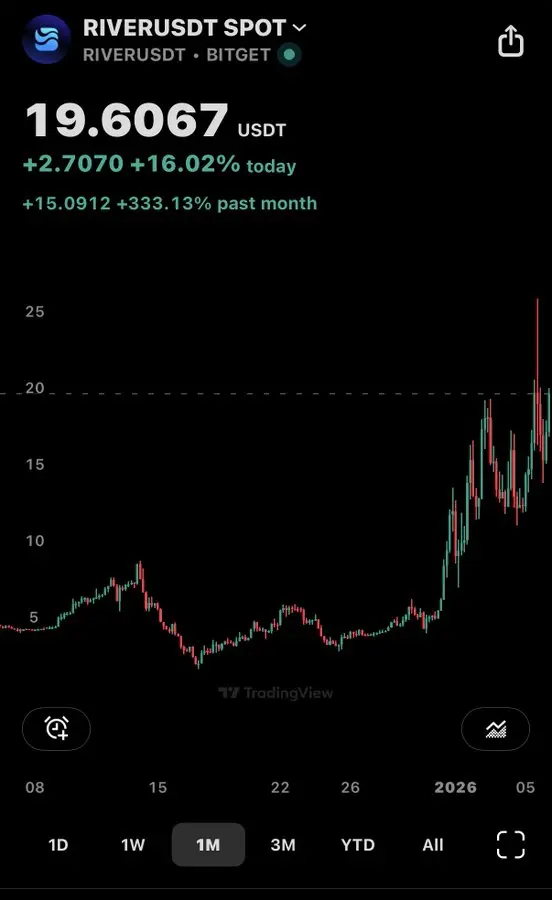
(Source: Trading View)
According to data from CoinGecko, a lesser-known cryptocurrency—River (RIVER)—has caused a stir over the past month, surging over 1900%, with its market cap jumping into the top 100 tokens. The native token RIVER of the multi-chain stablecoin abstract platform was trading at about $5 at the end of December, but since then, its price skyrocketed, recently trading around $82. Based on Monday’s prices, RIVER’s total market cap is approximately $1.6 billion, enough to make it the 67th largest cryptocurrency by market cap.
The platform aims to eliminate the need for cross-chain connected stablecoins and has attracted attention from some of the most influential figures in the crypto space, including legendary trader Arthur Hayes—both have been strongly supporting the token over the past month. Hayes predicted its rise early on, calling for more listings on centralized exchanges as early as January 6. Since then, despite most crypto markets declining, the token’s value has increased more than fourfold.
Last week, Sun Yuchen also joined the hype, investing $8 million into the protocol to support integrating his Layer-1 network Tron into the River ecosystem. This high-profile investment and endorsement significantly boosted RIVER’s price and visibility in the short term. When two highly influential figures in crypto endorse a project simultaneously, it often triggers a herd effect, with many retail investors buying in based on trust in these KOLs.
In this environment, the market is generally optimistic about RIVER, which has risen another 12% in the past 24 hours. Earlier Monday, its price briefly broke $87, hitting a new high. This sustained upward momentum indicates growing market interest in RIVER. However, such rapid and continuous increases also raise questions about sustainability. A 1900% monthly gain is not unprecedented in crypto markets but is usually accompanied by high speculation and the risk of sharp corrections afterward.
CoinGlass Warns of Capital Rate Manipulation Traps
Sun Yuchen and Hayes’ promotion has helped attract attention to the token, but its rapid rise may not be as straightforward as it seems. Blockchain analytics firm CoinGlass recently used RIVER as an example to illustrate how capital rate (the fee set by exchanges to maintain balance between price and contract price) can be manipulated to influence token prices.
CoinGlass posted last week on X: “Step one is simple: lower the price while heavily losing on funding. This concentrates short positions and reinforces the idea that ‘funding loss = inevitable rebound.’” CoinGlass pointed out that in such cases, traders go long, betting on price increases, expecting a rebound and receiving funding payments. But the firm states that this “expectation is a trap,” and such expectations can be reset multiple times to attract “consensus positions.”
The logic behind this manipulation is: first, large sell-offs push the price down while making the funding rate negative (shorts pay longs). This situation attracts traders to think, “The price is so low and I can still earn funding, so going long is profitable.” After a large number of longs enter, manipulators suddenly reverse the operation, pushing the price up and turning the funding rate positive (longs pay shorts), then sell at the high. Those attracted in find that although the price has risen, the funding costs are high, possibly forcing them to close positions, triggering a chain reaction of declines.
CoinGlass specifically cites RIVER as a case study, implying its price movements may involve such manipulation patterns. While there is no direct evidence that RIVER is being manipulated, this warning is an important risk alert for investors. When a token surges rapidly with well-known KOL endorsements, it could be either genuine value discovery or a carefully crafted pump-and-dump trap.
TVL Drops from 6 Billion to 1.6 Billion, Raising Concerns
According to the latest data from DeFiLlama, River’s total value locked (TVL) in its protocol is about $161 million, down from a peak of $605 million on October 6. The company’s over-collateralized stablecoin satUSD has a market cap of about $159 million, ranking 40th among stablecoins globally. The TVL has fallen 73% from its peak of $605 million to the current $161 million, contrasting sharply with RIVER’s price surge.
TVL is a core indicator of the actual usage and value locked in DeFi protocols. A decline in TVL indicates users are withdrawing funds from the protocol, and actual application is shrinking. Normally, a protocol’s TVL growth should be positively correlated with its token price—more locked funds imply higher real-world value, which should drive the token price up. But RIVER’s case is the opposite: TVL has plummeted while the token price has skyrocketed. This divergence is a very unhealthy signal.
This discrepancy may suggest that RIVER’s price increase is mainly driven by speculation rather than real application. Investors buying RIVER might not be optimistic about River Protocol’s long-term value and use cases but are simply betting on continued price increases. When the token price and the protocol’s fundamentals diverge significantly, a bubble could burst at any time. If market sentiment shifts or KOLs stop endorsing, RIVER could face a sharp correction.
Although satUSD’s ranking as the 40th stablecoin is decent, its market cap of $159 million is still tiny compared to USDT’s $187 billion. Stablecoins of this scale are difficult to compete with top-tier stablecoins in liquidity, use cases, and network effects. While River Protocol’s multi-chain stablecoin abstract concept is innovative, its actual adoption and user stickiness remain to be tested over time.
Disclaimer: The information on this page may come from third parties and does not represent the views or opinions of Gate. The content displayed on this page is for reference only and does not constitute any financial, investment, or legal advice. Gate does not guarantee the accuracy or completeness of the information and shall not be liable for any losses arising from the use of this information. Virtual asset investments carry high risks and are subject to significant price volatility. You may lose all of your invested principal. Please fully understand the relevant risks and make prudent decisions based on your own financial situation and risk tolerance. For details, please refer to
Disclaimer.
Related Articles
XRP Breaks Above $1.40 as Spot ETF Inflows Hit $17.6M Milestone
XRP breaks $1.40 after Ripple partnership boosts investor confidence and market momentum.
Spot XRP ETFs record $17.6M inflows, signaling rising institutional demand and interest.
Technical indicators show resistance ahead, with support holding near $1.40 and $1.3840.
Ripple’s XRP is
CryptoNewsLand3h ago
PEPE Reclaims 0.00000400 — Is This 1.8% Move the Start of a Bigger Run?
PEPE rebounds from 0.00000385 support, forming higher lows and stronger bullish structure.
Technical indicators like MACD and RSI show momentum with room for further upside.
Key resistance at 0.00000410; support at 0.00000380 critical for trend continuation.
PepeCoin — PEPE, has
CryptoNewsLand8h ago
ETH drops 0.58% in 15 minutes: derivatives liquidity contraction and proactive position reduction dominate short-term pullback
From 2026-04-19 04:30 to 2026-04-19 04:45 (UTC), within ETH’s 15-minute candlestick chart, the return recorded -0.58%, and the price range was 2321.62 to 2342.04 USDT, with an amplitude of 0.87%. The short-term selloff occurred against a backdrop of increased overall market volatility and a broad decline in the prices of major crypto assets; overall market risk appetite clearly fell, and traders’ wait-and-see sentiment strengthened.
The main driver behind this abnormal move is a sharp contraction in liquidity in the derivatives market and leveraged funds proactively reducing positions. Data shows that over the past 24 hours, the ETH/USD perpetual contract trading volume dropped 67.16% to approximately 74.87 million, open interest edged down 3.33% to 329 million, and liquidation amounts did not expand unusually. This structure indicates that the market lacks the risk of passive cascades; more funds chose to proactively step aside and wait on the sidelines, intensifying short-term selling pressure.
In addition, the long/short structure in which shorts held the upper hand (long/short ratio 47.48%:52.52%) and sentiment synchronization with the panic range reinforced the downward price trend. During the same period, major coins such as BTC and SOL also fell 2%-3.4% in tandem, further showing that this pullback was driven by system-wide risk sentiment. On-chain funds did not show any large abnormal transfers or large-scale liquidations of DeFi protocols; spot and on-chain liquidity remained generally stable, and no sudden system risk resonance was observed.
Current volatility-related risks still need close monitoring, especially as overall risk appetite continues to contract—ETH’s short-term price may face further downside probing. Watch subsequent changes in derivatives trading volume and open interest, extreme shifts in the long/short ratio and funding rate, and promptly monitor on-chain fund flows, large transfers, and any signs of amplified platform net outflows. For more market anomalies and deeper analysis, please continue to follow our upcoming market updates.
GateNews9h ago
Spark Protocol's January delisting of rsETH proves prudent as Aave faces ETH liquidity crisis
Spark Protocol's strategy of delisting low-usage assets and tightening collateral has faced initial backlash but proved wise during market turmoil. While maintaining higher interest rate caps, SparkLend ensures liquidity, unlike Aave, which now faces significant risks.
GateNews9h ago
Request Network (REQ) Surges 23.68% in 15 Minutes, 24-Hour Gain Reaches 116.52%
Request Network (REQ) surged 23.68% in just 15 minutes, reaching $0.152, with a 24-hour rise of 116.52% and trading volume over $8 million. Factors include retail interest and whale accumulation. Resistance at $0.160 and support at $0.122 are under observation.
GateNews10h ago
Solana Price Stalls Near $80 as ETF Outflows Weigh
Solana trades around $80, facing bearish sentiment due to ETF outflows and declining retail participation. Technical indicators show mixed signals, with resistance at $87 and $98, while support at $77 remains critical for stability.
CryptoFrontNews15h ago


