Saat menilai nilai aplikasi House Party Protocol (HPP), kunci utamanya bukan sekadar apa yang bisa dilakukan protokol ini, melainkan bagaimana setiap modulnya secara spesifik menangani proses komputasi, verifikasi, eksekusi strategi, pengambilan data, dan analisis aset.
Tantangan ini mencakup lima dimensi utama—Noösphere, ArenAI, Booost, Alpha Quark, dan kolaborasi multi-modul—yang bersama-sama membentuk infrastruktur inti HPP untuk aplikasi AI dan Web3.
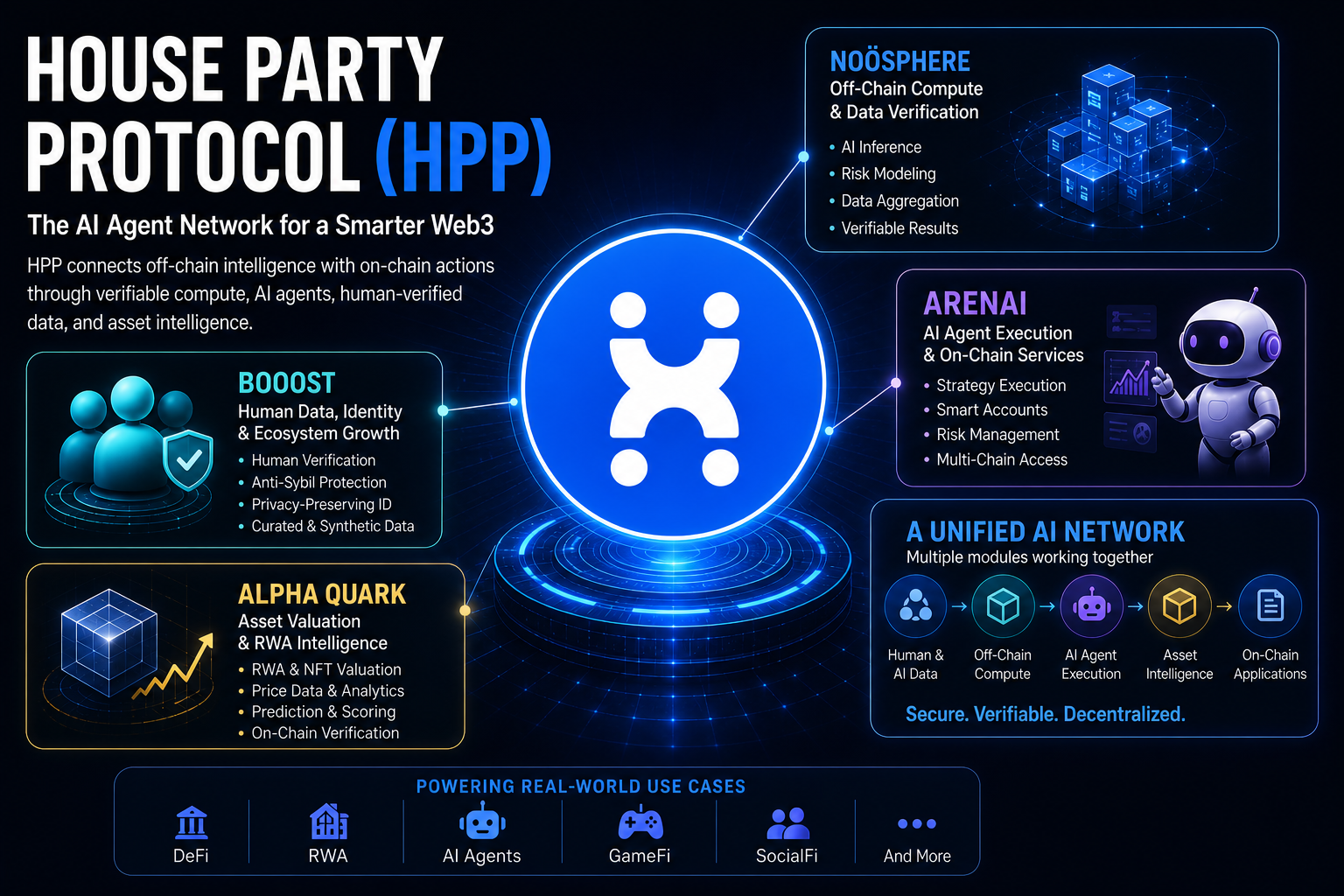
Use Case dan Tinjauan Arsitektur HPP
Use case HPP merupakan jaringan modular yang berfokus pada layanan AI, verifikasi data, dan eksekusi on-chain. Kekuatan utamanya terletak pada integrasi komputasi off-chain, agen cerdas, verifikasi identitas, dan analisis aset dalam infrastruktur yang native-AI.
Secara arsitektural, Noösphere bertanggung jawab atas komputasi cerdas off-chain dan jalur data yang dapat diverifikasi; ArenAI mengelola eksekusi strategi Agen AI; Booost menyediakan lapisan data manusia dan sintetis; dan Alpha Quark berfokus pada analisis cerdas aset RWA dan NFT. White paper resmi mendefinisikan HPP sebagai ekosistem data dan blockchain berorientasi AI yang menghubungkan sistem kelas enterprise dengan teknologi terdesentralisasi.
Proses dimulai dengan pengguna atau pengembang yang mengajukan kebutuhan tugas—seperti memanggil inferensi AI, verifikasi data, atau eksekusi strategi on-chain. Sistem kemudian memanggil modul yang sesuai berdasarkan jenis tugas. Masing-masing modul menjalankan proses komputasi, verifikasi, atau eksekusi. Hasilnya digunakan dalam aplikasi on-chain, marketplace data, atau analisis aset.
| Modul Resmi |
Fungsi Utama |
Use Case Utama |
| Noösphere |
Komputasi dan verifikasi off-chain |
Inferensi AI, penilaian risiko, agregasi data |
| ArenAI |
Eksekusi Agen AI |
Strategi otomatis, layanan keuangan on-chain |
| Booost |
Lapisan data dan identitas |
Verifikasi manusia, data sintetis, anti-sybil |
| Alpha Quark |
Kecerdasan aset |
Penilaian RWA, penilaian NFT, analisis risiko |
Tabel ini menegaskan bahwa HPP bukan produk tunggal, melainkan jaringan aplikasi yang didukung berbagai modul resmi.
Komputasi Off-chain dan Verifikasi Data oleh Noösphere
Noösphere adalah kerangka kerja cerdas off-chain dalam HPP, yang menghubungkan lingkungan blockchain deterministik dengan tugas komputasi dunia nyata yang dinamis. Hal ini memungkinkan smart contract meminta dan memverifikasi operasi off-chain seperti inferensi AI, pemodelan risiko, dan agregasi data multi-sumber.
Dalam praktiknya, pengguna atau smart contract menginisiasi permintaan komputasi off-chain—misalnya penilaian risiko atau inferensi model. Noösphere mengeksekusi tugas melalui agen terdesentralisasi. Sistem mengembalikan hasil lewat jalur yang dapat diverifikasi dan mengintegrasikan output ke lingkungan yang kompatibel EVM. Aplikasi on-chain kemudian memanfaatkan hasil kecerdasan off-chain yang telah diverifikasi.
Dengan mekanisme ini, smart contract statis memperoleh kemampuan interpretasi data dan komputasi yang lebih tinggi. Untuk DeFi, DeSci, analisis cerdas RWA, dan pasar inferensi, komputasi off-chain menekan biaya dan latensi dalam mengeksekusi tugas AI kompleks secara langsung on-chain.
Eksekusi Strategi Agen AI dan Layanan On-chain oleh ArenAI
ArenAI menjadi lapisan eksekusi cerdas dalam HPP, memungkinkan pengguna menerapkan strategi on-chain dan manajemen risiko melalui Agen AI. ArenAI mengemas kapabilitas eksekusi strategi AI sebagai layanan on-chain yang dapat diakses pengguna.
Secara teknis, pengguna memilih atau mengonfigurasi Agen AI, mengelolanya melalui smart account dan izin sesi. Agen akan mengeksekusi tugas berdasarkan data pasar, aturan strategi, dan parameter risiko. Sistem memastikan transparansi, verifikasi, dan kontrol pengguna secara on-chain. Pengguna dapat mengakses layanan strategi otomatis tanpa menulis kode. Dokumentasi resmi menyatakan bahwa ArenAI memungkinkan pengguna memanfaatkan strategi trading berbasis AI dan penyedia strategi dapat merilis strategi sebagai Agen AI.
Transformasi ini mengubah Agen AI dari alat analitik off-chain menjadi unit eksekusi yang terhubung dengan akun on-chain, DEX, CEX, dan lapisan likuiditas multi-chain.
Peran Booost dalam Insentif Pengguna dan Pertumbuhan Ekosistem
Booost berperan sebagai lapisan data manusia dan sintetis dalam ekosistem HPP, mendukung verifikasi identitas, sistem anti-sybil, alat identitas yang menjaga privasi, dan dataset terkurasi. Tujuan utamanya adalah menyediakan sumber data andal dan fondasi interaksi pengguna untuk jaringan AI.
Secara operasional, pengguna masuk ke skenario interaksi ekosistem melalui verifikasi identitas atau perilaku. Kapabilitas verifikasi Booost mengidentifikasi pengguna asli dan mengurangi risiko serangan sybil. Data manusia atau sintetis terkurasi digunakan untuk pelatihan AI dan optimasi aplikasi. Ekosistem memperoleh data partisipasi pengguna yang lebih andal untuk skenario sosial, gaming, metaverse, atau tata kelola.
Desain ini memastikan aplikasi AI HPP tidak hanya bergantung pada komputasi model, tapi juga pada data input yang tepercaya. Booost meningkatkan kredibilitas identitas, kualitas data, dan efisiensi pertumbuhan ekosistem bagi aplikasi yang memerlukan partisipasi pengguna otentik.
Penilaian Aset dan Use Case RWA oleh Alpha Quark
Alpha Quark berfokus pada analisis aset cerdas dalam HPP, meliputi RWA, NFT, alat penilaian on-chain, data harga, dan analitik prediktif. Modul ini menggunakan model AI untuk meningkatkan penetapan harga, verifikasi, dan finansialisasi aset on-chain.
Secara struktural, pengguna atau aplikasi mengirimkan data terkait aset—seperti NFT, real estat tokenisasi, koleksi, atau instrumen keuangan. Alpha Quark mengombinasikan model penilaian AI, verifikasi on-chain, dan data harga real-time untuk analisis. Sistem menghasilkan penilaian aset, skor risiko, atau analitik prediktif. Hasil ini digunakan dalam pinjaman, staking, asuransi, atau penetapan harga pasar. Sumber resmi menegaskan Alpha Quark mendukung penilaian RWA dan NFT berbasis AI, verifikasi on-chain, serta alat keuangan.
Hal ini menjawab tantangan utama aset RWA dan NFT—penilaian yang tidak transparan, risiko yang sulit diukur, dan data off-chain yang sulit diverifikasi—dengan menyediakan jalur terstruktur untuk analisis aset cerdas.
Struktur Jaringan Aplikasi AI Melalui Kolaborasi Multi-Modul
Kolaborasi multi-modul menjadi inti jaringan aplikasi HPP. Setiap modul memiliki spesialisasi—mulai komputasi, eksekusi, data, identitas, hingga analisis aset—dan membentuk rantai aplikasi lengkap melalui protokol terpadu.
Alur kerja tipikal: pengguna mengirim permintaan layanan AI melalui aplikasi; Noösphere menangani komputasi off-chain atau verifikasi data; ArenAI mengeksekusi strategi atau operasi on-chain; Booost menyediakan identitas pengguna dan kredibilitas data; Alpha Quark memberikan penilaian aset atau analisis risiko. Sistem kemudian mengembalikan hasil ke aplikasi on-chain, sistem enterprise, atau pasar terdesentralisasi.
Struktur ini memungkinkan HPP mencakup seluruh siklus mulai dari generasi data, verifikasi, komputasi, eksekusi, hingga komersialisasi. Model bisnisnya terbagi menjadi data-as-a-service, komputasi dan deployment AI, verification-as-a-service, serta kecerdasan aset berbasis AI.
Kendala Utama dalam Implementasi Aplikasi HPP
Implementasi HPP menghadapi tantangan berupa kompleksitas komputasi off-chain, biaya verifikasi data, risiko eksekusi Agen, dan tantangan koordinasi multi-modul. Seiring modul HPP semakin berkembang, tuntutan koordinasi sistem, efisiensi verifikasi, dan pemahaman pengguna juga meningkat.
Dalam alur aplikasi, pengguna harus menentukan jenis tugas dan cakupan izin. Sistem harus mencocokkan sumber daya dan memverifikasi hasil antar modul. Aplikasi harus mengatasi sumber data, keandalan model, izin eksekusi, dan pencatatan on-chain. Jaringan Agen AI hanya dapat berjalan andal jika hasil komputasi, kontrol pengguna, dan insentif ekonomi selaras.
Kendala ini tidak mengurangi nilai aplikasi; justru menegaskan bahwa keberhasilan HPP bergantung pada eksekusi teknis, kualitas data, mekanisme verifikasi, dan kolaborasi berkelanjutan antar peserta ekosistem.
Ringkasan
Use case House Party Protocol berpusat pada modul resmi—Noösphere, ArenAI, Booost, dan Alpha Quark. Noösphere mengelola komputasi dan verifikasi data off-chain; ArenAI menangani eksekusi strategi Agen AI; Booost menyediakan lapisan identitas dan data; Alpha Quark memungkinkan analisis cerdas aset RWA dan NFT.
Jalur implementasi mencakup pengguna menginisiasi permintaan, sistem memanggil modul, menjalankan komputasi atau verifikasi, menghasilkan output, dan melayani aplikasi on-chain. Nilai HPP terletak pada kolaborasi multi-modul, sementara tantangan utamanya adalah biaya komputasi, efisiensi verifikasi, kualitas data, dan risiko eksekusi.
FAQ
Apa saja use case House Party Protocol?
Use case House Party Protocol meliputi inferensi AI off-chain, verifikasi data, eksekusi strategi Agen AI, verifikasi identitas pengguna, data sintetis, penilaian RWA, penilaian NFT, dan analisis aset on-chain.
Apa peran Noösphere dalam HPP?
Noösphere bertanggung jawab atas komputasi dan verifikasi data off-chain, memungkinkan smart contract memanggil inferensi AI, penilaian risiko, dan agregasi data multi-sumber, serta mengintegrasikan hasil ke aplikasi on-chain melalui jalur yang dapat diverifikasi.
Bagaimana ArenAI mendukung aplikasi Agen AI?
ArenAI memungkinkan pengguna mengelola Agen AI melalui smart account dan izin sesi, sehingga dapat menjalankan strategi otomatis, manajemen risiko, dan operasi on-chain dengan transparansi dan kontrol penuh di tangan pengguna.
Bagaimana hubungan Booost dengan aplikasi HPP?
Booost menyediakan data manusia, data sintetis, verifikasi identitas, dan fitur anti-sybil untuk HPP, meningkatkan kualitas interaksi pengguna, keandalan data, dan efisiensi pertumbuhan ekosistem.
Untuk apa Alpha Quark digunakan secara utama?
Alpha Quark digunakan untuk penilaian cerdas, verifikasi on-chain, analisis harga, dan penilaian risiko aset RWA, NFT, serta aset tokenisasi lain, sehingga memfasilitasi integrasinya dengan DeFi, pinjaman, dan skenario asuransi.